A Massive List of Private K-8 Schools in Wilkes-Barre
Why Choose a Private, Non-Profit K-8 School in the Wilkes-Barre Area?
In Luzerne County, parents are increasingly seeking educational environments that go beyond the standard curriculum. The early years of a child’s education—from Kindergarten through 8th Grade—are highly formative. During this critical window of neuroplasticity, children develop the cognitive frameworks, study habits, and social-emotional skills that define their future academic journeys. Choosing an academically advanced private school during these years ensures that students are not merely memorizing facts, but are learning how to analyze, synthesize, and solve complex problems.
When we look at the cognitive benefits of an accelerated curriculum, the research is clear. Children who are challenged early on develop stronger critical thinking skills, greater academic resilience, and a lifelong love of learning. Rather than teaching to standardized state tests, an advanced private curriculum allows teachers to introduce higher-level concepts in science, mathematics, and literature when students are developmentally ready, regardless of rigid grade-level boundaries.
However, the academic program is only one piece of the puzzle; the structural model of the school matters just as much. This is where the distinction of a non-profit private school becomes vital.
Unlike for-profit institutions that must prioritize financial returns for owners or shareholders, non-profit private schools operate under a 501(c)(3) status. This means that every single dollar received through tuition, donations, or community grants is directly reinvested into the school. These funds are used to:
- Hire and retain highly qualified, state-certified teachers.
- Provide continuous professional development and training.
- Upgrade classroom technology, laboratory equipment, and learning materials.
- Maintain and enhance school facilities to create a safe, inspiring environment.
- Keep class sizes small to guarantee personalized attention.
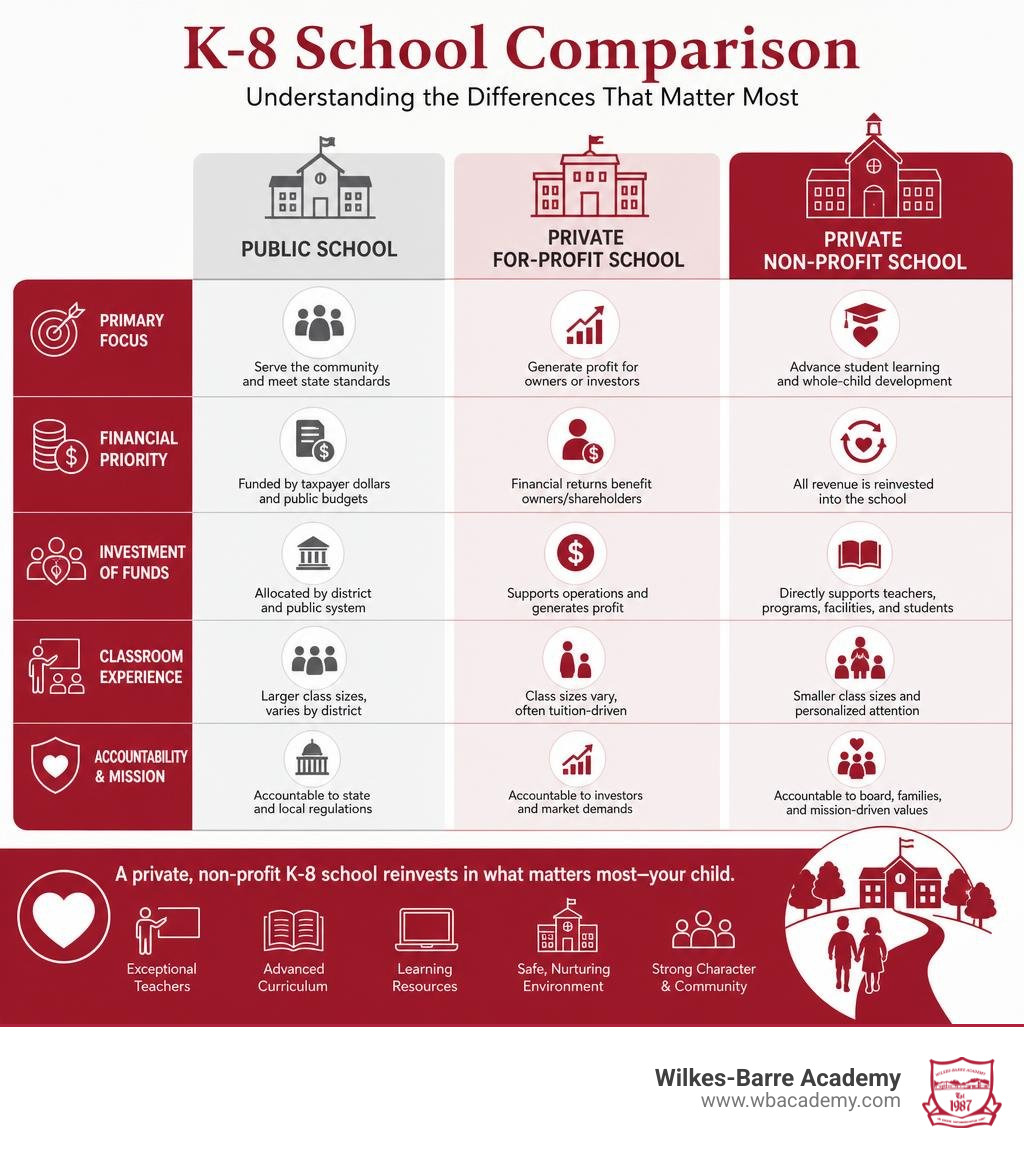
By choosing a non-profit K-8 school, you are partnering with an institution whose sole mission is the educational and personal growth of its students. This structural integrity ensures that your financial investment directly impacts your child’s daily classroom experience.
Which Private, Non-Profit Schools in the Wilkes-Barre Area Offer an Academically Advanced K-8 Curriculum?

Navigating the educational landscape of Luzerne County and the broader Northeastern Pennsylvania (NEPA) region can feel overwhelming. While there are several schooling options available, finding a school that is private, non-profit, secular, and specifically focused on an academically advanced K-8 curriculum narrows the field significantly.
At Wilkes-Barre Academy, we are proud to stand as the premier secular, non-profit option for advanced K-8 learning in the area. Operating from our single-location campus, we have spent years cultivating an environment where academic excellence and diverse community building go hand in hand.
Unlike parochial or faith-based schools, a secular private school focuses entirely on academic and personal development while welcoming families from all religious, cultural, and philosophical backgrounds. This secular foundation allows us to build a truly diverse, inclusive student body. In our classrooms, children learn alongside peers from various walks of life, which opens their eyes to different perspectives and prepares them to thrive in an increasingly globalized world.
To help you understand the broader landscape, parents exploring regional options often consult resources such as:
- The Complete List of Private Schools in Northeastern Pennsylvania to understand the general categories of schools available.
- The Best Private Schools in Luzerne for an analysis of regional educational standards.
- Our comprehensive Wilkes-Barre Private School Guide Finding the Perfect Fit to help align your family’s values with a school’s mission.
For families willing to look slightly outside Luzerne County for specialized models, regional institutions offer interesting comparisons. Some faith-based, non-profit middle school models operate in neighboring counties with an extended school day and mandatory study halls. However, for families in the immediate Wilkes-Barre area seeking a secular, comprehensive K-8 program, our local academy remains the ideal fit.
Essential Criteria for Evaluating Academically Advanced Programs
When compiling your own list of potential schools, we recommend evaluating each candidate against these strict criteria:
- Curriculum Depth and Flexibility: Does the school offer a curriculum that goes beyond state minimums? Can teachers accelerate learning for students who grasp concepts quickly?
- Class Size and Individualized Attention: What is the student-to-teacher ratio? Are classrooms crowded, or do they allow for personalized instruction?
- Teacher Certifications: Are the educators state-certified? Does the school require and fund continuing education to keep teaching methods current?
- School Culture and Diversity: Is the school community welcoming and inclusive? Does the environment foster mutual respect and collaboration?
- Reinvestment of Resources: As a non-profit, does the school clearly demonstrate that tuition dollars are reinvested into student resources, technology, and faculty development?
How Does Wilkes-Barre Academy’s Single-Classroom-Per-Grade Model Support Academic Excellence?
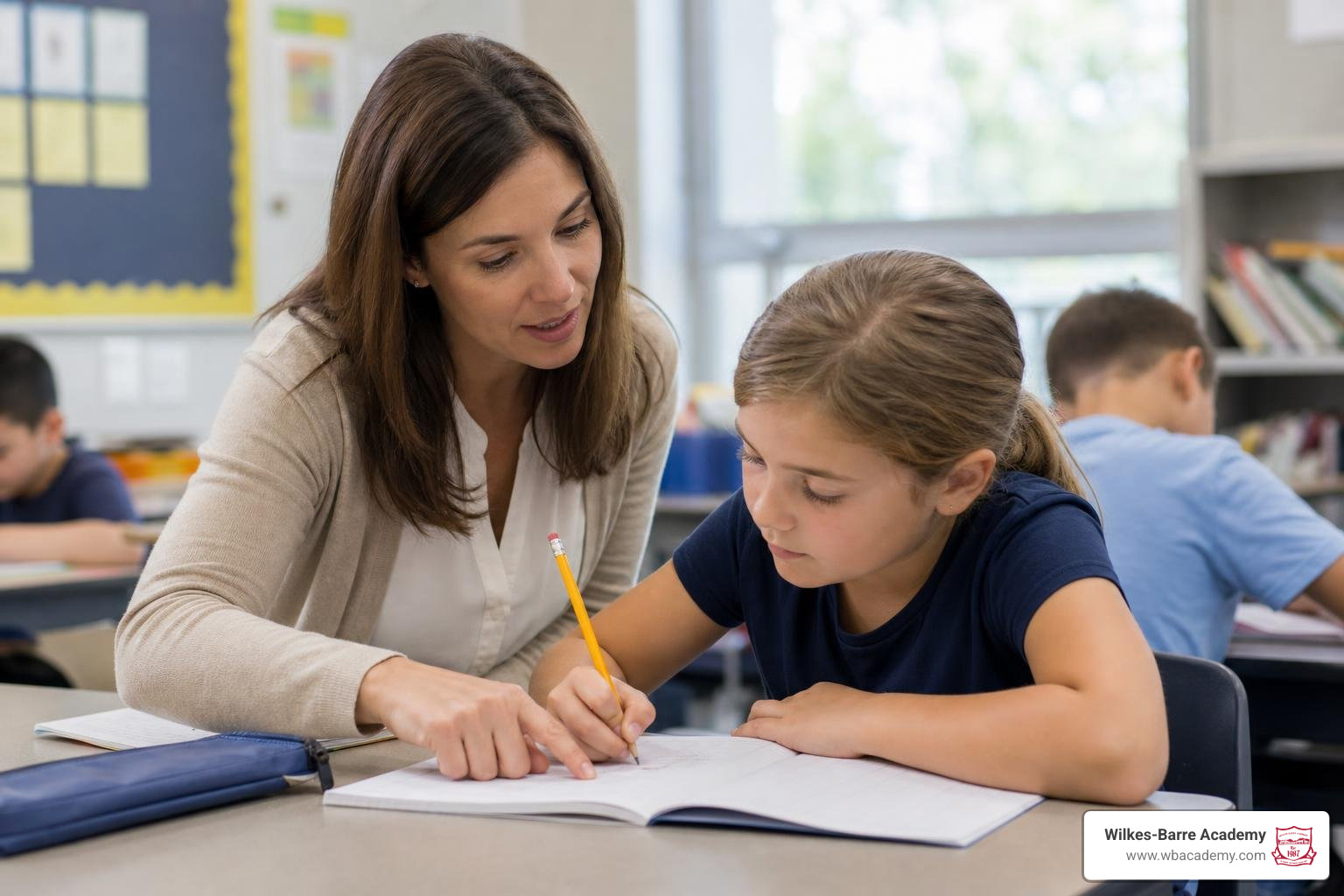
At our single-location campus, we believe that the structure of the classroom is just as important as the curriculum itself. This philosophy is why Wilkes-Barre Academy utilizes a unique single-classroom-per-grade model from Kindergarten through 8th Grade.
Having exactly one classroom per grade level fundamentally changes the educational dynamic. In a larger school with multiple tracks or classrooms per grade, students can easily become faces in a crowd, and teachers may struggle to coordinate strategies. In our close-knit model:
- No student falls through the cracks: Because there is only one cohort per grade, our teachers know every student’s academic strengths, weaknesses, learning style, and personality.
- Dynamic curriculum adaptation: Our state-certified teachers can collaborate directly and adapt their daily teaching strategies specifically to the needs, interests, and pace of that school year’s specific student group.
- Deep peer relationships: Students grow up together in a supportive, cohesive group, fostering deep friendships and a strong sense of belonging that minimizes social anxiety and maximizes academic focus.
To maintain this high standard of individualized learning, we place an immense emphasis on our faculty. All of our teachers are state-certified and are required to pursue continuing education. This ensures that our classrooms are always led by professionals who are well-versed in the latest, research-backed pedagogical methods.
Furthermore, this model fosters open, direct communication channels between families and school staff. Parents do not have to navigate complex administrative layers to get updates on their child’s progress. Instead, they enjoy a direct partnership with educators who are deeply invested in their child’s success.
For more insights into how personalized education transforms student outcomes, we invite you to explore:
- The Best Wilkes-Barre Area Schools for Individualized Learning
- Our guide on the 7 Best Schools for Personalized Attention and Student Development
- Our perspective on The Best Diverse and Close-Knit Schools in Pennsylvania
How Do Different Private K-8 Educational Models in Northeastern Pennsylvania Compare?
When researching private education in NEPA, you will encounter several distinct models. Understanding how these models structure their school days, curricula, and student support systems is essential to making the right choice for your family.
Some schools utilize an extended-day model. For example, certain regional programs feature an extended day ending in the late afternoon, incorporating a mandatory study hall and a mandatory summer program. While this highly structured, intensive model works well for middle school readiness in certain environments, other families prefer a balanced, highly advanced academic day that allows students to participate in external extracurriculars, family activities, and traditional after-school life.
At our academy, we focus on maximizing the efficiency of the standard school day through an accelerated curriculum. Rather than simply adding more hours to the day, we focus on the quality of instruction. We distinguish our program from standard grade-level instruction by integrating advanced concepts directly into the daily schedule, ensuring that students are intellectually stimulated without experiencing academic burnout.
To help you visualize these differences, we have outlined the primary distinctions between the regional private school models below:
| Feature / Model | Secular Advanced Academies (e.g., Wilkes-Barre Academy) | Standard Private Schools | Faith-Based / Parochial Schools |
|---|---|---|---|
| Primary Focus | Accelerated academics, individualized learning, critical thinking | Standard grade-level curriculum with smaller class sizes | Religious education, moral development, standard curriculum |
| Classroom Structure | Single-classroom-per-grade for close-knit community and tailored pacing | Multiple classrooms per grade, standardized pacing | Multiple classrooms per grade, traditional pacing |
| Community Dynamics | Highly diverse, secular, inclusive of all backgrounds | Varies; often draws from a broad regional base | Centered around a specific faith community |
| Faculty Requirements | State-certified teachers with mandatory continuing education | Certified or non-certified teachers depending on school policy | Certified or non-certified teachers depending on diocesan policy |
To dive deeper into why these structural differences matter, you can read our detailed analysis on Why a Private K-8 School in Pennsylvania Makes the Grade and check out our comparison of The 7 Best Accelerated Learning Private Schools Compared to see how different academic frameworks stack up.
How Do Tuition, Financial Support, and Enrollment Processes Work for Local Private Schools?
Investing in a private K-8 education is a significant decision for any family. Understanding how tuition is structured, what financial resources are available, and how to navigate the admissions timeline can make the process much smoother.
Because non-profit private schools do not receive public school tax funding, they rely on tuition and charitable donations to operate. However, because of their 501(c)(3) status, these schools work diligently to keep tuition as affordable as possible and to offer robust financial support options.
Navigating Financial Support and Scholarships
In Pennsylvania, families have access to unique financial support systems designed to make private education accessible:
- Educational Improvement Tax Credit (EITC): This incredible state program allows Pennsylvania businesses and individuals to redirect their state tax liabilities directly to approved non-profit scholarship organizations. These organizations then distribute the funds as tuition assistance to eligible families. Parents and donors can learn more from the official Pennsylvania Department of Community and Economic Development’s EITC program page.
- School-Based Financial Aid: Most non-profit schools, including our academy, offer internal financial aid packages based on documented financial need.
- Flexible Payment Plans: To help families budget effectively, schools often provide monthly or quarterly payment schedules rather than requiring a single lump-sum payment at the start of the school year.
For a thorough breakdown of how non-profit school finance works, read our resource on Investing in Education Pennsylvania Non-Profit Private Schools Explained and explore All About Private School Options.
The Admissions Timeline: Step-by-Step
Securing a spot in an academically advanced K-8 program requires planning. Because schools with a single-classroom-per-grade model have limited seats, we recommend starting the process early in the school year prior to enrollment.
- Initial Inquiry: Submit an online inquiry form to share your child’s age, grade level, and academic background.
- Private Tour: Schedule a personal tour to see the classrooms in action, meet the faculty, and experience the school’s culture firsthand. For tips on what to look for, see our guide on Touring the Best Private Schools in Wilkes-Barre.
- Student Assessment: Academically advanced schools often conduct a gentle academic screening or assessment to ensure your child is placed in the environment best suited to their developmental needs.
- Application and Financial Aid Submission: Complete the formal application and submit any necessary financial aid documentation.
- Enrollment Confirmation: Once accepted, secure your child’s desk by submitting the enrollment agreement and deposit.
Supporting Working Families: Before- and After-Care
For working parents, a school’s academic program must be matched by practical, reliable childcare solutions. High-quality private schools address this need by offering structured before- and after-school care programs. These programs are not merely “babysitting” services; they provide a safe, familiar environment right on the school’s campus where students can complete homework, participate in recreational activities, and socialize with their peers under the supervision of familiar school staff.
What Are the Most Common Questions Parents Ask About Wilkes-Barre Private Schools?
Making the transition to a private K-8 school is a journey filled with questions. Here are the top inquiries we receive from families exploring their options in Luzerne County.
Is Wilkes-Barre Academy a religious school?
No, Wilkes-Barre Academy is a completely secular, non-religious private school. We believe that a secular environment is highly beneficial for a child’s social and intellectual development. By remaining independent of any religious affiliation, we are able to welcome a wonderfully diverse student body representing a wide array of cultures, backgrounds, and belief systems.
In our school, children learn to respect and celebrate their differences, fostering a global perspective and preparing them to interact compassionately and effectively with people from all walks of life.
What before- and after-school care options are available for working parents?
We understand the demands placed on working families, which is why we provide comprehensive, structured before-care and after-care programs.
These programs operate directly on our single-location campus, eliminating the need for mid-day transportation to off-site childcare facilities. Students can arrive early in the morning and stay after the standard school day ends, spending their time in a safe, supervised, and productive environment. They have the opportunity to get a head start on their homework, play educational games, and enjoy outdoor recreation with their classmates.
How does the admissions process work for academically advanced K-8 schools?
The process is designed to be welcoming, thorough, and focused on finding the perfect fit for your child. It begins when you submit an online inquiry or call our office. From there, we invite you to schedule a private tour of our single-location campus. This visit allows you to see our single-classroom-per-grade model in action and ask our administrators any questions you may have.
Following the tour, we arrange a student assessment. This screening helps us understand your child’s current academic standing and ensures they will thrive within our accelerated curriculum. Once the assessment is complete and the formal application is reviewed, we work with you to finalize enrollment and discuss any tuition support options, such as EITC scholarships or customized payment plans.
How Can You Take the Next Step in Your Child’s K-8 Education?
Choosing the right school for your child’s Kindergarten through 8th Grade years is one of the most impactful decisions you will ever make. An academically advanced, non-profit education does more than prepare students for high school; it instills a deep-seated confidence, a sharp analytical mind, and a genuine love for intellectual discovery.
At Wilkes-Barre Academy, our single-classroom-per-grade model ensures that your child will receive the personalized attention, rigorous curriculum, and close-knit community support they need to reach their full potential.
We encourage you to take the next step in your child’s educational journey. Contact us today to schedule a private tour of our single-location campus, meet our dedicated, state-certified faculty, and discover why our academy is the perfect place for your child to grow, learn, and succeed.
Explore our Academics page to learn more about our curriculum and start the enrollment process today.