EITC Program in Pennsylvania: Eligibility Basics Demystified
What is the EITC Program in Pennsylvania?
When parents and business leaders ask what is the eitc program in pennsylvania, they are asking about one of the most successful educational tax credit models in the country. Enacted under Act 2001-4 and governed by statutory provisions (24 Pa. Stat. §§ 20-2001-B through 20-2013-B), the Educational Improvement Tax Credit program is administered statewide by the Pennsylvania Department of Community and Economic Development (DCED) in collaboration with the Department of Revenue. The PA DCED Educational Improvement Tax Credit Guidelines outline how state tax revenues are strategically redirected to directly expand educational access.
Under the current legislative framework, the overall program is subject to a statutory statewide cap—recently standing at $590 million total across educational tax initiatives. Within this comprehensive funding pool, the state establishes strategic allocations:
- At least $60 million must be directed toward economically disadvantaged students.
- Up to $30.5 million is allocated to fund early childhood education through pre-kindergarten scholarships.
- The remaining funds support standard K-12 tuition scholarships and approved public school educational innovations.
Understanding how this funding functions requires distinguishing between a tax credit and a tax deduction. A standard tax deduction merely lowers a taxpayer’s total taxable income before their final liability is calculated. In contrast, an EITC tax credit delivers a direct, dollar-for-dollar reduction against state tax liability. When an authorized business or individual makes an approved contribution, they receive a substantial state credit that replaces money they would have otherwise sent directly to Harrisburg.
What is the EITC Program in Pennsylvania for Eligible Families?
For families exploring K-8 educational options across Luzerne County, the EITC serves as a primary avenue for need-based tuition assistance. These scholarship funds are designed to bridge the gap between household finances and private school costs.
Eligible scholarship funds can be used toward essential educational costs, including:
- Tuition expenses for qualified private or non-profit elementary and middle schools.
- Mandatory school enrollment and academic fees.
- District-approved student transportation costs directly tied to attending the school.
At our single-location campus in Wilkes-Barre, we partner closely with approved scholarship organizations so our families can access these vital resources. Families should never let initial tuition figures deter them from pursuing academic excellence; exploring financial aid for PA private schools helps ensure an advanced curriculum remains accessible for hardworking families.
Approved Educational Organizations (SO, EIO, PKSO)
The EITC framework distributes business contributions through three distinct categories of state-approved 501(c)(3) nonprofit entities:
- Scholarship Organizations (SOs): Nonprofits that receive business contributions and distribute need-based tuition scholarships directly to eligible K-12 students.
- Educational Improvement Organizations (EIOs): Nonprofits that fund innovative public school academic programs, hands-on science and arts laboratories, and specialized enrichment initiatives.
- Pre-Kindergarten Scholarship Organizations (PKSOs): Organizations that disburse early childhood tuition assistance to help young children enroll in certified pre-K learning environments.
By funneling resources through approved nonprofits, Pennsylvania encourages educational diversity. Learn more about the community impact of investing in education at non-profit private schools to see how community contributions strengthen academic foundations.
Student and Family Income Eligibility Guidelines
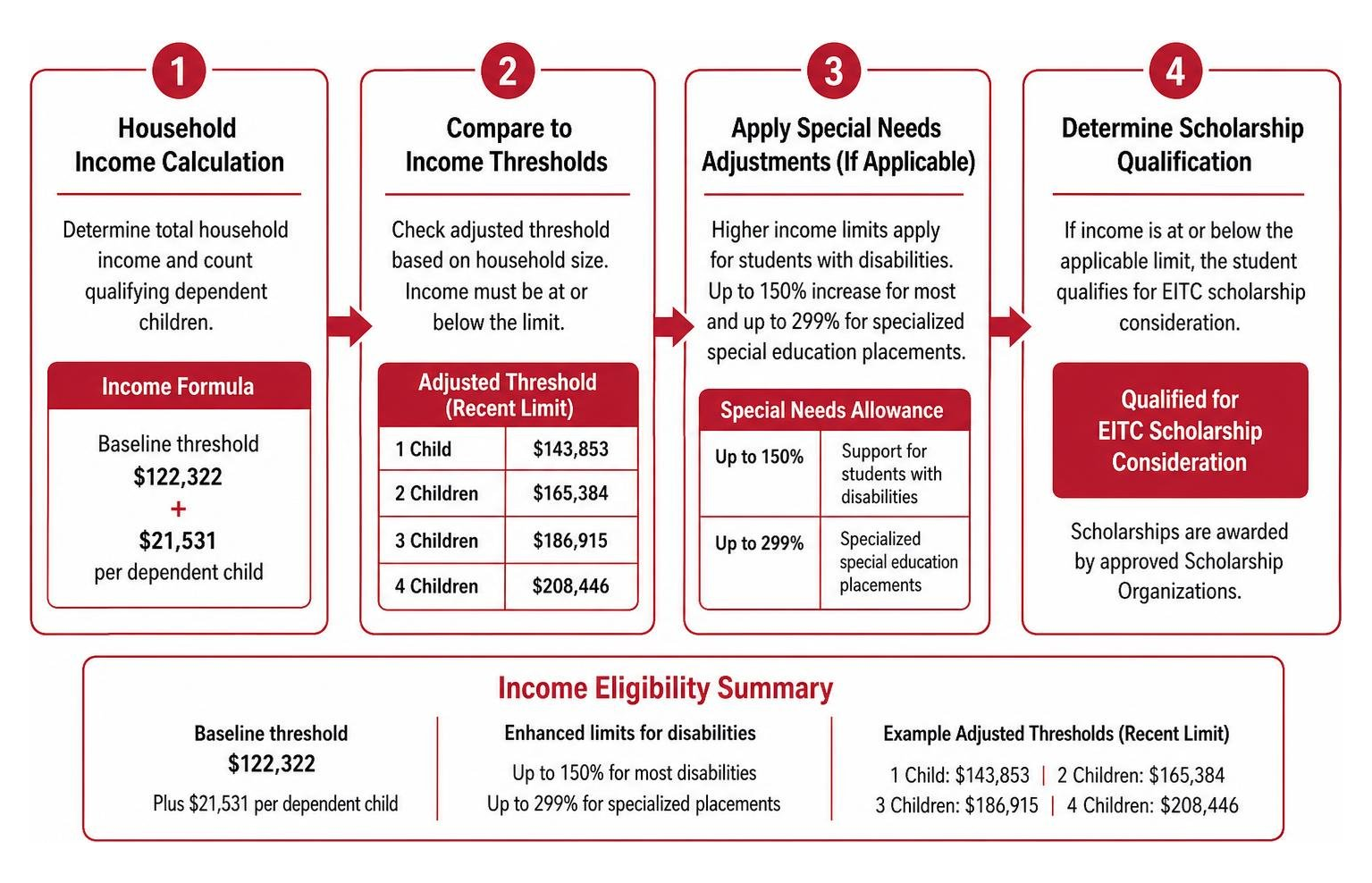
Income qualification for EITC scholarships is established on a sliding scale based on total household size. The Commonwealth adjusts these thresholds annually to account for inflation, ensuring middle-income and working-class families maintain access.
The baseline household income threshold is set at $112,348, with an additional $19,775 allowance for each qualifying dependent child. In recent state updates, these limits have scaled up to $122,322 plus $21,531 per dependent member, significantly broadening the number of qualifying families. Furthermore, Pennsylvania provides enhanced income thresholds for students with disabilities:
- Support for Students with Disabilities: The income allowance increases by 150% of the baseline limit.
- Specialized Placements: The allowance expands up to 299% if the student is enrolled in a specialized special education institution.
| Household Size | Baseline Income Cap | Adjusted Threshold (Recent Limit) | Special Needs Allowance (Up to 150%) |
|---|---|---|---|
| Family with 1 Child | $132,123 | $143,853 | $198,185 |
| Family with 2 Children | $151,898 | $165,384 | $227,847 |
| Family with 3 Children | $171,673 | $186,915 | $257,510 |
| Family with 4 Children | $191,448 | $208,446 | $287,172 |
Across the state, approximately 71% of Pennsylvania K-12 students qualify under state income rules, yet statutory caps mean roughly 10% receive funded awards. Statewide data shows that over 66,838 students receive EITC awards annually, with an average scholarship account value of $2,613.
Families wondering if can you actually afford private school in Pennsylvania will find that when combined with school-based aid, EITC scholarships bring personalized learning well within reach.
Application Process and Reporting for Scholarship Recipients
Applying for an EITC scholarship does not involve dealing directly with state tax agencies. Instead, parents apply directly through the school or an affiliated Scholarship Granting Organization. The general application cycle follows a simple rhythm:
- Spring Application Windows: Families submit standard financial verification documents (e.g., federal Form 1040) to the designated scholarship organization or school tuition committee.
- School Verification: School administrators verify enrollment status and calculate household eligibility.
- Award Allocation: Scholarship organizations distribute awards directly toward the student’s tuition account before the start of the academic year.
Under recent state reporting mandates administered through the Pennsylvania Department of Revenue Educational Tax Credits guidelines, Scholarship Organizations must maintain detailed compliance tracking. Beginning with the 2025–26 academic year, reporting guidelines require SOs to document student disability status, grade brackets (K-8 vs. 9-12), home school district of residence, and individual award sizes. This ensures transparent state oversight and fair fund distribution across all Pennsylvania communities.
How Businesses and Individual Donors Participate Through Tax Credits

Pennsylvania’s EITC model allows both corporate enterprises and individual taxpayers to transform their state tax liabilities into community educational grants.
For business firms, the state provides two core contribution tiers:
- One-Year Commitment: 75% state tax credit against eligible state taxes.
- Two-Year Consecutive Commitment: 90% state tax credit when the business agrees to provide the identical contribution amount for two consecutive taxable years.
- Economically Disadvantaged Bonus: Tax credits can rise to 85% for a single year or 99% for a two-year commitment when contributions are explicitly directed to organizations serving economically disadvantaged student populations.
- Pre-K Organizations: Donations to PKSOs receive a 100% credit on the first $10,000 contributed and 90% on the remainder up to a $200,000 annual maximum.
A single business firm can claim up to a maximum of $750,000 in EITC credits per taxable year. Because the non-credited balance (e.g., the remaining 10%) can often be claimed as a charitable deduction on federal income tax returns, the net out-of-pocket cost of funding local scholarships is remarkably low.
Reviewing how much is private school in PA illustrates how local corporate support helps offset tuition expenses for growing families.
What is the EITC Program in Pennsylvania for Business Donors?
To participate, a business must pay one or more of the following eligible Pennsylvania taxes:
- Corporate Net Income Tax
- Bank Shares Tax
- Title Insurance & Trust Company Shares Tax
- Insurance Premiums Tax
- Mutual Thrift Tax
- Malt Beverage Tax
- Retaliatory Fees under Section 212 of the Insurance Company Law of 1921
- Personal Income Tax (for S-Corporations, LLCs, and general partnerships)
Business contributions must follow strict state procedural timelines managed by the PA DCED:
- Application Submission: Businesses submit an electronic application through the DCED Single Application system. Renewing businesses with existing two-year commitments submit between May 15 and June 30. New business applicants and additional request filers apply starting July 1. Applications are approved on a first-come, first-served basis for each processing day.
- 60-Day Contribution Window: Upon receipt of an official DCED approval letter, the business has exactly 60 calendar days to make its financial contribution to its selected approved organization.
- 90-Day Proof Deadline: Within 90 calendar days of the approval letter, the business must submit written proof of the contribution (gift acknowledgment) to the DCED to finalize the credit award.
Pass-through entities (S-Corps, LLCs, and Partnerships) can elect to apply credits directly to the entity’s liability or pass them through to individual owners. Under the PA Department of Revenue EITC Application Rules, pass-through entities must file an irrevocable written election (such as Form REV-1123 or via myPATH) on or before the tax return due date (including extensions) to pass credits to partners, shareholders, or members in proportion to their distributive share. If this election is not submitted on time, the unused credits will expire.
Individual Participation Through Special Purpose Entities (SPEs)
Individual wage earners and high-income professionals who do not own a corporation can also redirect their personal state income taxes via Special Purpose Entities (SPEs).
An SPE is a state-approved pass-through partnership established exclusively to pool individual contributions and distribute EITC tax credits.
- Eligibility: Any individual or couple paying Pennsylvania Personal Income Tax (which taxes earned income and capital gains at a flat 3.07% rate) who is affiliated with or employed by a Pennsylvania business entity.
- State Tax Credit Rate: SPE participants receive a 90% PA state tax credit passed through on their state tax return.
- Joint Filing Advantage: If one spouse works for or is affiliated with a Pennsylvania business, their joint Pennsylvania income tax liability can be offset by the credit.
- Tax Form Reporting: The SPE provides the donor with a Pennsylvania Schedule K-1 in February. The individual applies the passed-through credit directly to Line 23 OC (Other Credit) of Pennsylvania Form PA-40, while claiming the remaining 10% non-credited donation on federal Schedule A if itemizing.
EITC vs. OSTC and the Working Pennsylvanians Tax Credit
Because several Pennsylvania tax credit and scholarship initiatives use similar acronyms, it helps to distinguish how these separate state policies function.
Opportunity Scholarship Tax Credit (OSTC)
While the EITC is available to students statewide based solely on household income, the Opportunity Scholarship Tax Credit (OSTC) adds a geographic requirement. To qualify for an OSTC award, a student must not only meet the household income limits but must also physically reside within the attendance boundary of a public school designated by the Pennsylvania Department of Education as falling in the lowest-achieving 15% of elementary or secondary schools statewide. Understanding Pennsylvania school choice and opportunity scholarships helps families determine which scholarship track aligns with their address and background.
Working Pennsylvanians Tax Credit (WPTC)
Signed into law during the 2025–26 state budget cycle and rolling out for the 2026 tax filing season, the Working Pennsylvanians Tax Credit is a distinct tax initiative designed for low-to-moderate-income workers.
- Federal EITC Match: The WPTC acts as a direct state-level piggyback match, providing eligible workers with a refundable state credit equal to 10% of their federal Earned Income Tax Credit, providing up to $805 in direct annual relief.
- Fully Refundable: Unlike the business-funded educational tax credit, the WPTC is claimed directly by individuals on Form PA-40 and is paid out as a refund even if the worker owes zero Pennsylvania income tax.
| Program Feature | Educational Improvement Tax Credit (EITC) | Opportunity Scholarship Tax Credit (OSTC) | Working Pennsylvanians Tax Credit (WPTC) |
|---|---|---|---|
| Primary Purpose | K-12 private school tuition aid & public school innovation | Tuition aid for students in underperforming school zones | State tax relief for low-to-moderate wage earners |
| Funding Source | Corporate & SPE state tax credit donations | Corporate & SPE state tax credit donations | State general revenue budget allocation |
| Student Location Rule | Any Pennsylvania school district | Must reside in bottom 15% achieving public school zone | N/A (Based on individual earned income) |
| Refundable Status | Nonrefundable credit to donor | Nonrefundable credit to donor | Fully refundable direct payment to filer |
Frequently Asked Questions About Pennsylvania Educational Tax Credits
What is the difference between a tax credit and a tax deduction under PA EITC?
A tax deduction lowers the total dollar amount of income subject to taxation. For instance, a $1,000 deduction for a filer in a 25% tax bracket reduces their overall tax bill by $250. An EITC tax credit is a dollar-for-dollar offset against your final Pennsylvania state tax liability. A $1,000 EITC credit reduces the amount you owe the state by a full $900 (under a 90% two-year commitment), while the remaining $100 can frequently be deducted on federal tax filings.
Can individual taxpayers participate in the PA EITC program?
Yes. Individual taxpayers who pay Pennsylvania state personal income tax can join a state-approved Special Purpose Entity (SPE). The SPE combines donations from multiple individuals, submits an umbrella EITC application to the DCED, and distributes the resulting 90% state tax credits to members via Form PA Schedule K-1. Taxpayers apply these credits directly to their PA-40 individual tax return.
How does the EITC differ from the Opportunity Scholarship Tax Credit (OSTC)?
While both programs use identical business tax credit mechanics (75% for one year, 90% for two years) and identical household income thresholds, the OSTC requires that student recipients live within the attendance boundary of a public school ranked among the bottom 15% on state standardized assessments. EITC scholarships carry no geographic restriction beyond residing in the Commonwealth of Pennsylvania.
Conclusion
The Pennsylvania Educational Improvement Tax Credit program offers a balanced framework where business contributions directly create educational opportunities. For families across Luzerne County seeking a focused academic environment, the EITC helps make private education a realistic option.
At Wilkes-Barre Academy, our single-location campus provides a dedicated, academically advanced K-8 curriculum designed around a single classroom per grade. This structure supports individualized instruction, strong family-school collaboration, and a close-knit learning community. We work closely with parents to navigate the scholarship application process and ensure every qualified student has the opportunity to thrive in our classrooms.
If you are a family exploring private education options or a local business owner interested in directing your state tax liability toward student learning, explore our EITC Grant resources to take the next step.