

Don’t Panic! How to Master the Admissions and Enrollment Process
Why Admissions and Enrollment Feels So Overwhelming (And How to Simplify It)
The admissions and enrollment process can feel like a maze — deadlines, forms, residency rules, health requirements, and more, all at once.
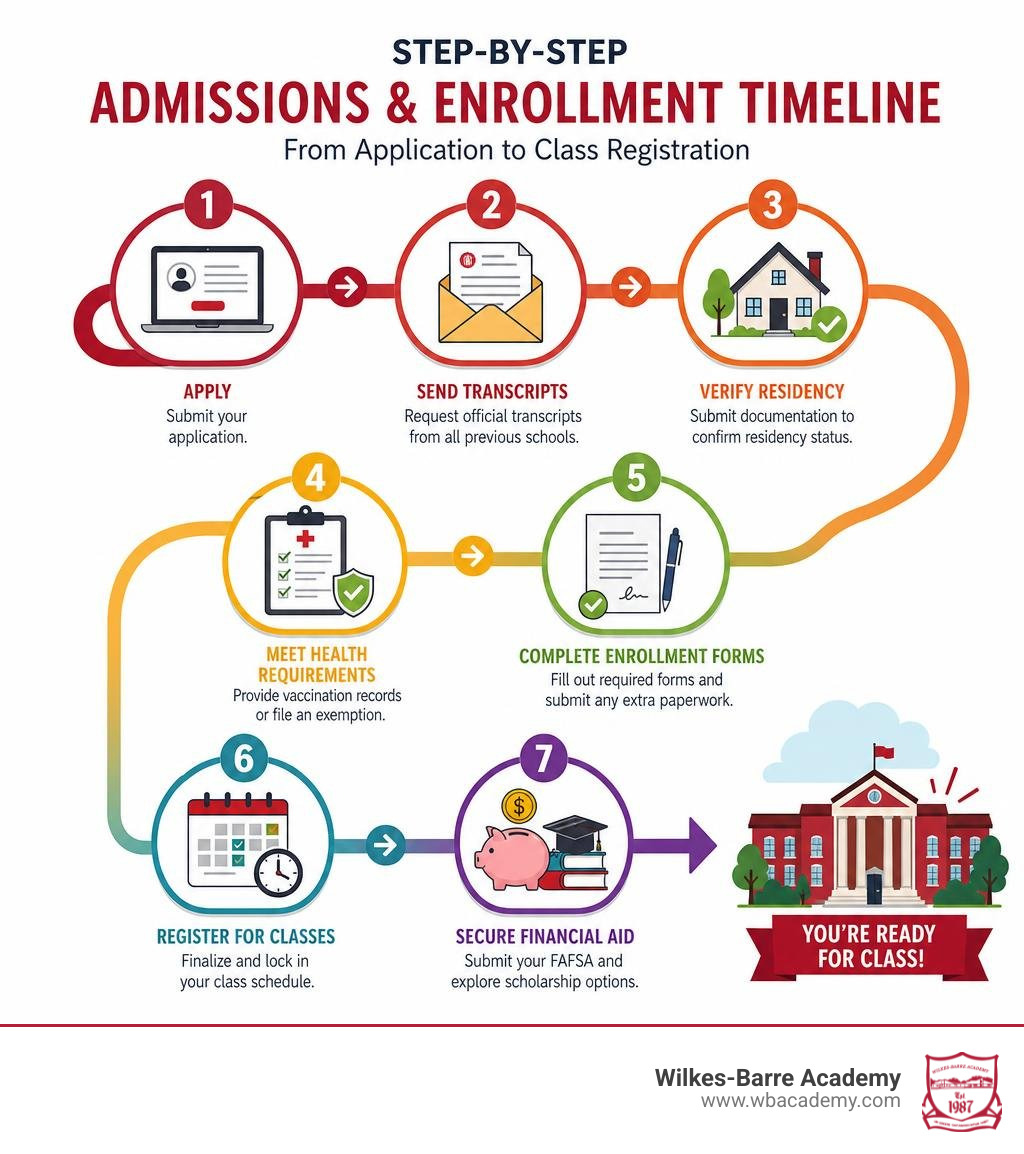
Here’s a quick overview of what the process typically involves:
- Apply — Submit your application through the institution’s portal or a common platform like CommonApp
- Send transcripts — Request official transcripts from all previous schools
- Verify residency — Submit documentation to confirm in-state or out-of-state status
- Meet health requirements — Provide vaccination records or file an exemption
- Complete enrollment forms — Fill out FERPA releases, waitlist requests, and any other required paperwork
- Register for classes — Finalize your schedule once admitted
- Secure financial aid — Submit your FAFSA and review scholarship options
Most colleges and universities have a dedicated Admissions and Enrollment office to guide you through every one of these steps. Organizations like NACAC — which represents more than 28,000 admissions professionals worldwide — exist specifically to support students through this journey.
But even with that support, it’s easy to feel lost, especially if it’s your first time navigating the system.
This guide breaks it all down in plain language — step by step, no jargon — so you know exactly what to do, when to do it, and who to call when you’re stuck.
Explore more about admissions and enrollment:
- how to apply to private school pennsylvania
- private school admissions wilkes-barre
- switching from public to private school pennsylvania
Understanding the Role of the Admissions and Enrollment Office
When we think of higher education, we often think of professors, lecture halls, and late-night study sessions. But before any of that can happen, you must pass through the gateway: the Admissions and Enrollment office.
This office is the nerve center of any academic institution. Its primary mission is to manage strategic Enrollment Management | Enrollment Management | TTU and to serve as a comprehensive support hub. Whether you are looking at a massive public university or a local college, the staff here are responsible for coordinating recruitment, managing student records, administering orientation programs, and evaluating academic credentials.
For example, at a large institution like Texas Tech University, which boasts a total of 40,944 students enrolled from all 50 states and 108 different countries, enrollment management is a massive logistical undertaking. To keep things running smoothly, offices like the Enrollment Services Center at Penn State coordinate multiple moving parts. They ensure that student aid, registrar services, and undergraduate admissions work in perfect harmony.
When you interact with these offices, they provide several core services:
- Academic Records Management: Ensuring the accuracy, integrity, and privacy of your transcripts, grades, and enrollment status.
- Orientation Services: Welcoming programs that assist with your transition to campus life.
- Financial Aid Coordination: Connecting you with dedicated advisors to navigate scholarships, grants, and work-study programs.
- Registration Assistance: Helping you clear academic holds and finalize your class schedule.
How to Contact and Access Admissions and Enrollment Services
Getting in touch with an admissions office shouldn’t feel like trying to contact a secret society. Modern institutions offer multiple communication channels to meet students where they are. Whether you prefer a face-to-face chat, a quick phone call, or a virtual meeting from the comfort of your couch, options are readily available.

Most enrollment offices provide:
- Phone Support: Dedicated hotlines where you can speak directly with an admissions specialist or financial aid advisor.
- Email Communication: A reliable way to submit inquiries and receive written confirmation of policy details.
- Virtual Lobbies: Zoom-based virtual offices operating during standard business hours (typically Monday through Friday, 9 a.m. to 4 p.m.) where you can drop in without an appointment.
- In-Person Visits: Walk-in services at physical campus locations for hands-on assistance.
Navigating Virtual Admissions and Enrollment Portals
If you cannot make it to campus, virtual portals are your best friend. Through platforms like the Penn State Admissions | College Admissions portal, prospective students can easily submit applications, upload supporting documents, and check their admission status in real time.
These virtual spaces connect you to a world of opportunity. For instance, Penn State leverages its digital presence to support a global network of more than 800,000 alumni and over 50,000 career preparedness programs.
When navigating a virtual portal, look for live chat features to get immediate answers to simple questions. Many schools also offer virtual campus tours and online information sessions, allowing you to explore campus life and academic programs from anywhere in the world.
In-Person Support for Admissions and Enrollment
While virtual tools are incredibly convenient, sometimes you just need to sit down with a human being. In-person enrollment services are designed to handle complex issues that require hands-on troubleshooting.
At institutions like Undergraduate Admissions – Office of Admission and Enrollment | The University of Texas at Dallas , located in the nation’s fourth-largest metropolitan area, visiting the campus visitor center allows you to meet face-to-face with an admission counselor.
In-person visits are ideal for:
- Document Intake: Submitting physical documents, such as official transcripts or residency affidavits, directly to staff.
- Resolving Registration Holds: Sitting down with an advisor to figure out why you cannot register for classes and taking immediate steps to clear the hold.
- Setting Up Payment Plans: Discussing tuition payments and setting up installment plans with the bursar’s office.
Key Forms, Documentation, and Submission Timelines
To ensure a smooth transition into your chosen program, you must stay organized. Missing a deadline or submitting an incomplete form can delay your registration and impact your financial aid.

When applying, always follow the golden rule of admissions: submit your application before ordering your transcripts. As noted by the Apply – Office of Admissions – Naval Postgraduate School , submitting your application first ensures that when your official transcripts arrive, they can be immediately linked to your file, preventing major processing delays.
Local institutions, such as those highlighted in the Admissions Overview | College Admission – King’s College guide, emphasize that keeping a checklist of required documents and monitoring your applicant portal weekly is the best way to stay on track.
Essential Paperwork for College Registration
Once you are admitted, the paperwork does not stop. You will need to complete several institutional forms to finalize your enrollment:
- Academic Fresh Start: A program allowing returning students to exclude older, poor academic coursework from their current GPA calculation.
- Profile Information / Change of Name/Address: Forms used to update your legal name, permanent address, or social security number.
- Course Waitlist Requests: Forms submitted when a desired class is full, placing you in a queue to grab a spot if another student drops.
- FERPA Release Forms: Authorization forms that allow the school to share your academic or financial records with designated family members.
- Student Parent Priority Registration: In certain states, legislative mandates (such as Senate Bill 459 in Texas) require institutions to offer priority registration to student parents with children under 18, allowing them to build schedules around childcare.
Health Compliance and Vaccination Requirements
Most colleges and universities require students under a certain age (typically 22) who are taking on-campus or hybrid courses to show proof of immunization against bacterial meningitis.
To comply with these health regulations, you must submit an official vaccination record showing you received the vaccine or a booster within the last five years. If you require an exemption for medical reasons or due to reasons of conscience (including religious beliefs), you must submit an official state-approved exemption form. Be sure to submit these records well in advance of registration, as health non-compliance is one of the most common reasons for registration holds.
Residency Requirements, Tuition Rates, and Special Populations
Your residency status has a massive impact on what you will pay for your education. Public universities and community colleges charge significantly lower tuition rates to in-state residents because those institutions are partially funded by state taxpayers.
To qualify for in-state tuition, you must submit a residency form along with supporting documentation (such as lease agreements, utility bills, or tax returns) proving you have lived in the state for a consecutive 12-month period.
Fortunately, there are options for diverse student populations:
- Undocumented Students: Many states allow undocumented students to qualify for in-state tuition rates if they graduated from an in-state high school and submit a notarized residency affidavit.
- International Students: International student offices provide dedicated visa support, travel safety guidance, and English-language pathways.
- Veterans: Specialized school certifying officials help military veterans and their dependents utilize GI Bill® benefits.
- Students with Disabilities: Accessibility offices coordinate accommodations, such as extended testing time or assistive technology.
- Adult Learners & Transfer Students: Transfer agreements and flexible evening or online classes help adult learners balance school with work and family.
To help you understand the structural differences in how these processes are managed, here is a quick comparison:
| Feature | Community Colleges | Four-Year Universities | |
|---|---|---|---|
| Admission Requirements | Generally open-door; requires high school diploma or GED. | Competitive; requires GPA, test scores (often optional), and essays. | |
| Tuition Structure | Extremely affordable; heavy focus on local residency. | Higher cost; distinct in-state vs. out-of-state tiers. | |
| Support Services | Broad, localized support for commuters and adult learners. | Extensive, centralized offices for global and diverse populations. | |
| Local Examples | Local community college systems | [Admission and Financial Aid | Wilkes University ](https://www.wilkes.edu/admissions/index.aspx) |
Frequently Asked Questions about Admissions and Enrollment
How do residency requirements affect my tuition rates?
Residency requirements directly determine whether you pay in-state or out-of-state tuition. Out-of-state tuition can be two to three times more expensive than in-state rates. To secure the lower rate, you must submit a residency form and supporting documents proving physical presence and intent to establish a permanent home in the state for at least 12 consecutive months. Undocumented students can often sign an affidavit form to qualify for in-state rates if they meet state-specific high school graduation criteria.
What is the best way to submit transcripts without causing delays?
The fastest and most secure method is electronic delivery. Have your previous school send your official transcript directly to your new institution’s enrollment office via an approved electronic sending service (such as Parchment or National Student Clearinghouse). Always submit your online application before ordering transcripts to ensure the system can automatically link your academic records to your active file.
How do FERPA release forms protect my student privacy?
The Family Educational Rights and Privacy Act (FERPA) is a federal law that protects the privacy of student education records. Once you turn 18 or enroll in a postsecondary institution, your academic and financial records belong solely to you. Your school cannot share your grades, schedule, or financial aid details with anyone—including your parents—unless you sign a FERPA release form authorizing them to do so.
Conclusion: Finding the Right Path for Your Educational Journey
Navigating the admissions and enrollment maze for higher education takes patience, organization, and a clear understanding of the steps involved. By staying on top of deadlines, leveraging virtual resources, and reaching out to campus advisors when you need help, you can set yourself up for a stress-free transition into college life.
But what if you are looking for this same level of care, structured academic planning, and individualized support much earlier in your child’s educational journey?
At Wilkes-Barre Academy, we believe that the foundation for academic success begins long before college. Located right here in Luzerne County, our private, non-profit K-8 school offers an academically advanced curriculum designed to challenge and inspire young minds.
We stand out by maintaining a single classroom per grade, ensuring that every student receives the individualized learning and personal attention they deserve. We pride ourselves on building strong family-school connections within a close-knit, diverse community that feels like family.
If you are ready to bypass the public school crowd and give your child a head start, we invite you to explore our community:
- Learn more about our straightforward Admissions process.
- Read about our step-by-step Enrollment steps.
- Review our competitive Tuition rates.
- Find out how we make private education accessible through Financial Aid for PA Private Schools.
- Discover how easy the transition can be by reading our guide on From Public to Private and Navigating the PA School Swap.
Whether you are preparing for the first day of kindergarten or mapping out your path to a university degree, the right support makes all the difference. Contact us today to see how we can partner with your family for a lifetime of academic success!