The 7 Best Accelerated Learning Private Schools Compared
What Is Accelerated Learning and How Does It Differ From Remediation?
To understand why leading private schools are shifting toward accelerated learning, we must first clear up a common misconception: acceleration is not remediation.
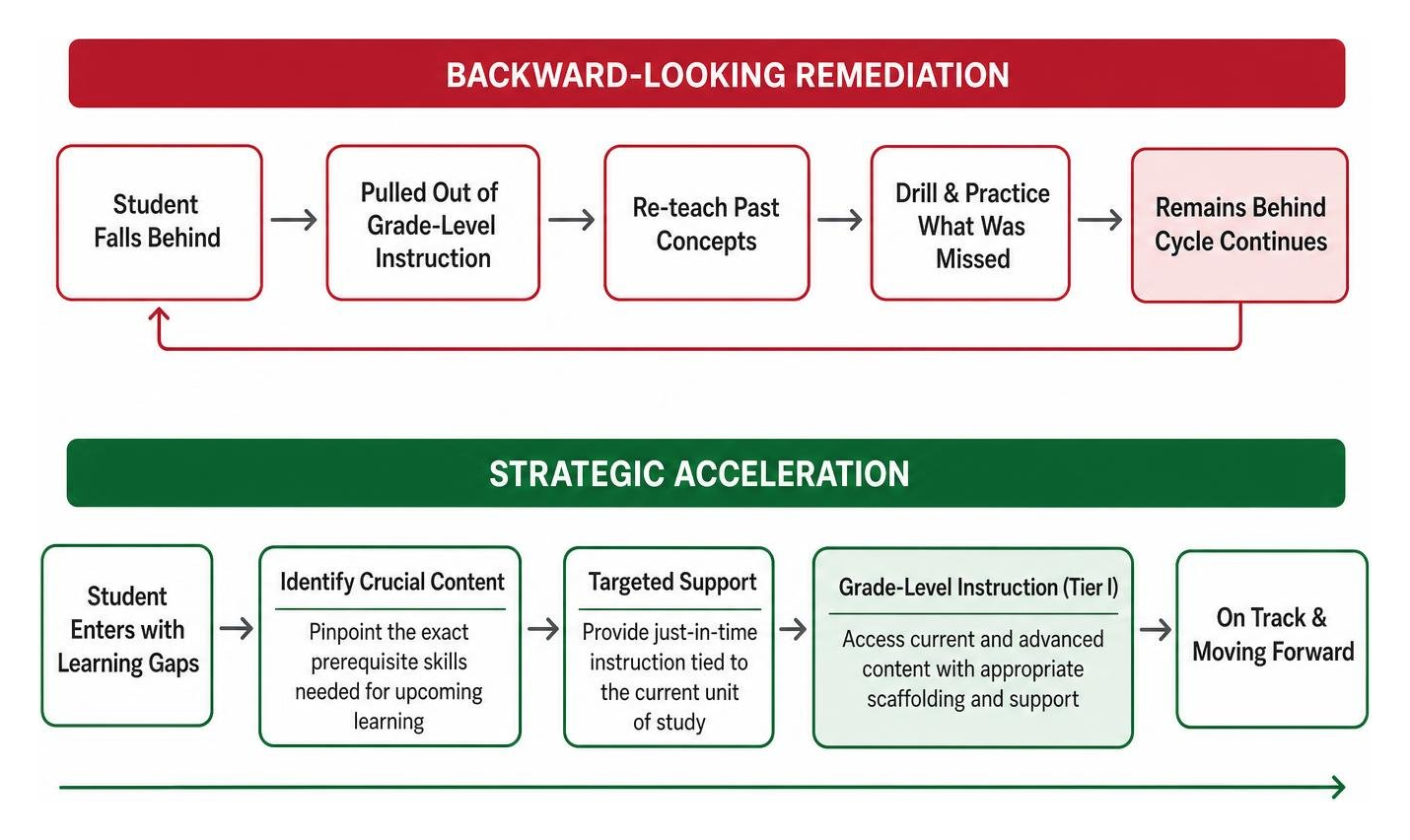
When a student falls behind or enters a school year with academic gaps, traditional education systems typically turn to remediation. Remediation looks backward. It isolates the student, pulls them out of grade-level instruction, and forces them to drill past concepts they missed. Unfortunately, research shows this approach often traps children in a permanent cycle of low expectations, leaving them perpetually behind their peers.
Accelerated learning takes the opposite approach. It is a forward-looking strategy designed to keep students moving along their intended grade-level trajectories. Instead of re-teaching everything from previous years, teachers strategically prepare students for success in current and advanced grade-level content by introducing crucial prerequisite concepts right when they are needed.
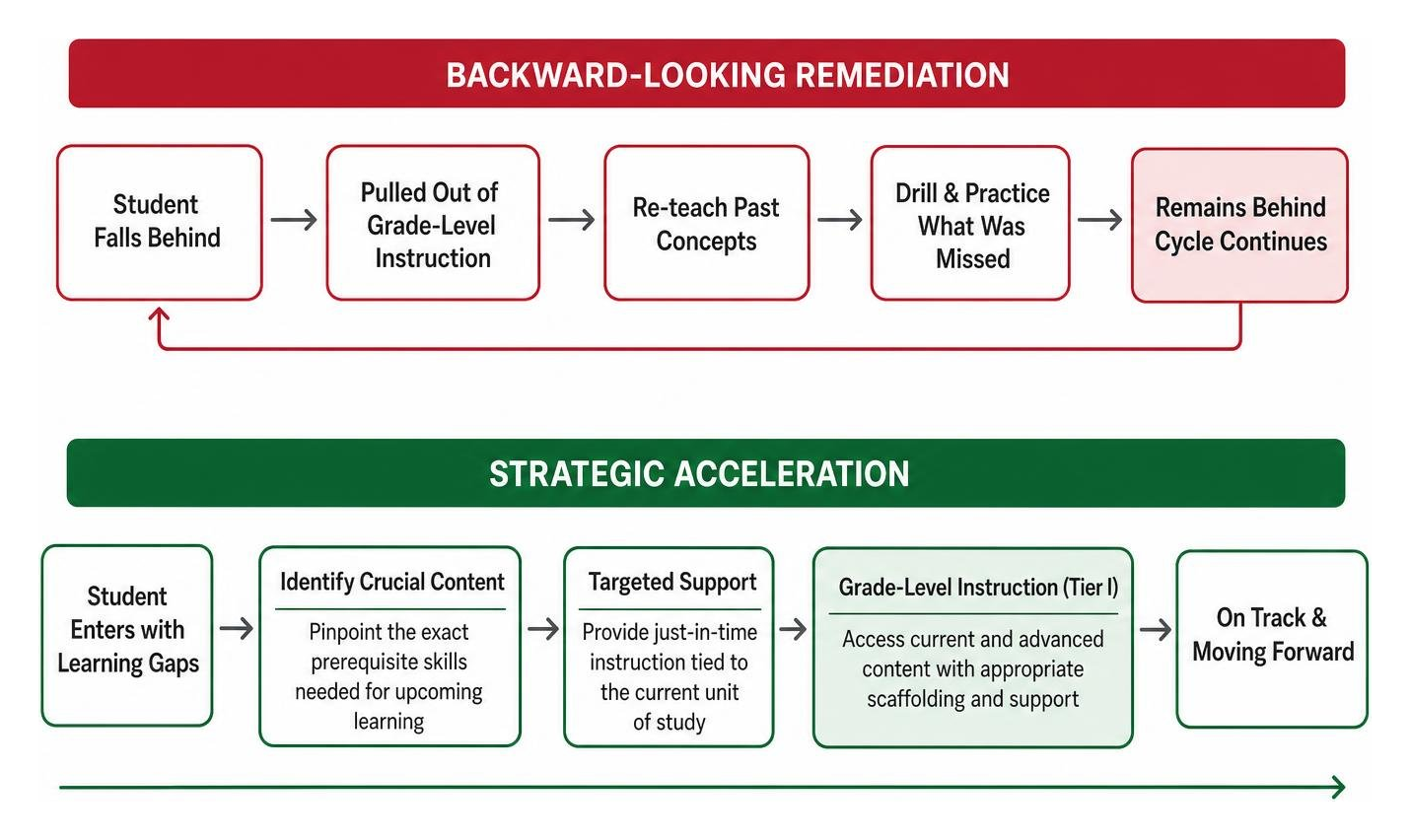
At the heart of this approach is a commitment to high-quality Tier I grade-level instruction. Rather than lowering the bar, accelerated learning schools keep the academic standard high while providing the scaffolding students need to reach it.
According to educational research on learning recovery, the most effective acceleration strategies involve:
- Identifying Crucial Content: Pinpointing the exact skills and knowledge required to access upcoming advanced material, rather than trying to cover every past concept.
- Targeted Support: Delivering just-in-time tutoring and instruction directly tied to the current unit of study.
- Focusing on Essential Skills: Prioritizing deep mastery of core concepts over a superficial rush through a textbook.
By focusing on forward momentum, students build immediate confidence and see the direct relevance of what they are learning. For families looking to understand how these standards are certified and measured, exploring the certified success for Pennsylvania private school students provides valuable context on how rigorous benchmarks are maintained.
Which Private Schools Are Recognized as Leaders in Accelerated Learning?
Across the country, several private schools have emerged as national pioneers in accelerated curriculum design. These institutions have replaced century-old teaching models with research-driven frameworks, such as Singapore Mathematics, Next Generation Science Standards (NGSS), and Socratic humanities.
One of the most significant structural shifts in these schools is the use of specialized domain teaching starting as early as Kindergarten. Instead of asking a single elementary teacher to be an expert in seven different subjects, these schools employ dedicated specialists for math, literacy, science, and the arts. This ensures that even the youngest students receive instruction from educators with deep subject-matter expertise.
To see how these philosophies translate into different school environments, we can look at the distinct models driving academic acceleration today. For parents evaluating local options, our comprehensive guide on academics outlines how these advanced curriculum standards are structured in a K-8 setting.
| Model Type | Core Methodology | Student-Teacher Ratio | Key Pacing Mechanism |
|---|---|---|---|
| 1-to-1 Personalized Mastery | Completely customized, one-on-one instruction | 1:1 | Student’s individual learning DNA and daily feedback |
| AI-Powered and Gamified Sprint | AI-adaptive morning sprints paired with afternoon workshops | Variable (with 1:1 check-ins) | “XP Gating” (mastery of daily targets) |
| Integrated Leadership & Finance | Specialized domain teaching, Singapore Math, and advanced core curriculum | 8:1 to 9:1 | 80-minute core blocks with advanced pathways |
| Self-Directed, Project-Based Quest | Mixed-age studios, Socratic discussions, and multi-week Quests | Mixed-Age Studios | Daily goal-setting and peer-reviewed mastery |
| Wilkes-Barre Academy (Individualized K-8) | Advanced core academics, single classroom per grade, and close-knit community | Low student-to-teacher | Tailored individual pacing within a structured class |
The 1-to-1 Personalized Mastery Model
This model, championed by leading personalized learning programs, is built on the belief that dedicated one-on-one time with an educator is the most effective way to maximize student performance. By designing the entire school day around a single student and teacher, the curriculum is customized to the child’s unique learning style and pace. Instructors provide immediate, daily feedback, allowing students to move rapidly through concepts they grasp quickly and take extra time on challenging topics without falling behind a class schedule.
The AI-Powered and Gamified Sprint Model
Utilized by cutting-edge virtual and hybrid programs, this approach leverages advanced AI-adaptive platforms to compress K-12 standards. Students complete high-cognitive-load academic sprints in the morning, where they must achieve 100% competency to unlock “XP” (experience points). This “XP Gating” system ensures that students cannot rush ahead with unaddressed learning gaps. Once morning academic targets are met, students earn the freedom to participate in hands-on afternoon workshops, such as systems engineering or competitive speech.
The Integrated Leadership, Finance, and Entrepreneurship Model
Some advanced schools combine rigorous core academics with real-world life skills. Their curriculum features extended 80-minute instructional blocks for core subjects alongside a fully integrated Leadership, Finance, and Entrepreneurship program. Students receive hundreds of hours of financial literacy instruction and build actual, revenue-generating businesses. This model relies heavily on subject-specific specialists from Kindergarten onward to ensure high-level academic depth.
The Self-Directed, Project-Based Quest Model
Popularized by modern student-centered networks, this approach replaces traditional classrooms with mixed-age “studios.” Students take full ownership of their learning, navigating multi-week “Quests” that integrate math, science, and history into real-world challenges (like launching a food truck or designing a model city). There are no traditional grades or lectures; instead, students demonstrate mastery through public exhibitions, Socratic debates, and peer reviews, fostering deep critical thinking and collaboration.
How Do Leading Private Schools Measure and Demonstrate Student Outcomes?
To prove the effectiveness of accelerated learning, top private schools rely on objective, external benchmarks rather than subjective grading. One of the primary tools used is the MAP (Measures of Academic Progress) assessment, which measures student growth velocity over time. Because MAP testing adapts to each student’s performance, it allows advanced learners to show growth far beyond their chronological grade level, effectively shattering traditional academic ceilings.
The data generated by these accelerated models is compelling:
- Math Nation & STEMscopes: Schools utilizing these research-backed STEM programs consistently show elevated proficiency. Studies demonstrate that STEMscopes Math users achieve 4% to 5.8% higher overall passing rates on state assessments, while Math Nation users see math proficiency rates jump by up to 17%.
- Leading Accelerated Model Outcomes: Students in these advanced, specialized domain programs perform 2 to 3 times above state and national benchmarks in standardized assessments. By the end of the school year, 99% of these students are on track for grade-level or above reading, and 98% are on track for grade-level or above math.
- Real-World Milestones: Beyond test scores, outcomes are demonstrated through portfolios, public speaking milestones (such as defending a thesis or presenting to large audiences), and entrepreneurship projects.
These metrics prove that when students are freed from rigid, time-bound pacing, their capacity for growth increases dramatically. To learn more about how a private school education serves as a springboard for future academic milestones, read our analysis on why going private is the ultimate grade upgrade.
What Role Does Technology and AI Play in Enabling Accelerated Learning?
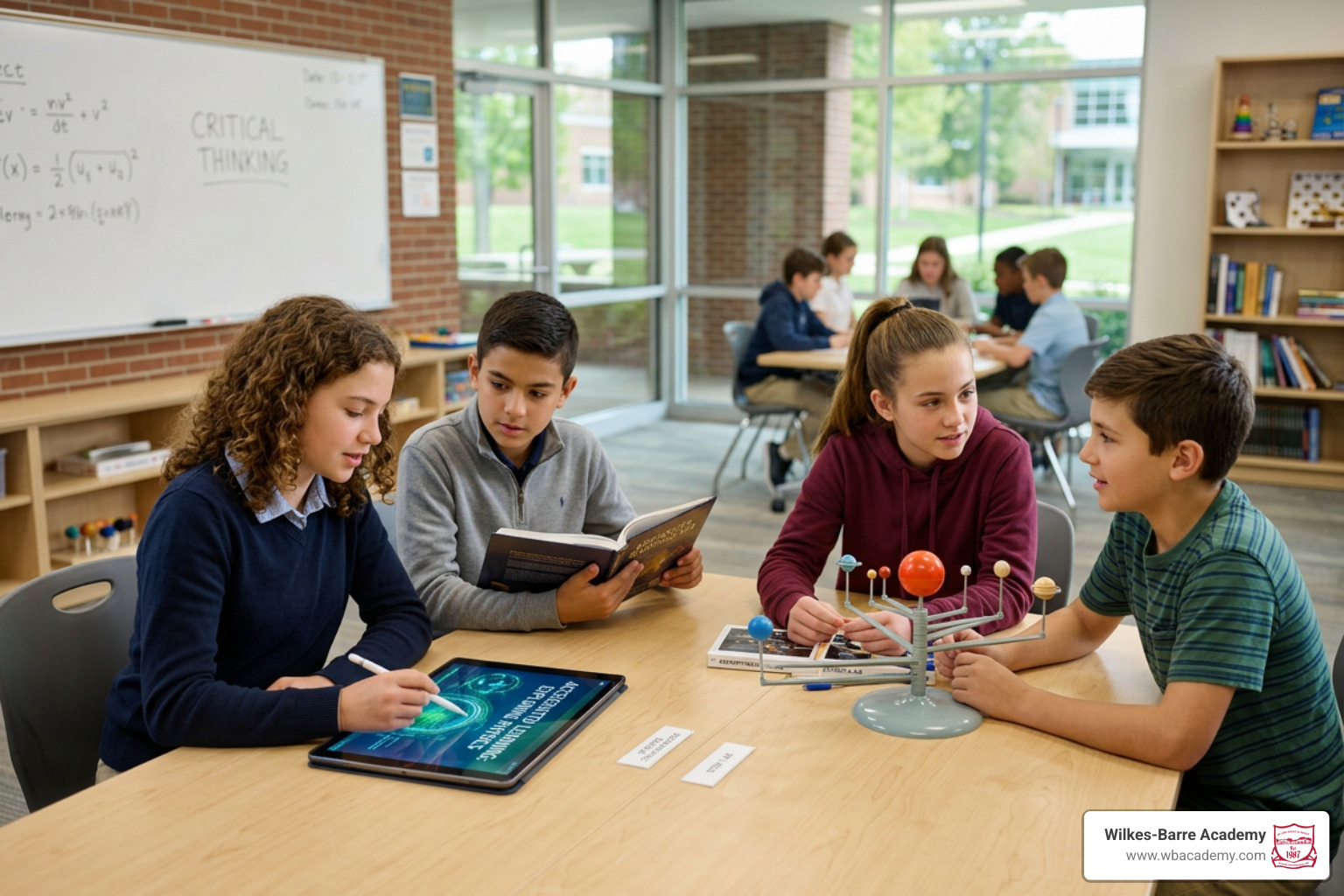
In the leading private schools of 2026, technology is not just a digital substitute for paper worksheets; it is the engine that makes hyper-personalized pacing possible. AI-adaptive learning platforms act as personal tutors, constantly diagnosing a student’s strengths and weaknesses in real-time.
When a student struggles with a math concept, the AI does not simply mark the answer wrong and move on. It dynamically adjusts the difficulty, generates targeted practice problems, and provides immediate instructional feedback. This concept is often referred to as cognitive offloading. By allowing intelligent software to handle routine skill practice and diagnostic tracking, teachers are freed from grading paperwork and can spend their time on high-level mentoring, Socratic discussions, and hands-on projects.
However, top schools are careful to balance screen time with active, real-world learning. Many implement structured intervals, such as the Pomodoro technique (25 minutes of focused, high-intensity digital learning followed by a physical break), to keep students engaged and prevent digital fatigue.
At the elementary and middle school levels, technology is integrated thoughtfully to enhance, rather than replace, human connection. For an inside look at how we balance digital tools with hands-on instruction, visit our dedicated page on technology in the classroom.
How Do Top Schools Balance Rigorous Academics With Whole-Child Development?
A common worry among parents is that an accelerated curriculum will place too much pressure on young children. The leading private schools address this by intentionally balancing rigorous academic pacing with robust social-emotional learning (SEL) and executive function support.
In these environments, learning how to learn is treated with the same importance as mathematics or reading. Schools build self-regulation and accountability through structured systems, such as:
- Daily Progress Reports & Goal-Setting: Students learn to plan their day, track their own academic progress, and reflect on their learning habits.
- Executive Function Coaching: Explicit instruction in time management, organization, and focus strategies helps students manage their workloads without stress.
- Therapy Dog & Counseling Programs: Schools integrate certified therapy dogs, small-group counseling, and mindfulness blocks to support mental health and emotional resilience.
Furthermore, these schools recognize that arts, physical movement, and creative thinking are not “extras” to be cut when academics get tough; they are the very foundation of how the human brain learns. Regular recess, physical education, music, and visual arts are woven directly into the daily schedule to stimulate creative problem-solving and keep children energized.
To learn more about how personalized attention supports both academic growth and emotional wellbeing, read about the best schools for personalized attention and student development.
How Does Wilkes-Barre Academy Deliver Individualized Academic Acceleration?
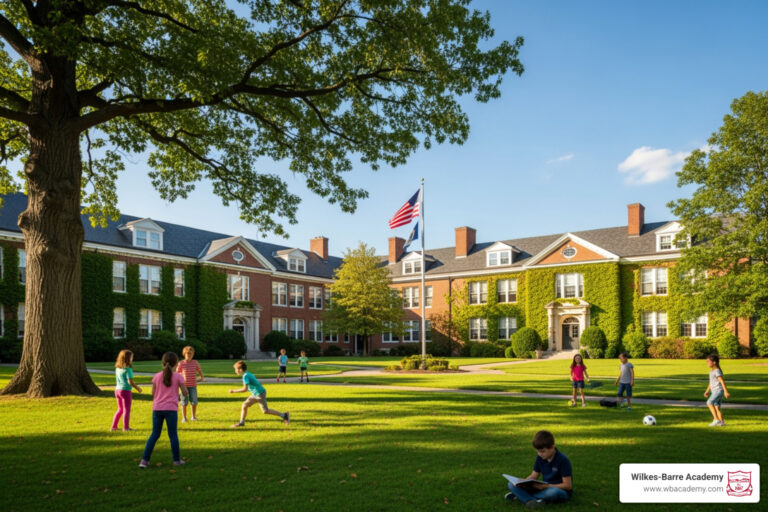
For families in Luzerne County, Wilkes-Barre Academy offers a premier, single-location K-8 private school experience designed around these very principles of individualized acceleration and whole-child development.
Unlike larger institutional schools, we maintain a single classroom per grade. This deliberate structure allows our experienced teachers to truly know every student’s academic profile, learning style, and personal interests. We don’t believe in a one-size-fits-all education; instead, our small class sizes enable us to tailor the pacing of our advanced curriculum to challenge gifted learners while providing immediate, individualized support to those who need it.
We also believe that a child’s academic success is deeply connected to their environment. Our school is a close-knit, diverse community where strong family-school connections are celebrated. Parents are active partners in their child’s educational journey, creating a supportive network that helps students thrive both inside and outside the classroom.
By combining a warm, nurturing environment with high academic standards, we prepare our students to transition seamlessly into the area’s most competitive high school programs. To see how our graduates excel, explore our resource on the fast track to high school success via private education, or learn more about our philosophy of small classes and big hearts at Wilkes-Barre Academy.
Frequently Asked Questions About Accelerated Learning Private Schools
Will an accelerated curriculum cause academic burnout or high stress in children?
Not when it is implemented correctly. Leading accelerated schools prevent burnout by structuring the day to balance high-cognitive-load academic blocks with hands-on projects, physical movement, and creative arts. Because these models focus on mastery rather than endless homework and test prep, students often experience less academic anxiety than they would in a traditional, high-pressure grading system.
How do accelerated private schools accommodate students with diverse learning needs?
Because accelerated learning is built on personalized pacing and low student-teacher ratios, it is uniquely suited for diverse learners. Gifted students are free to advance years ahead without grade-level ceilings, preventing boredom and disengagement. Meanwhile, neurodiverse students or those with learning differences can take the time they need to achieve true mastery of core concepts, supported by adaptive technology and targeted teacher intervention.
How do I find the best accelerated private school options in my local area?
When researching local private schools, look for key indicators of quality such as a low student-to-teacher ratio, a curriculum that is regularly refreshed based on modern research, and a strong emphasis on whole-child development. For families in Northeastern Pennsylvania, reviewing the 2026 Best Private Schools in Wilkes-Barre and the surrounding Luzerne County area is an excellent starting point to find highly-rated programs.
Conclusion
The educational landscape of July 2026 has made one thing clear: traditional, one-size-fits-all schooling is no longer enough to prepare children for a rapidly changing world. Leading accelerated learning private schools are redefining education by placing student mastery, personalized pacing, and whole-child development at the center of the classroom.
By choosing an academically advanced, supportive environment, you give your child the freedom to learn at the speed of their own curiosity—building the critical thinking, resilience, and confidence they need to succeed in high school, college, and beyond.
If you are looking for an exceptional, individualized K-8 education for your child in Luzerne County, we invite you to explore our advanced academic programs. Visit our Academics Page to learn more about how we can partner with your family to unlock your child’s full potential.