Why Advanced Academics and Inclusivity Anchor the Wilkes-Barre Academy Mission

Advanced Academics and Inclusion at Wilkes-Barre Academy
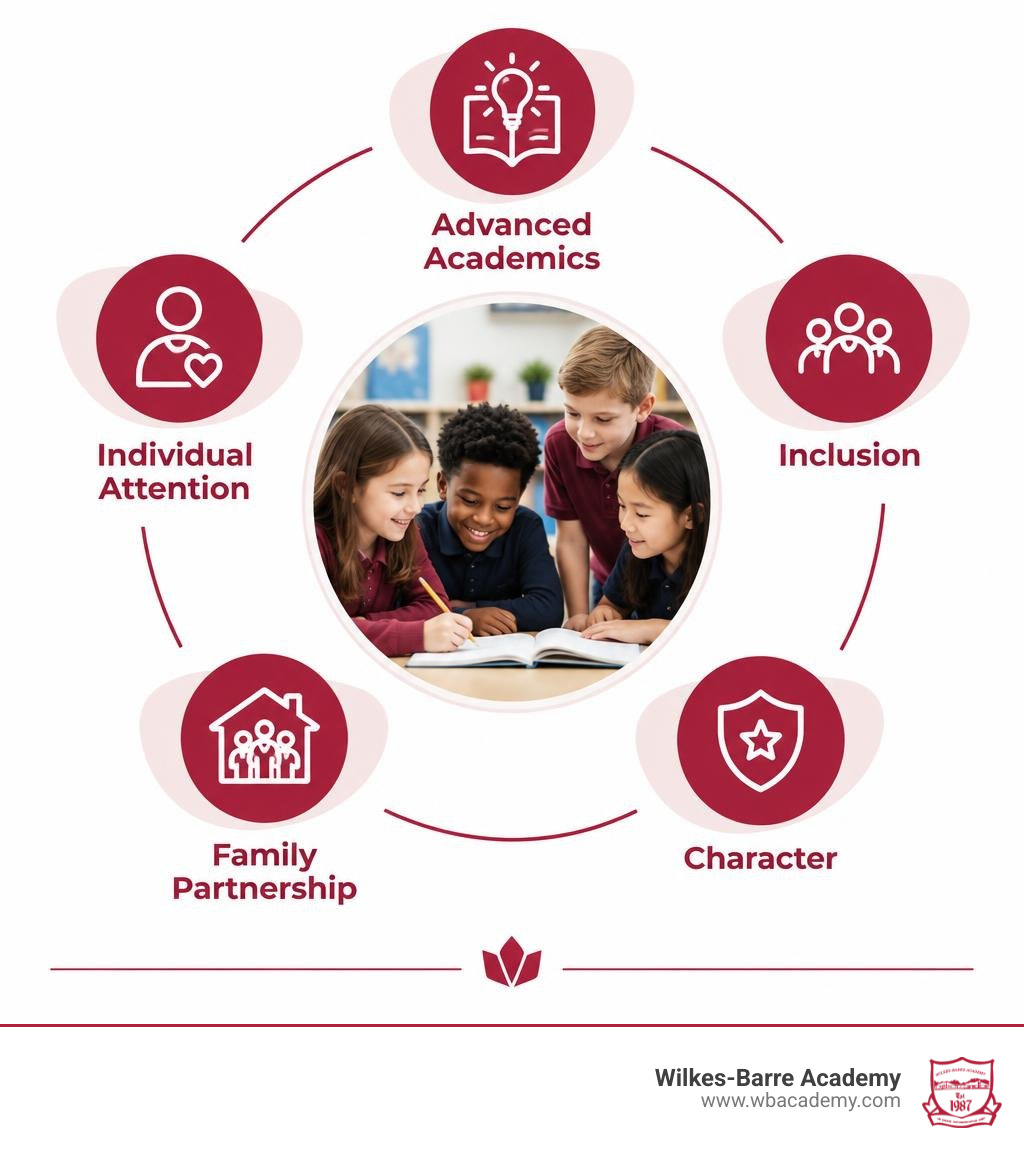
The mission and values of Wilkes-Barre Academy center on giving K-8 students an academically advanced education that is personal, supportive, and inclusive. The school pairs high expectations with individualized attention, strong family-school communication, and a close-knit, non-sectarian community where children can build confidence, responsibility, character, and a lasting interest in learning.
Founded in 1987 after the success of its affiliated Small Wonders Day Care School, Wilkes-Barre Academy was created because families wanted a high-quality learning path beyond preschool. Its one-classroom-per-grade structure helps teachers know students well, respond to their needs, and support progress beyond test scores.
For busy parents, that approach means a school experience designed around both achievement and growth: strong academics, meaningful relationships, and a community that welcomes students without discrimination based on race, color, religious creed, ancestry, national origin, age, or sex.
The Core Mission and Values of Wilkes-Barre Academy
At Wilkes-Barre Academy, our educational philosophy rests on the belief that children thrive when they are intellectually challenged within a secure, nurturing environment. As a private, non-profit, and non-sectarian institution, our purpose is simple yet profound: to nurture academic excellence, independent thinking, and personal integrity in every student who walks through our doors.
We view learning as an ongoing partnership between dedicated teachers, ambitious students, and engaged families. Rather than viewing education purely as standardized testing and rote memorization, we focus on the holistic growth of the child. We cultivate a school atmosphere where curiosity is celebrated, high standards are the norm, and mutual respect binds our entire student body together.
Origins and Purpose: Defining the Mission and Values of Wilkes-Barre Academy
Our story began with a grassroots passion for early childhood development. In 1978, twin sisters Cletta Salavantis and Cappie Evers founded Small Wonders Day Care School in Wilkes-Barre, Pennsylvania. Their goal was straightforward: provide working and single parents in the Wyoming Valley with reliable, enriching care for their infants and young children. As mothers with three children each, the founders understood the daily pressures modern families face.
Although neither founder attended college, their deep respect for education inspired them to build an exceptional learning environment. By 1980, Small Wonders expanded to include kindergarten. As those early learners blossomed, parents asked a crucial question: Where can our children continue receiving this level of attention, structure, and academic rigor?
Listening to these parent advocates, our founders established Wilkes-Barre Academy in 1987. From day one, we designed our K-8 program to offer an advanced curriculum paired with deep individual support. We operate as a dedicated single-location school at 20 Stevens Road in Wilkes-Barre, keeping our entire academic community unified under one roof.
Cultivating Character and Inclusivity in Everyday School Life
Academic capability without strong character leaves an education incomplete. We intentionally weave core values—integrity, accountability, empathy, and respect—into our daily school routines.
Our non-discrimination policy reflects our core beliefs. We welcome students, families, and staff regardless of race, color, religious creed, ancestry, national origin, age, or sex. Because we are non-sectarian, our classrooms naturally bring together children from diverse cultural and philosophical backgrounds.
Every day, students practice these values through:
- Collaborative Group Work: Learning to listen actively, value diverse opinions, and solve complex problems collectively.
- Peer Mentorship: Older middle school students model positive behaviors, read with younger peers, and lead school assemblies.
- Community Engagement: Participation in local service projects that show students the value of giving back to Luzerne County.
- Accountability Systems: Clear, consistent behavioral expectations that guide students to take ownership of their choices and learn constructive conflict resolution.
Individualized Learning Through a Single-Classroom Model

A cornerstone of our educational structure is our commitment to maintaining a single classroom per grade level from Kindergarten through 8th Grade. In an educational era often dominated by overcrowded classrooms and fragmented cohorts, our single-track design ensures that every child is truly known, understood, and valued.
How Small Class Sizes Reinforce the Mission and Values of Wilkes-Barre Academy
When there is only one classroom per grade, no student gets lost in the crowd. Our state-certified teachers monitor the academic, social, and emotional trajectory of every learner in real time. If a student struggles with a mathematical concept, the teacher can deliver targeted intervention right away. When a student shows advanced aptitude in reading or science, we can accelerate instruction to keep them thoroughly engaged.
This focused structure fosters:
- Immediate Feedback: Students receive actionable guidance on their work daily, shortening the learning curve.
- Active Class Participation: In smaller settings, hesitation fades. Every child has regular opportunities to speak up, ask questions, and lead discussions.
- Strong Peer Bonds: Spending the school year with a dedicated cohort creates lasting friendships and a supportive, collaborative learning culture.
Academic Excellence Paired with Comprehensive Student Growth
We set rigorous academic benchmarks, preparing our middle school graduates to excel in top regional high schools and honors programs. However, our definition of student success reaches far beyond traditional test scores.
We systematically cultivate public speaking skills, scientific inquiry, artistic expression, and analytical writing. From hands-on laboratory experiments to dramatic presentations and musical performances, our students develop the poise and confidence needed to navigate complex real-world challenges.
| Educational Dimension | Traditional Multi-Track Model | Wilkes-Barre Academy Single-Classroom Model |
|---|---|---|
| Classroom Cohort | Multiple rotating classes per grade level | Single, unified cohort per grade level (K-8) |
| Instructional Customization | Standardized pacing geared to the median | Tailored pacing with targeted support and acceleration |
| Student-Teacher Rapport | Teachers manage broad rosters | Deep, personalized understanding of each learner’s strengths |
| Peer Community | Diffuse social circles across multiple tracks | Close-knit peer relationships that foster mutual encouragement |
| Accountability & Support | Potential for quiet students to blend into the background | High visibility with proactive academic and emotional check-ins |
Dedicated Faculty and a Thriving, Diverse Community

The strength of any school rests in the passion and expertise of its educators. At Wilkes-Barre Academy, our faculty brings deep professional knowledge, seasoned classroom experience, and genuine devotion to every student.
Veteran Educators Embodying Institutional Tenets
Our faculty members boast remarkable longevity, creating a level of institutional stability and generational trust that is rare in modern education:
- Eileen Sholtis (Kindergarten): Brings 37 years of total teaching experience, including 36 dedicated years guiding young learners at Wilkes-Barre Academy.
- Amanda Sullick (Music): Brings 31 years of teaching experience, with 17 years at our academy, inspiring student creativity through our performing arts curriculum.
- Amanda O’Toole (8th Grade Teacher & Education Director): Brings over 17 years of teaching experience, including 16 years leading our middle school program and academic operations.
- Ashley Kishbaugh (3rd Grade): Offers 16 years of instructional experience, with 8 years spent shaping foundational elementary skills at our school.
- Jessica Richmond (Director of Small Wonders): Has served as a pillar of our affiliated early childhood program for 18 years, ensuring smooth transitions into kindergarten.
- Ambria Salavantis (Leadership Team): Holds an MBA from Wilkes University and applies strategic, mission-aligned leadership to our day-to-day operations.
Our educators pursue continuous professional development and bring rich personal passions to the classroom—from community development work and artistic performance to innovative classroom technology. This low turnover means our teachers often instruct multiple siblings within a family, building lasting bonds with our parents.
Non-Discrimination and Lifelong Family Partnerships
We believe an exceptional school functions as a second home. Open communication between parents and teachers is standard practice here, not an occasional courtesy. Through regular updates, parent-teacher conferences, and community gatherings, parents stay actively involved in their child’s educational journey.
Our strict non-discrimination policy ensures that every family feels respected, supported, and included. This open, welcoming culture frequently leads our graduates to stay connected long after 8th-grade commencement—returning to our single-location facility as guest speakers, community partners, and eventually, as parents enrolling their own children. Wilkes-Barre Academy remains committed to the principles of private, non-profit education, operating as a single institution dedicated to serving families throughout Luzerne County.
Strategic Priorities and the Vision for the Future
Having celebrated our milestone 30th graduating class in 2025, Wilkes-Barre Academy is moving toward our 40th anniversary with clear strategic priorities. Our forward-looking initiatives honor our founding traditions while equipping our students for an evolving world.
Key future priorities for our school include:
- Campus and Facility Modernization: Continuing proactive upgrades across our 20 Stevens Road facility to ensure enhanced physical security, updated learning spaces, and modern classroom resources.
- STEAM Integration: Expanding hands-on science, technology, engineering, arts, and mathematics curricula through grant-funded initiatives and specialized equipment.
- Co-Curricular Expansion: Introducing new clubs, academic competitions, arts programs, and athletic opportunities that complement our rigorous classroom standards.
- Instructional Support Systems: Investing in teacher professional development and classroom tools that support tailored, differentiated instruction across all grade levels.
- Community Outreach: Deepening our service partnerships throughout the Wyoming Valley to provide real-world learning and civic leadership opportunities for our students.
Frequently Asked Questions About Wilkes-Barre Academy
What is the primary educational mission of the academy?
Our primary mission is to deliver an academically advanced, individualized education within a supportive, non-sectarian, family-like environment. We focus on intellectual development, moral integrity, self-discipline, and a genuine love for lifelong learning.
How does the single-classroom structure benefit K-8 students?
By maintaining exactly one classroom per grade level, our teachers can closely monitor every student’s individual progress. This setup eliminates crowded conditions, allows for immediate academic intervention or acceleration, and builds a supportive, cohesive peer community.
How does the school promote diversity and inclusivity?
Wilkes-Barre Academy is non-sectarian and maintains an open non-discrimination policy. We evaluate admissions, hire staff, and administer our educational programs without regard to race, color, religious creed, ancestry, national origin, age, or sex, cultivating a diverse, respectful school community.
Conclusion
A complete education requires both intellectual challenge and personal character. By pairing an advanced curriculum with genuine individual attention, an inclusive school culture, and an experienced faculty, Wilkes-Barre Academy prepares students to step confidently into secondary education and beyond.
Our commitment to small class sizes, open family partnerships, and character development ensures that every child is prepared for academic success and purposeful citizenship. We invite prospective families to discover the history and educational approach on our story page and see how our school community helps children flourish.