Can You Actually Afford Private School in Pennsylvania?
Can Pennsylvania Families Actually Afford Private School?
If you’re wondering how to pay for private school in Pennsylvania, you’re not alone — and the answer is more encouraging than most parents expect.
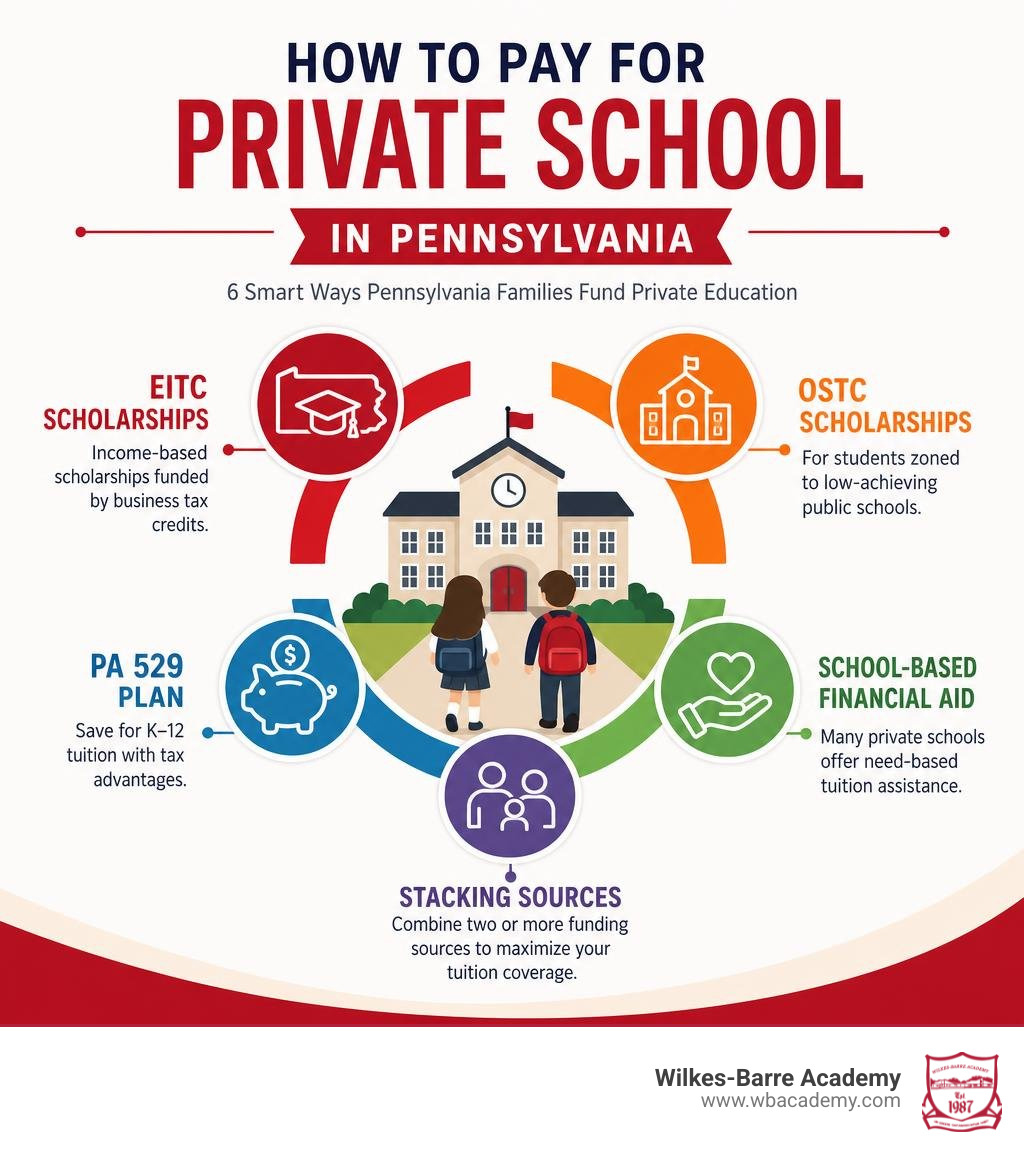
Here are the main ways Pennsylvania families cover private school tuition:
- EITC scholarships — income-based scholarships funded by business tax credits, applied for directly through the school
- OSTC scholarships — for students zoned to low-achieving public schools, up to $8,500/year (or $15,000 for special education students)
- PA 529 Investment Plan — contribute and withdraw for K-12 tuition, with up to $18,000/year deductible from Pennsylvania state taxes
- School-based financial aid — many private schools offer their own tuition assistance programs
- Employer tuition assistance — some employers offer up to $5,250/year in dependent education benefits
- Stacking sources — combining two or more of the above can cover the majority of tuition costs
Private school tuition averages around $12,350/year for elementary and $16,040/year for high school nationally. That feels out of reach for many families. But Pennsylvania has built one of the most robust school choice ecosystems in the country, with programs that can dramatically reduce — or even eliminate — out-of-pocket costs.
The challenge isn’t that funding doesn’t exist. It’s that most families don’t know where to look.
This guide walks you through every realistic option, step by step.
Simple guide to how to pay for private school pennsylvania:
Understanding the Cost of K-12 Education in PA
Before we dive into the “how,” let’s demystify the “how much.” When many parents think of private school, they picture eye-watering, Ivy-League-level tuition rates. While some elite boarding schools do charge those rates, the reality for local, community-focused private schools is much more grounded.
In the United States, the average private school tuition is approximately $12,350 per year for elementary schools and $16,040 per year for high schools. In Pennsylvania, these numbers fluctuate based on location, school size, and available resources. When researching the best private schools in Wilkes-Barre, PA (2026), you will find that local options are often significantly more affordable than the national averages.
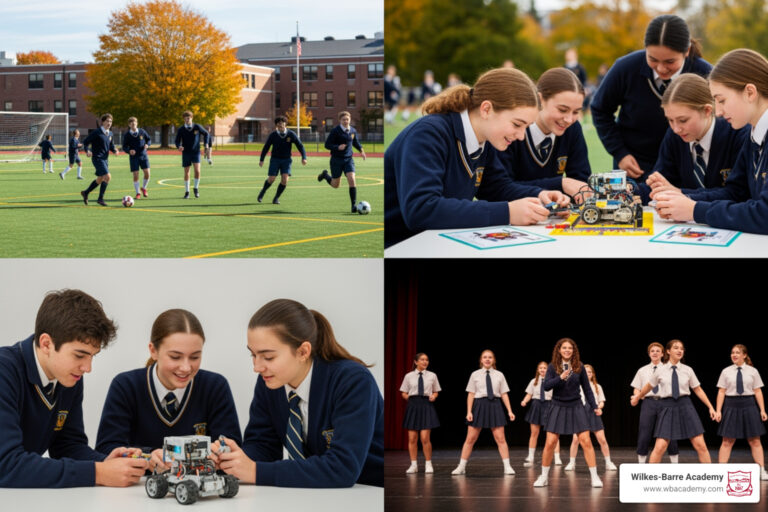
At Wilkes-Barre Academy, we intentionally keep our tuition structured to remain accessible for hard-working families in Luzerne County. You can explore our current rates on our dedicated tuition page.
When evaluating school selection, it is vital to look beyond the sticker price. Many families assume they won’t qualify for assistance, only to discover that a combination of state tax credits, local scholarships, and smart financial planning brings the actual cost well within their household budget. For a deeper breakdown of tuition rates and affordable local choices, check out our guide on how much is private school in PA: tuition stats and affordable options.
How to Pay for Private School Pennsylvania: State Tax-Credit Programs (EITC & OSTC)
Pennsylvania is a national leader in school choice, having provided over $2 billion in taxpayer-funded support through its tax-credit programs since their inception. In the 2023-24 budget alone, these programs directed $470 million to help families send their children to private and religious schools.
Instead of traditional “vouchers” where state money is handed directly to parents, Pennsylvania utilizes a tax-credit system. Businesses donate directly to approved scholarship organizations and receive substantial tax credits in return. These organizations then distribute the funds to eligible families.
For families in Luzerne County, accessing these programs is one of the absolute best ways to make private education a reality. At Wilkes-Barre Academy, we actively participate in these initiatives. You can read more about how we facilitate this process on our EITC grant page.
While these programs are incredibly beneficial, navigating them requires a bit of strategy. As noted in this guide on opportunity scholarships in Pennsylvania: what families in Western PA should know before counting on one – Pittsburgh Education Lawyer, receiving an eligibility letter does not guarantee a scholarship or admission; families must take proactive steps to secure funding and enroll in their school of choice.
What is the Educational Improvement Tax Credit (EITC)?
The Educational Improvement Tax Credit (EITC) program allows businesses to receive a 75% tax credit on their donation to a scholarship organization, which jumps to an incredible 90% if the business commits to making the same donation for two consecutive years.
Because of this generous incentive, millions of dollars flow into approved Scholarship Granting Organizations (SGOs) every year. These organizations then award scholarships to families based on household income.
To be eligible for an EITC scholarship in the 2025-2026 and 2026-2027 school years, a household’s base income must not exceed $116,055, with an additional allowance of $20,428 for each dependent. For example, a family with two children can have a household income of up to $156,911 and still qualify for EITC assistance.
What is the Opportunity Scholarship Tax Credit (OSTC)?
The Opportunity Scholarship Tax Credit (OSTC) is a sister program to the EITC, but it targets a specific group of students: those who live within the boundary lines of a low-achieving public school. The Pennsylvania Department of Education defines “low-achieving” as public schools scoring in the bottom 15% statewide on standardized tests.
If your local public school is on this list, your child may qualify for an OSTC scholarship to attend a private school like Wilkes-Barre Academy.
- General-education students can receive up to $8,500 per year.
- Special education students can receive up to $15,000 per year (and in some high-cost scenarios, even more).
Like the EITC, these funds are distributed through approved scholarship organizations and are subject to the same household income limits.
Maximizing Your Savings with a PA 529 Investment Plan
If you think 529 plans are only for college, we have some fantastic news. Thanks to federal tax law changes, families can use 529 plans to pay for K-12 private school tuition up to $10,000 per year, per student.
The PA 529 Investment Plan is an exceptional tool for Pennsylvania residents. In fact, it received a prestigious Gold Rating from Morningstar in 2023, making it one of only two programs in the entire country to earn this distinction.

Tax Benefits of Using a PA 529 Plan for K-12 Tuition
Using the PA 529 Investment Plan (IP) offers several massive tax advantages for Pennsylvania families:
- State Tax Deduction: Pennsylvania taxpayers can deduct up to $18,000 per beneficiary, per year ($36,000 for married couples filing jointly, provided each spouse has at least $18,000 of taxable income) from their Pennsylvania taxable income.
- Tax-Free Growth: Any earnings on your investments within the plan grow entirely free from federal and state income taxes.
- Tax-Free Withdrawals: As long as the money is used for qualified education expenses—including K-12 private school tuition—withdrawals are completely tax-free.
- High Limits: The maximum lifetime contribution limit across all PA 529 accounts for a single beneficiary is a generous $511,758.
To understand how to best structure these contributions for your family, you can read this detailed analysis on how to maximize your PA 529 tax deduction: a guide for young families – Bright Advisers.
How to Pay for Private School Pennsylvania Tuition by Sequencing 529 Payments
Here is a brilliant financial strategy—often called the “sequencing” or “routing” strategy—that allows you to save money on tuition you were already planning to pay out of pocket.
As detailed in this guide on paying for K-12 tuition with a 529, Pennsylvania has no minimum holding period for funds in a PA 529 account. This means you can deposit your tuition money into a PA 529 plan, let the transaction clear, and immediately withdraw it to pay your child’s private school tuition.
By routing the money through the 529 plan rather than paying the school directly from your checking account, you instantly qualify for the state tax deduction.
At Pennsylvania’s flat state income tax rate of 3.07%, routing $10,000 through a PA 529 plan saves you $307 per year in state taxes per child. If you have two children in private school, that is $614 in free money every year just for changing the order of your payments!
Stacking Multiple Funding Sources for Maximum Affordability
The secret to making private school affordable for the long haul is “stacking.” You do not have to rely on just one program. Instead, you can combine state scholarships, tax advantages, school-based aid, and employer benefits to cover the vast majority of your tuition bill.
Let’s look at how these different funding sources compare:
| Funding Source | Annual Limit | Key Eligibility Requirement |
|---|---|---|
| EITC Scholarship | Varies by SGO | Household income under $116,055 (+$20,428 per dependent) |
| OSTC Scholarship | Up to $8,500 (Gen-Ed) / $15,000 (Special Ed) | Must live in attendance boundary of bottom 15% public school |
| PA 529 Plan K-12 Withdrawal | Up to $10,000 per student | None (used for qualified K-12 tuition) |
| Employer Tuition Assistance | Up to $5,250 (tax-free under Sec. 127) | Offered by participating employers |
| School-Based Financial Aid | Varies by school | Determined by school’s internal financial aid application |
Combining EITC, School-Based Aid, and Employer Assistance
Imagine a family with two children attending Wilkes-Barre Academy. Their total annual tuition is $16,000.
By utilizing a stacking strategy, they might:
- Receive an EITC Scholarship of $4,000 through a local scholarship organization.
- Qualify for School-Based Financial Aid of $2,000 directly from our school’s internal assistance fund.
- Access Employer Tuition Assistance of $3,000 through a parent’s workplace benefit program.
- Route the remaining $7,000 of out-of-pocket tuition through a PA 529 Plan, saving them an additional $215 in state income taxes.
By stacking these resources, their actual out-of-pocket cost drops from $16,000 to a highly manageable $7,000 (and they save on their tax bill!).
How to Pay for Private School Pennsylvania Families Can Access via Scholarship Organizations
To get EITC or OSTC funding, you must apply through an approved Scholarship Granting Organization (SGO). These are independent, state-approved non-profit organizations.
While some organizations prioritize specific counties, many statewide SGOs accept applications from families across Pennsylvania. An example of a prominent Pennsylvania scholarship organization is The Learning Lamp, which administers partial K-12 tuition assistance.
When applying through an SGO, keep these best practices in mind:
- Strict Windows: Many SGOs only accept applications during a very tight window (often June 1 through June 30). Missing this window usually means automatic rejection.
- Complete Documentation: You will need to provide your most recent tax returns (typically the first page of your IRS Form 1040) to verify your adjusted gross income.
- Volunteer Requirements: Some SGOs require scholarship recipients to complete a set number of volunteer hours (such as 5 hours per year) to remain eligible for renewal.
Navigating School Types, Oversight, and the Application Process
As you research how to pay for private school in Pennsylvania, you will also want to make sure you understand the types of schools available. This ensures you find a school that matches your academic expectations and qualifies for state funding. To begin exploring highly-rated schools in our area, you can review private schools in Wilkes-Barre, PA – Niche.

Licensed Private Academic Schools vs. Nonpublic Non-Licensed Schools
Pennsylvania categorizes private schools into two primary groups:
- Licensed Private Academic Schools (LPAS): These schools are formally licensed by the State Board of Private Academic Schools. They must meet rigorous state standards regarding teacher certification, curriculum, and facilities.
- Nonpublic Non-Licensed Schools: These are often religious or church-affiliated schools. While they must register with the state, they are not subject to the same licensing requirements.
Both categories of schools must provide a minimum of 180 days of instruction (or 900 hours for elementary and 990 hours for secondary students). However, licensed private academic schools are held to strict standards regarding the withholding of student records; while they can withhold academic transcripts for unpaid tuition, they must always release student health and immunization records by law.
Accountability and Oversight for Participating Schools
To receive funding from the EITC or OSTC programs, a private school must be an approved “destination institution.” This means the school must comply with Pennsylvania’s civil rights laws and maintain appropriate academic and attendance records.
This regulatory oversight ensures that taxpayer-supported scholarship dollars are only directed to reputable, high-performing schools that provide a safe and enriching environment for students.
Frequently Asked Questions about Paying for Private School in PA
What are the income limits for EITC and OSTC scholarships?
For the current school year, the household income limit is $116,055, plus $20,428 for each dependent. The allowance for dependents makes these programs highly accessible for middle-class families with multiple children.
What is the difference between a school voucher and a tax-credit scholarship in PA?
While people often use the terms interchangeably, they are legally different. A traditional school voucher program uses direct public education funds (tax dollars) to pay for private school tuition. Pennsylvania does not currently have a traditional voucher program.
Instead, Pennsylvania uses tax-credit scholarship programs (EITC and OSTC). These programs incentivize private businesses to donate to scholarship organizations in exchange for state tax credits. For more details on how these distinct mechanisms operate, read our overview of the voucher program.
How do families find and compare participating private schools in Pennsylvania?
We recommend starting with reputable online directories and school choice platforms. For instance, you can view our school profile on WILKES-BARRE ACADEMY – Schools – School Choice USA to see how we compare.
Once you have a shortlist, schedule a physical tour, ask about their specific EITC/OSTC partnerships, and request a meeting with their financial aid administrator to discuss your family’s options.
Conclusion
Paying for private school in Pennsylvania is entirely achievable when you leverage the right state programs, tax-advantaged savings plans, and school-based support. By stacking EITC scholarships with a PA 529 Investment Plan and utilizing school-specific aid, the dream of an exceptional private education can easily become a budget-friendly reality.
At Wilkes-Barre Academy, we are dedicated to helping families navigate this financial journey. We offer an academically advanced curriculum in a warm, close-knit, single-classroom-per-grade environment that ensures your child receives the individualized attention they deserve.
To learn more about our rigorous program, visit our academics page. If you are ready to take the next step toward securing your child’s future, we invite you to explore our enrollment page and schedule a visit to our Wilkes-Barre campus today!