The Facts on PA Private School Non-Discrimination
What PA Parents Need to Know About Private School Non-Discrimination Policies
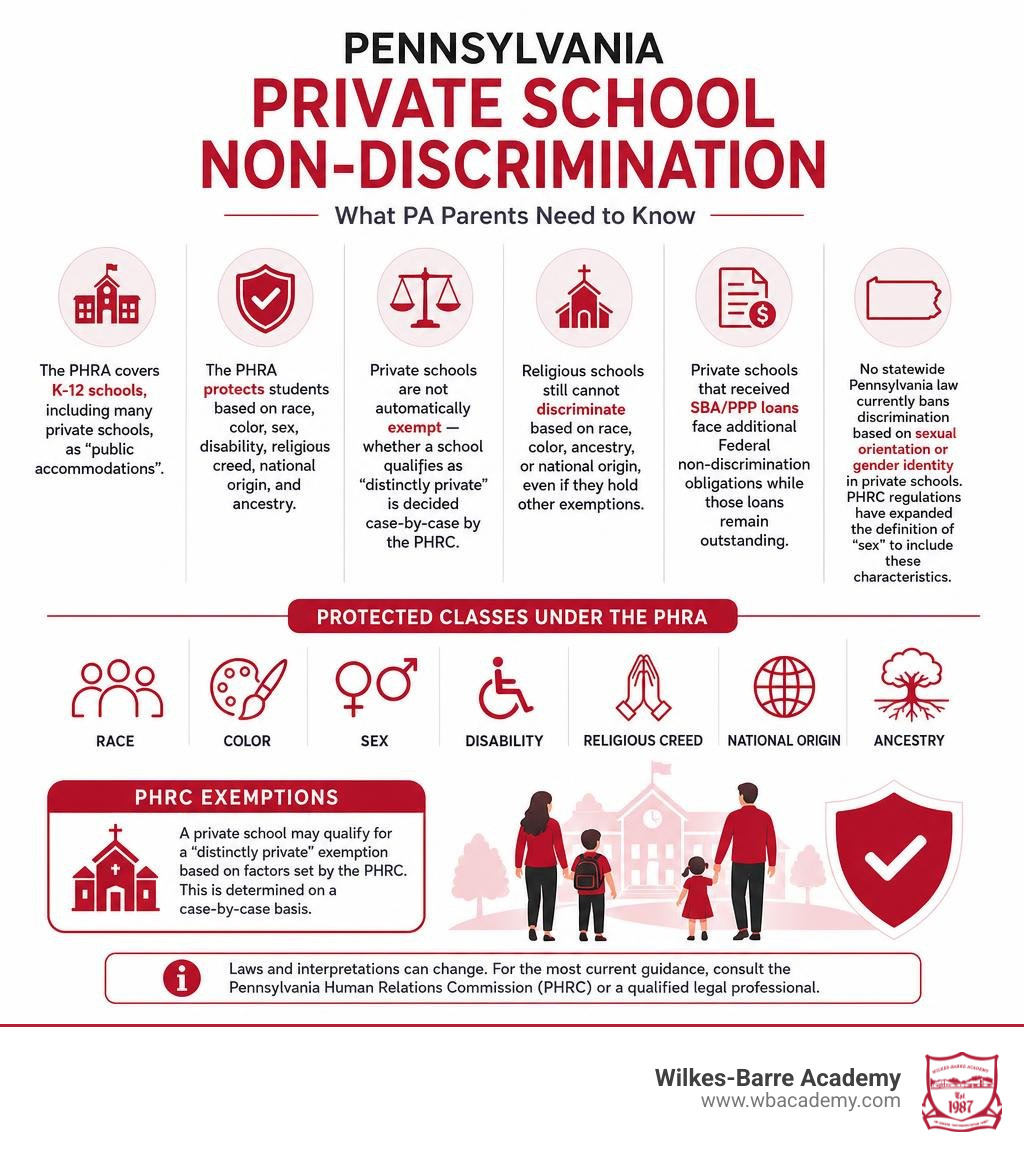
Understanding the private school non-discrimination policy in PA is essential for any parent choosing where to enroll their child. Here’s a quick overview of what the law currently requires:
Key facts at a glance:
- Pennsylvania’s Pennsylvania Human Relations Act (PHRA) covers K-12 schools, including many private schools, as “public accommodations”
- The PHRA protects students based on race, color, sex, disability, religious creed, national origin, and ancestry
- Private schools are not automatically exempt — whether a school qualifies as “distinctly private” is decided case-by-case by the Pennsylvania Human Relations Commission (PHRC)
- Religious schools still cannot discriminate based on race, color, ancestry, or national origin, even if they hold other exemptions
- Private schools that received SBA/PPP loans face additional federal non-discrimination obligations while those loans remain outstanding
- No statewide Pennsylvania law currently bans discrimination based on sexual orientation or gender identity in private schools — though PHRC regulations have expanded the definition of “sex” to include these characteristics
Many parents assume private schools operate outside the law’s reach. That’s not quite right — and the gap between what is protected and what isn’t can directly affect your child.
Simple private school non-discrimination policy pa word guide:
Understanding the Private School Non-Discrimination Policy PA Framework
When it comes to educational equity in Pennsylvania, the legal landscape can feel like a complex puzzle. Public schools are bound by a vast net of constitutional mandates, state codes, and federal statutes. For private schools, the rules are different, but they are far from non-existent.
To understand how a private school non-discrimination policy in PA operates, we must first look at the state’s primary civil rights enforcement mechanisms: the Pennsylvania Human Relations Act (PHRA) and the Pennsylvania Fair Educational Opportunities Act (PFEOA). While the PFEOA primarily governs post-secondary and trade schools, the PHRA is the heavy lifter for K-12 institutions.
Under the PHRA, K-12 schools are broadly evaluated as “public accommodations.” This classification means that any facility or institution that opens its doors to the general public for educational purposes must operate without unlawful discrimination. However, because private schools are independently funded and operated, the state applies a nuanced, factual test to determine exactly how these laws apply to individual institutions.
To help navigate this framework, the state provides official Policies and Nondiscrimination Guidelines outlining how educational institutions must maintain environments free from bias, exclusion, and harassment.
Distinctly Private Exemptions vs. Public Accommodations
One of the most common misconceptions is that all private schools are entirely exempt from state non-discrimination laws. In Pennsylvania, this is not a blanket rule. Instead, the Pennsylvania Human Relations Commission (PHRC) evaluates private schools on a case-by-case basis to determine if they qualify as “distinctly private” institutions.
If an institution is deemed “distinctly private” (meaning it has highly selective, non-public membership criteria and does not function as a standard public accommodation), it may fall outside certain PHRA provisions. However, this exclusion is incredibly narrow and fact-specific.
Furthermore, even if a school is certified as a religious or denominational educational institution, its exemptions are strictly capped. Under 16 Pa. Code § 47.73 – Limitation of exemption, religious schools are explicitly prohibited from discriminating on the basis of:
- Race
- Color
- Ancestry
- National origin
This means that while a religious private school may prioritize students of its own faith in admissions, it can never turn away a student or treat them unequally based on their racial background or national heritage.
Protected Classes Under Pennsylvania State Law
For those private schools subject to state oversight, Pennsylvania law protects several distinct classes of individuals. Over the years, these protections have evolved to match modern civil rights standards. The foundational protected classes under the PHRA include:
- Race (which explicitly includes protective hairstyles and textures historically associated with race, such as braids, locks, and twists)
- Color
- Sex
- Religious creed
- National origin
- Ancestry
- Handicap or disability (including the use of trained guide or support animals)
A major milestone in Pennsylvania civil rights history occurred when the PHRC published finalized rulemaking in the Pennsylvania Bulletin. This update aligned state definitions with federal civil rights interpretations. Most notably, the definition of “sex” was formally clarified to include:
- Gender identity or expression
- Affectional or sexual orientation
- Pregnancy and childbirth
- Differences of sex development (intersex characteristics)
By broadening these definitions, Pennsylvania ensured that students and employees in covered institutions have a clear path to recourse if they experience discrimination based on who they are or whom they love.
Federal vs. State Non-Discrimination Mandates
To truly understand how a private school non-discrimination policy in PA functions, we have to look at how state laws interact with federal regulations. The table below outlines the key differences between the protections offered under Pennsylvania state law (PHRA) and major federal civil rights laws:
| Protection Category | Pennsylvania State Law (PHRA) | Federal Law (Title IX / Section 504 / ADA) |
|---|---|---|
| Applicability to Private Schools | Applies unless the school is proven to be “distinctly private” on a case-by-case basis. | Applies to any private school receiving federal financial assistance (including grants or loans). |
| Gender Identity & Sexual Orientation | Protected under expanded PHRC definitions of “sex.” | Protected under federal Title IX interpretations for funded programs. |
| Disability Accommodations | Covered under public accommodation rules; requires reasonable access and modifications. | Section 504 and ADA Title III require academic and physical access for funded/public programs. |
| Enforcement Agency | Pennsylvania Human Relations Commission (PHRC). | U.S. Department of Education Office for Civil Rights (OCR). |
Many public school districts outline these overlapping federal and state responsibilities in comprehensive compliance documents, such as the widely referenced BoardDocs® Policy: 103 Equal Educational Opportunity and Anti-Discrimination/Harassment. While private schools are not bound by public school board policies, they often look to these frameworks to design their own robust compliance procedures.
The Impact of SBA Loans on a Private School Non-Discrimination Policy PA
A surprising turn in federal compliance occurred during the early 2020s when many private schools across Pennsylvania accepted federal financial assistance through Small Business Administration (SBA) programs, such as the Paycheck Protection Program (PPP).
Accepting an SBA loan changes a private school’s legal status instantly. Under federal law, any recipient of federal financial assistance must agree to strict non-discrimination mandates. For as long as those loans are active and outstanding, the private school is legally required to prohibit discrimination based on:
- Race, color, and national origin (Title VI)
- Sex, including gender identity and sexual orientation (Title IX)
- Age (Age Discrimination Act)
- Disability (Section 504 of the Rehabilitation Act)
To meet these requirements, schools must designate a formal compliance officer to handle complaints. Anyone who believes a school has violated these terms can file a complaint directly with the school or with the federal Office for Civil Rights (OCR). These federal complaints must typically be filed within 180 days of the alleged discriminatory act, ensuring a swift and structured resolution process.
IRS Requirements for Private School Non-Discrimination Policy PA Publication
Even if a private school does not receive state funding or federal loans, it must still answer to the Internal Revenue Service (IRS) to maintain its tax-exempt 501(c)(3) status. Under IRS Revenue Procedure 75-50, every private school must have a racially non-discriminatory policy as to students.
Historically, schools had to publish this policy annually in a newspaper of general circulation. However, modern updates have made this process much simpler. As outlined in the legal analysis of Private School Nondiscrimination Policies: Website …, private schools can now satisfy IRS requirements by prominently displaying their non-discrimination policy on their official, publicly accessible website year-round. This policy must state clearly that the school admits students of any race, color, and national or ethnic origin to all the rights, privileges, programs, and activities generally accorded or made available to students at the school.
Identifying and Addressing Education Discrimination
Discrimination in an educational setting is not always as obvious as a closed door or an explicit refusal to enroll a student. It often manifests in subtle, systemic, or administrative ways.
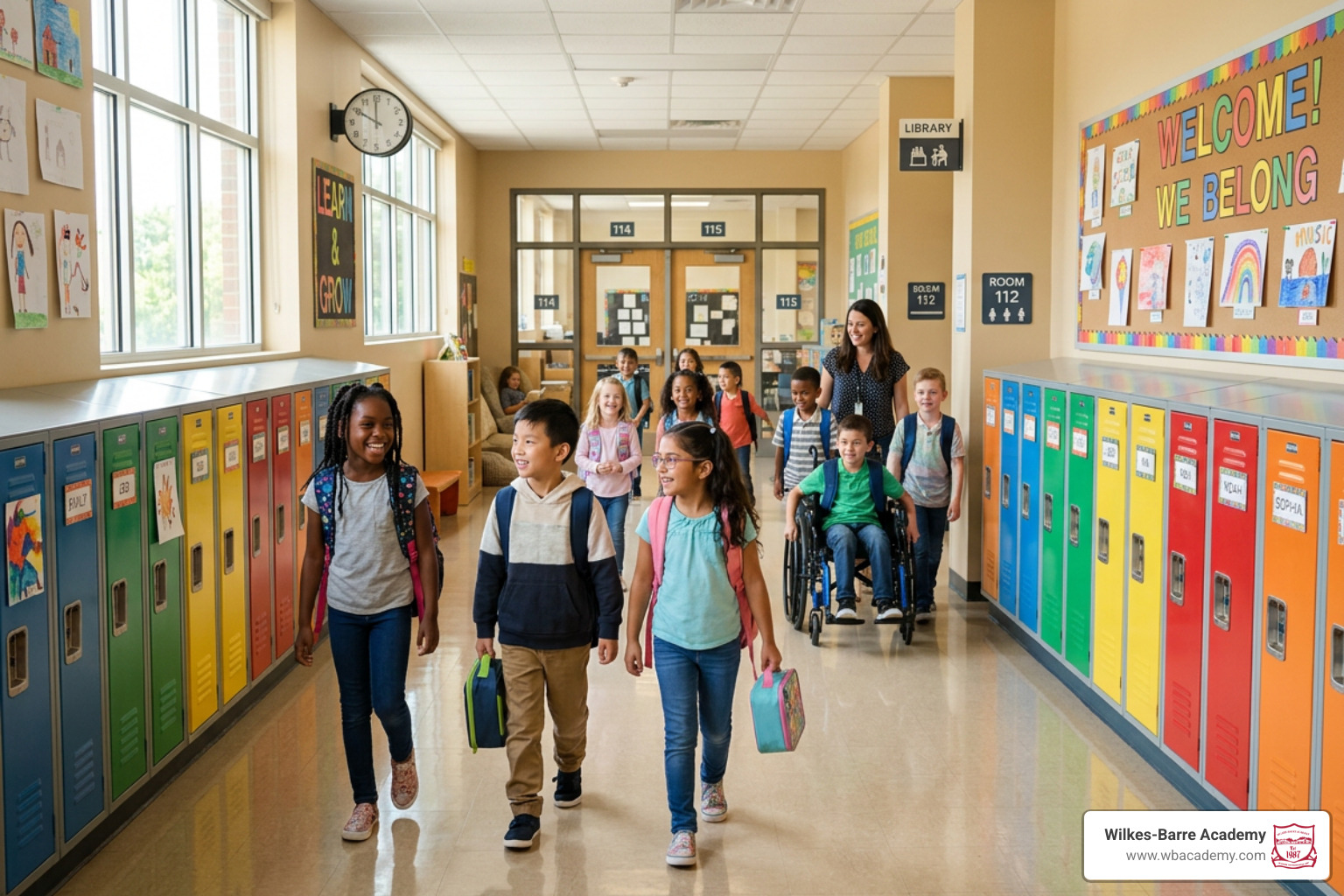
According to the state’s resource on Education Discrimination | Pennsylvania Human Relations Commission | Commonwealth of Pennsylvania, illegal education discrimination can take many forms:
- Grading Bias: A teacher grading or disciplining students differently based on their race, sex, or disability status.
- Admission Denial: Rejecting a qualified applicant due to a protected characteristic, or using admissions criteria that have an unjustified disparate impact on a protected group.
- Physical Access Barriers: Failing to provide ramps, accessible doorways, or appropriate facilities for students with physical disabilities.
- Unaddressed Harassment: Allowing a hostile environment to persist where students are subjected to offensive slurs, images, or actions without prompt administrative intervention.
Handling Harassment, Bullying, and Retaliation
Private schools have a moral and legal duty to protect their students from harm. Under Pennsylvania law, bullying is defined as intentional electronic, written, verbal, or physical acts directed at another student in a school setting that are severe, persistent, or pervasive. These acts must substantially interfere with a student’s education, create a threatening environment, or disrupt school operations.
In Pennsylvania, programs like Safe2SayPA allow students and parents to anonymously report safety concerns and bullying. It is also highly illegal for any school to retaliate against a student, parent, or employee who opposes discriminatory practices or files a complaint.
We believe that keeping families informed is the first step in protecting students. For a deeper dive into how state laws shield your child, check out Private School Student Safety Pennsylvania: A Parent’s Guide to the Law.
Reasonable Accommodations for Disabilities and Religious Needs
Providing an equal opportunity for success means recognizing that different students have different needs. For students with disabilities, private schools are generally expected to provide reasonable accommodations to ensure they can access the curriculum and facilities.
While private schools are not legally required to draft public-school-style Individualized Education Programs (IEPs), they often work closely with families to create service plans or 504 accommodation agreements. These might include:
- Modifying testing environments (e.g., giving extra time or a quiet space)
- Providing physical access modifications (such as ramps or adaptive desks)
- Allowing the use of assistive technology or trained service animals
Religious accommodations are also a critical piece of the puzzle. Schools must make reasonable adjustments for students’ religious observances, such as allowing excused absences for holy days or accommodating specific dress code requirements linked to a student’s faith.
For more information on how we align our daily operations with these principles, you can review our Civil Rights Accordance documentation.
How Private Schools Handle Complaints and Compliance
When a concern about discrimination or harassment arises, a swift, transparent, and fair process is essential to resolve the issue. Most private schools establish a clear internal process to handle complaints. This ensures that parents, students, and staff have a reliable path to seek help without fear of retaliation.
A typical compliance process includes both informal and formal resolution paths:
- The Informal Process: Often, misunderstandings or minor conflicts can be resolved through guided dialogue. A parent or student might meet with a teacher, principal, or designated compliance officer to discuss the issue and find a mutually agreeable solution.
- The Formal Process: If the issue is severe, or if the informal process doesn’t resolve the concern, a formal written complaint can be filed.
- Investigation: Once a formal complaint is received, the school’s compliance officer or an impartial administrator will launch an investigation. This involves interviewing witnesses, gathering evidence, and reviewing school records.
- Timeline: Best practices dictate that investigations should be completed promptly—typically within 30 calendar days—with written findings provided to all parties involved.
Many institutions model their public notices on standard templates, such as this clear Non-Discrimination Announcement, which outlines who to contact, how to file a report, and the school’s commitment to a safe, unbiased learning environment.
Frequently Asked Questions about PA Private School Policies
Are religious private schools completely exempt from PA non-discrimination laws?
No. While religious private schools in Pennsylvania enjoy certain exemptions—such as the ability to prioritize members of their own faith during admissions or hire staff who adhere to their religious tenets—they are never exempt from laws prohibiting discrimination based on race, color, ancestry, or national origin. Under Pennsylvania regulations, these core protections apply to all educational institutions operating as public accommodations.
What should parents do if they suspect discrimination at a PA private school?
If you suspect your child is facing discrimination, start by documenting everything: dates, times, specific actions, and any written communications. Next, follow the school’s internal grievance procedure by contacting the principal or compliance officer.
If the school fails to address the issue, or if the school is not exempt from state laws, you can file a formal education discrimination complaint with the Pennsylvania Human Relations Commission (PHRC). That state and federal complaints have strict filing timelines (often within 180 days of the incident), so it is important to act promptly. You can also reach out to the PHRC regional office nearest to Luzerne County for guidance.
Do PA private schools have to protect LGBTQ+ students?
The answer depends on the school’s funding, location, and specific religious affiliations. If a private school accepted federal SBA loans, it must comply with federal Title IX protections, which prohibit discrimination based on sexual orientation and gender identity.
Furthermore, the PHRC’s expanded regulations define “sex” discrimination to include sexual orientation and gender identity. However, because “distinctly private” or religious schools may challenge these applications on a case-by-case basis, protection can vary. Additionally, many local municipalities in Pennsylvania have passed local non-discrimination ordinances that offer explicit protections for LGBTQ+ individuals within their borders.
Conclusion
Navigating the legalities of a private school non-discrimination policy in PA can feel overwhelming, but it highlights a vital truth: every child deserves a safe, supportive, and enriching environment to learn and grow.
At Wilkes-Barre Academy, we take immense pride in our close-knit, diverse community here in Luzerne County. As a single-location, private, non-profit K-8 school, we do things a little differently. We feature a single classroom per grade, allowing us to focus on highly individualized learning while building strong, lasting family-school connections. We believe that our diversity is our greatest strength, and we are committed to maintaining a warm, inclusive environment where every student is valued for who they are.
If you are looking for a school that combines academic excellence with a supportive, community-focused atmosphere, we invite you to learn more About our programs.
Ready to take the next step? Explore our Admissions page or find details on student Enrollment to join the Wilkes-Barre Academy family today!