Why Early Language Learning Matters: Spanish for Pennsylvania Kids
Why Finding a Quality Spanish Class for Your Elementary Student in PA Matters
Finding the right spanish class in an elementary school in pennsylvania is one of the best ways to give your child a lifetime cognitive advantage.
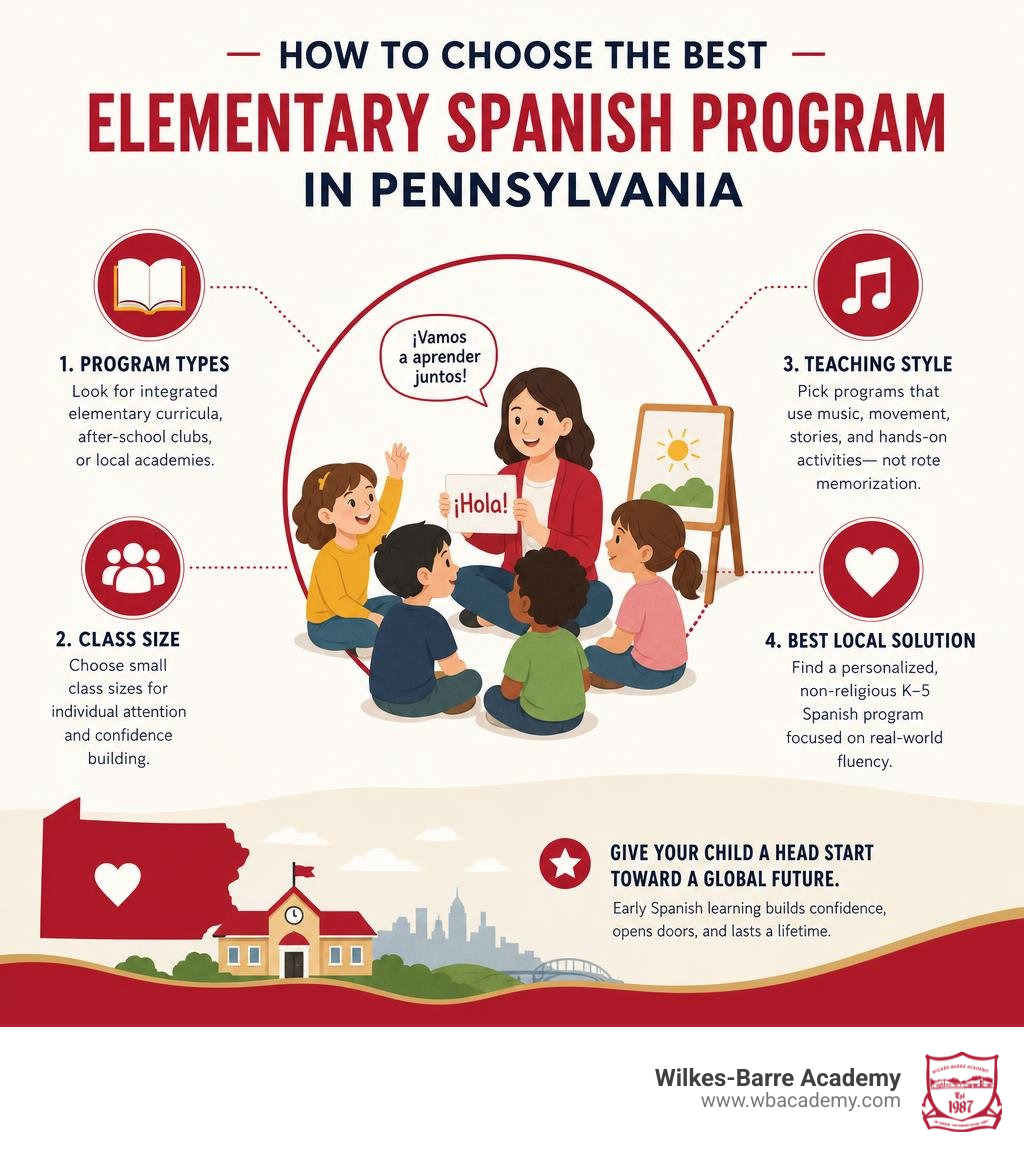
If you are a busy parent looking for the best early language options, here is a quick guide to help you find the right fit:
- Program Types: Look for options like integrated elementary curricula, after-school language clubs, or local private academies.
- Class Size: Choose programs with small class sizes. Children need individual attention to build speaking confidence.
- Teaching Style: Avoid rote memorization. The best classes use music, movement, and hands-on play.
- The Best Local Solution: Wilkes-Barre Academy in Luzerne County offers a highly personalized, non-religious K-5 Spanish curriculum focused on real-world fluency.
Young children have a unique window for learning languages. Their brains are like sponges. They can absorb phonetic sounds naturally and speak without an accent.
Unfortunately, many public schools do not start foreign language classes until middle or high school. By then, the natural window for easy language learning has closed.
That is why finding a high-quality program during the elementary years is so critical. It is not just about learning vocabulary. It is about building a flexible, creative mind and preparing your child for a global future.
Handy spanish class elementary school pennsylvania terms:
- academic activities and competitions
- spelling bee school pennsylvania
- science fair elementary school pennsylvania
The Cognitive and Social Benefits of Early Language Acquisition
Have you ever watched a young child pick up a tablet and figure out how to use it in seconds? Children’s brains are designed to map patterns rapidly. This incredible neuroplasticity makes early childhood the absolute prime window for language acquisition. When a child joins a spanish class elementary school pennsylvania program, they are not just memorizing words—they are fundamentally reshaping how their brain processes information.
Research shows that early bilingualism acts as a full-body workout for the brain. It stimulates cognitive flexibility, meaning bilingual children are often better at problem-solving, multi-tasking, and creative thinking. Because they must constantly choose the correct language context, their executive function—the brain’s command center—becomes highly developed. This leads to a measurable boost in memory retention and overall academic success.
But the benefits extend far beyond report cards. Learning a second language builds deep cultural empathy. When children learn how another culture expresses itself, they realize that their way of viewing the world is just one of many. It opens their minds to new behaviors, customs, and traditions, helping them grow into tolerant, compassionate global citizens.
In our increasingly interconnected world, bilingualism is a gift that lasts a lifetime. Whether they are traveling, collaborating in future careers, or simply talking to neighbors, speaking Spanish gives children a massive head start.
Choosing the Right Spanish Class: Interactive vs. Traditional Programs
Not all language classes are created equal. If you grew up sitting at a desk, copying conjugations from a chalkboard, and feeling terrified of speaking out loud, you experienced the traditional grammar-heavy approach. Unsurprisingly, this method rarely produces fluent speakers.
For young children, language is best learned when it is lived. The most effective programs use an interactive, immersion-style environment. Instead of rote translation drills, children acquire real vocabulary and sentence structures naturally through:
- Total Physical Response (TPR): Pairing physical actions with verbal commands (e.g., jumping when they hear “salta“).
- Music and Movement: Singing songs like “Buenos Días” and “Los Pollitos Dicen” to absorb pronunciation and rhythm without stress.
- Storytelling and Role-Play: Acting out real-world scenarios, like ordering food at a restaurant or asking for directions.
- Art and Crafts: Building hands-on projects while discussing colors, shapes, and textures entirely in Spanish.
By focusing on active verbalization and spontaneous interaction rather than perfect grammar, children build lasting conversational confidence. They learn to speak and react automatically without translating from English in their heads first.

| Feature | Interactive Immersion Programs | Traditional Rote-Learning Classes |
|---|---|---|
| Primary Focus | Active speaking, listening, and real-world communication | Reading, writing, and grammatical rules |
| Teaching Methods | Songs, games, physical movement, and storytelling | Vocabulary sheets, translation drills, and desk work |
| Classroom Environment | High-energy, low-stress, and highly collaborative | Quiet, structured, and focused on individual testing |
| Fluency Outcome | Natural pronunciation and conversational confidence | Slow translation and hesitation when speaking |
| Cultural Integration | Celebrations, crafts, and food are core to lessons | Culture is treated as an occasional side topic |
Finding a Quality Spanish Class Elementary School Pennsylvania Program
If you are looking for a top-tier spanish class elementary school pennsylvania program in Luzerne County, the educational landscape can vary significantly. While some public options like the Wilkes-Barre Area School District provide general academic foundations, specialized early foreign language programs are not always integrated into the daily elementary schedule. Some parents turn to private tutors to fill the gaps, utilizing resources like the 25 Highest Rated Spanish Tutors Near Wilkes Barre, PA to find individual support.
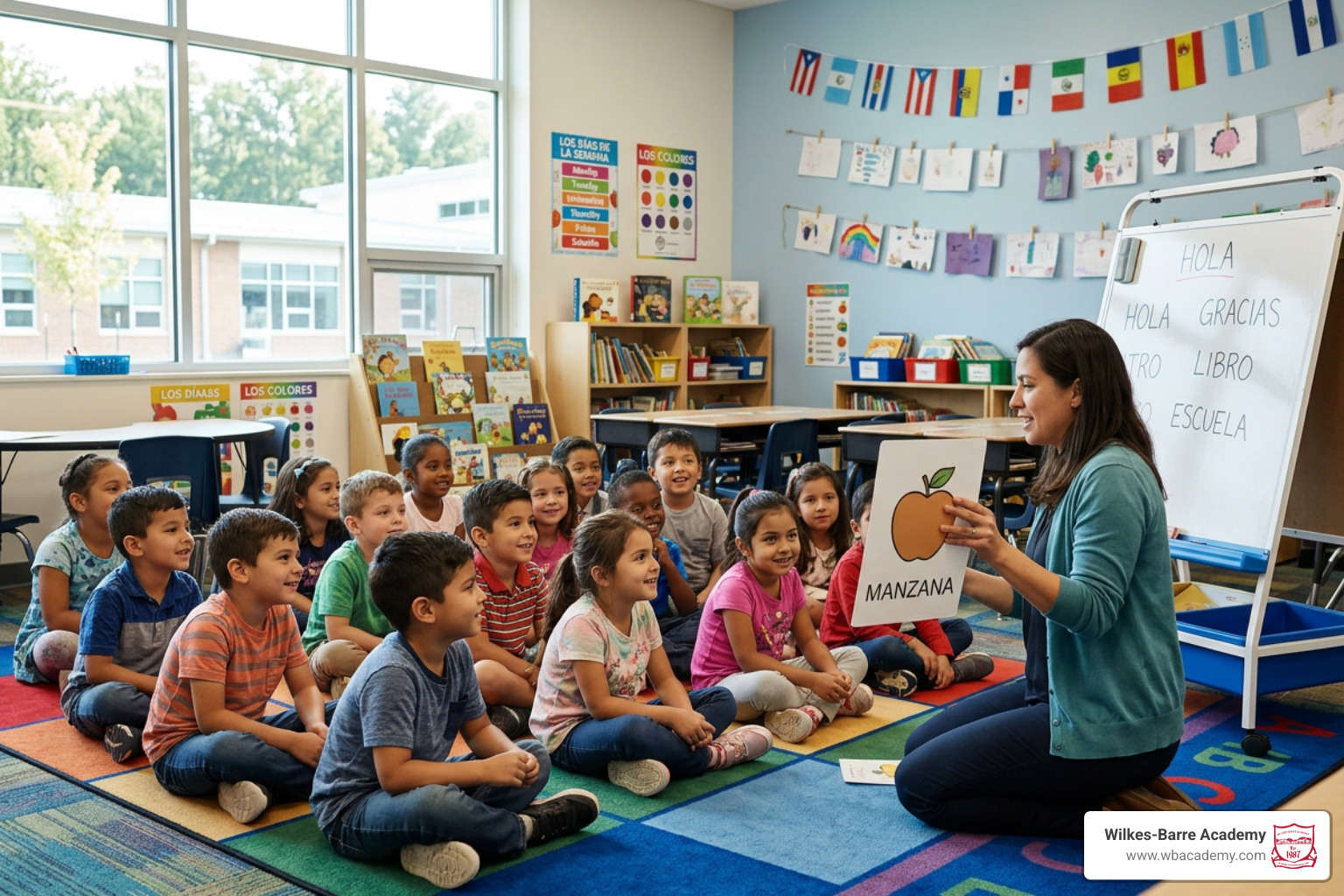
However, the most consistent way to build fluency is through daily, structured peer interaction. At Wilkes-Barre Academy, we provide an academically advanced Academics curriculum that integrates Spanish directly into our students’ weekly routines. Because we operate as a single-location, non-profit K-8 school with a single classroom per grade, we can offer highly individualized learning.
Our close-knit, diverse community allows us to foster strong family-school connections. We believe that technology should support this growth, which is why our Academics/Technology integration helps students document their language journeys. To learn more about our school’s mission and culture, explore our About page.
Curriculum Standards for a Spanish Class Elementary School Pennsylvania
To ensure that language acquisition is both fun and effective, a high-quality program must follow a clear, grade-by-grade developmental progression. We design our lessons to match the cognitive milestones of each age group, moving from basic vocabulary to complex, real-world conversational skills.
While public frameworks like the DENVILLE TOWNSHIP SCHOOL DISTRICT Spanish K-5 Curriculum Guide offer great benchmarks for public school rotations, and schools like Tenniswood Spanish – Tenniswood Academics – Tenniswood Elementary demonstrate the value of structured elementary language blocks, our curriculum focuses on deeper, continuous integration:
- Kindergarten: The primary focus is oral and listening skills. Children learn basic greetings, colors, shapes, family members, and numbers 0-10 through play, repetitive songs, and sensory activities.
- First Grade: Students explore the alphabet, letter sounds, basic food items, body parts, and numbers up to 100. We begin introducing simple written words to bridge the gap between spoken and written Spanish.
- Second Grade: We introduce practical cross-curricular concepts. Students practice basic addition and subtraction in Spanish, learn to tell time on the hour and half hour, and study calendar and weather vocabulary.
- Third Grade: Children expand their numerical vocabulary up to 1,000,000 and begin basic multiplication and division in Spanish. They also explore cultural holidays, comparing traditions like Day of the Dead and Three Kings Day.
- Fourth Grade: Lessons shift toward regional studies. Students learn about market food vocabulary and explore the historical and cultural Spanish influences on the Southwest United States.
- Fifth Grade: By the end of elementary school, students apply their skills to real-world scenarios. They learn about community careers, transportation, restaurant dining etiquette (including ordering food in Spanish), and study the geography and currencies of Spanish-speaking countries.
Extracurricular and After-School Spanish Class Elementary School Pennsylvania Options
For families looking to extend their child’s language exposure beyond the standard school day, extracurricular clubs and seasonal programs are fantastic options. Participating in a Spanish Club or language-themed enrichment group allows kids to socialize and practice their conversational skills in a relaxed, low-stakes environment.
Many successful programs in Pennsylvania structure these activities as voluntary after-school clubs. For example, some regional programs like those detailed on Spanish Enrichment Programs for Elementary & Middle School and Spanish Classes for Kids – Spanish for Kids, Baby and Me Preschool Spanish, Elementary School Spanish Clubs, Summer Camp, Preschool Enrichment, Spanish Exploradores utilize highly interactive games, crafts, and music to keep children engaged after the school bell rings.
At Wilkes-Barre Academy, we highly value these supplemental experiences. We encourage our families to explore our diverse range of Extracurricular Activities to see how we keep our students active, creative, and culturally engaged.
Frequently Asked Questions about Elementary Spanish in PA
What age is best to start a Spanish class elementary school pennsylvania program?
The earlier, the better! Research shows that the window for effortless, accent-free language acquisition begins to decline around age seven or eight. Starting in early childhood—such as in preschool or kindergarten—allows children to naturally absorb the unique phonetic sounds of Spanish.
Many successful dual-language programs, such as the one described by Kindergarten – DLI – St. Cletus School , show that even young kindergarteners can learn to read and decode in Spanish within a matter of months. At Wilkes-Barre Academy, we introduce Spanish early in our curriculum to take full advantage of this developmental sweet spot. You can read more about our specific classes on our Spanish Class page.
How can parents support Spanish learning at home?
You do not need to speak fluent Spanish to help your child succeed! The best way to support their learning is to make it a fun, shared household experience:
- Use Bilingual Materials: Read bilingual picture books together or point out Spanish labels on household objects.
- Incorporate Music and Media: Play Spanish children’s songs in the car or watch familiar animated shows with Spanish audio tracks enabled.
- Practice Daily Routines: Encourage your child to teach you the Spanish words for everyday items, colors, or numbers during dinner or playtime.
- Celebrate Culture: Explore Spanish-speaking traditions, try cooking authentic recipes together, and celebrate cultural holidays at home.
Are there Spanish summer camps available in Pennsylvania?
Yes! Intensive seasonal programs and summer camps are excellent for preventing “summer learning loss” and giving kids an immersive language boost. These camps often combine language lessons with active summer fun, such as outdoor games, water play, theatrical skits, and hands-on cultural crafts.
If you are interested in enrolling your child in our school community and taking advantage of our year-round academic and extracurricular offerings, we invite you to review our Enrollment process.
Conclusion
Providing your child with early exposure to Spanish is one of the most impactful decisions you can make for their cognitive, academic, and social development. In a warm, collaborative, and interactive environment, learning a second language becomes an exciting adventure rather than a chore.
At Wilkes-Barre Academy, located in the heart of Luzerne County, we are proud to offer an academically advanced, single-classroom-per-grade environment where every child receives the individualized attention they need to thrive. Our close-knit, diverse community is dedicated to helping students build global awareness, academic confidence, and a lifelong love of learning.
We encourage you to explore our vibrant Student Activities page and find out how our program can benefit your family. If you are ready to take the next step, visit our Admissions page to learn more about joining our school family today!