Everything You Need to Know About PA Private School Extended Care
What Is an Extended Day Program at a Private School in PA?
If you’re researching an extended day program private school PA families can rely on, here’s the quick answer:
PA private school extended day programs at a glance:
| Feature | Typical Details |
|---|---|
| Before-care hours | 7:15 AM – 8:30 AM (varies by school) |
| After-school hours | 3:00 PM – 6:00 PM |
| Ages served | Preschool (age 3) through Grade 6–8 |
| Contract options | Full-week contracts or drop-in |
| Drop-in rates | ~$20–$35/day |
| Activities | Homework help, outdoor play, arts, sports |
| Regulated by | PA Department of Human Services (DHS) |
For busy working parents, the school day ending at 3:00 PM doesn’t always line up with real life.
That gap — between dismissal and the end of a typical workday — is exactly what extended day programs are designed to fill. These programs keep children in a safe, familiar, supervised environment after (and sometimes before) regular school hours.
In Pennsylvania, many private schools go a step further. They don’t just offer a holding area. They extend the school’s own educational philosophy into the afternoon — with structured activities, homework time, outdoor play, and enrichment options that keep kids engaged.
Think of it less as babysitting, and more as a continuation of the school day.
Whether you need five-days-a-week coverage or just occasional drop-in care, PA private school extended programs are built with working families in mind.
Benefits of Private School Extended Care in Pennsylvania
For families in Wilkes-Barre and across Luzerne County, extended care can make the school week much more manageable. But the best programs do more than solve a scheduling problem. They support the whole child.
At Wilkes-Barre Academy, we see extended care as an extension of a strong school community. In a private school setting, students often benefit from smaller groups, familiar adults, and consistent expectations. That matters at 7:30 in the morning and at 5:15 in the afternoon.

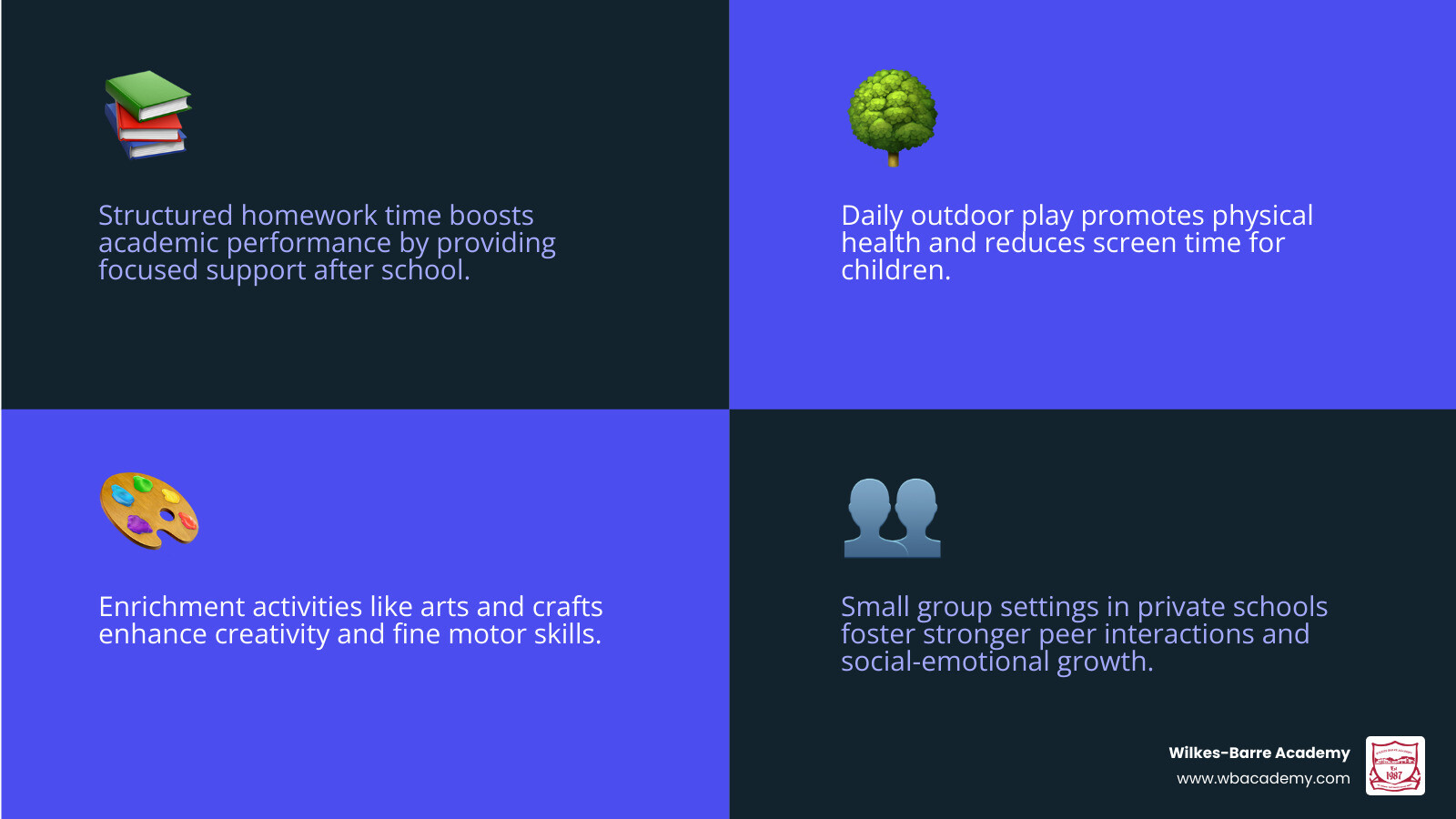
Some of the biggest benefits of private school extended care include:
Consistency in environment
- Children stay in a place they already know.
- Families deal with one school community instead of juggling multiple locations.
- Transitions are smoother, which is especially helpful for younger students.
Academic support
- Many extended day programs include homework time, reading time, or quiet study.
- That can reduce the evening homework scramble at home.
- In smaller private school settings, students may receive more individualized support.
Social-emotional growth
- Children build friendships across classes and grade levels.
- After-school time often includes cooperative games, creative projects, and relaxed social play.
- A good program helps students unwind after a structured academic day.
Safe supervision for working families
- Parents can work a full day knowing their child is supervised in a secure setting.
- This peace of mind is one of the biggest reasons families choose extended care.
Enrichment beyond the bell
- Programs commonly blend academics with fun: arts, music, movement, outdoor play, and hands-on activities.
- In other words, students are not just waiting around watching the clock. Nobody wants a 9-year-old practicing advanced boredom.
If you want to explore our approach, you can learn more about Before After School Care.
A final benefit worth noting: private schools can often align after-school care with the values families already chose during the admissions process. For us, that means close relationships, individualized learning, and a caring school culture that does not suddenly disappear at dismissal.
Logistics of an Extended Day Program Private School PA
When families compare programs, logistics matter just as much as philosophy. Hours, eligibility, staffing, supervision, billing, and emergency policies all shape whether a program actually works for your schedule.
In Pennsylvania, extended care programs may be regulated through the PA Department of Human Services depending on how they are structured. Parents who want to review state child care information can also explore the Pennsylvania Department of Human Services. Research also shows that some school-age providers in Pennsylvania operate with strong quality standards and can earn top state ratings. For parents, that is a reminder to ask practical questions:
- Who supervises the children?
- How are attendance and pickup handled?
- What happens in bad weather?
- Is the space age-appropriate?
- Are students given a balance of structure and downtime?
In the Wilkes-Barre area, families may compare private school extended care with other local arrangements. If you are specifically looking at private school care in Luzerne County, the main advantage is often continuity: your child remains in a familiar educational environment instead of switching settings mid-day.

Typical Hours and Eligibility for Extended Day Program Private School PA
Across Pennsylvania private schools, the most common pattern looks like this:
- Before-care starts between 7:15 AM and 7:45 AM
- The regular school day begins around 8:00 AM to 8:30 AM
- After-school care starts at dismissal, often around 3:00 PM to 3:30 PM
- Programs typically end between 5:30 PM and 6:00 PM
Based on the research, 7:15 AM is a common early-care start time, and 6:00 PM is a common after-care end time. Some schools offer free before-care, while after-care is more often fee-based.
Eligibility also varies by school, but common age ranges include:
- Preschool students beginning at age 3
- Lower school and elementary students
- Some programs through Grade 4, Grade 6, or Grade 8
That range matters. Not every program serves all ages, and some schools split students by developmental stage. Younger children may stay in classroom-based spaces with more rest and play, while older students may use gyms, libraries, or multi-purpose rooms with homework support and group activities.
For families with younger children, our Small Wonders Daycare page may also be helpful when comparing care options.
When evaluating eligibility, we recommend asking:
- What age or grade levels are accepted?
- Are current students given priority?
- Is care available every school day?
- Are early childhood and K-8 students grouped separately?
- Is drop-in allowed, or is advance registration required?
These details can make the difference between “this sounds nice” and “this actually works for our family.”
Activities and Enrichment in an Extended Day Program Private School PA
A strong extended day program private school PA families choose should offer a thoughtful mix of structure and breathing room.
The most common activities in Pennsylvania private school extended care programs include:
- Homework or quiet study time
- Independent reading
- Outdoor play
- Arts and crafts
- Table games and puzzles
- Music and movement
- Age-appropriate sports
- Free play and social time
Research from PA private schools shows that many programs intentionally combine active and quiet periods. That is important because children do not all need the same thing after school. Some need to run. Some need to read. Some need a snack immediately and should not be asked any hard questions until then.
A well-designed afternoon usually includes:
Transition time
- Attendance
- Snack
- A moment to decompress
Active play
- Playground time
- Gym games
- Outdoor sports when weather allows
Quiet or focused activities
- Homework
- Reading
- Art projects
- Building activities
Flexible enrichment
- Music
- Seasonal clubs
- Creative projects
- Science or themed activities
Research also suggests that some Pennsylvania programs offer seasonal enrichment and vacation-day programming, not just standard before- and after-care. That can be especially useful for school breaks and conference days.
Understanding Costs, Fees, and Registration
Cost is one of the most common questions families ask, and understandably so. Extended care pricing in Pennsylvania private schools can vary a lot depending on:
- Hours used
- Student age
- Contract length
- Whether care is part-time or full-time
- Whether you choose scheduled or drop-in attendance
- Whether fees apply for late pickup or special-day programming
Contract Rates and Drop-In Options
Based on the Pennsylvania research, private school extended care is usually priced in one of three ways:
Contract or semester plans
- Families commit to a set number of days per week or a full session.
- One school in the research charged $1,750 per session for five days per week.
- Another listed a yearly contract of $2,700 for the 2025-2026 school year.
Hourly billing
- One program charged $12 per hour, billed in 15-minute increments.
- Another used hourly drop-in billing around $20 per hour.
Daily drop-in rates
- Research examples included drop-in fees of $27 per day and $35 per day.
Here is a simple comparison based on the PA research:
| Pricing Model | Typical Range in PA Research | Notes |
|---|---|---|
| Full contract | $1,750 per session to $2,700 per year | Best for families needing regular coverage |
| Hourly care | About $12 to $20 per hour | Good for variable schedules |
| Daily drop-in | About $27 to $35 per day | Useful for occasional care |
| Before-care | Sometimes free | Not all schools charge for morning care |
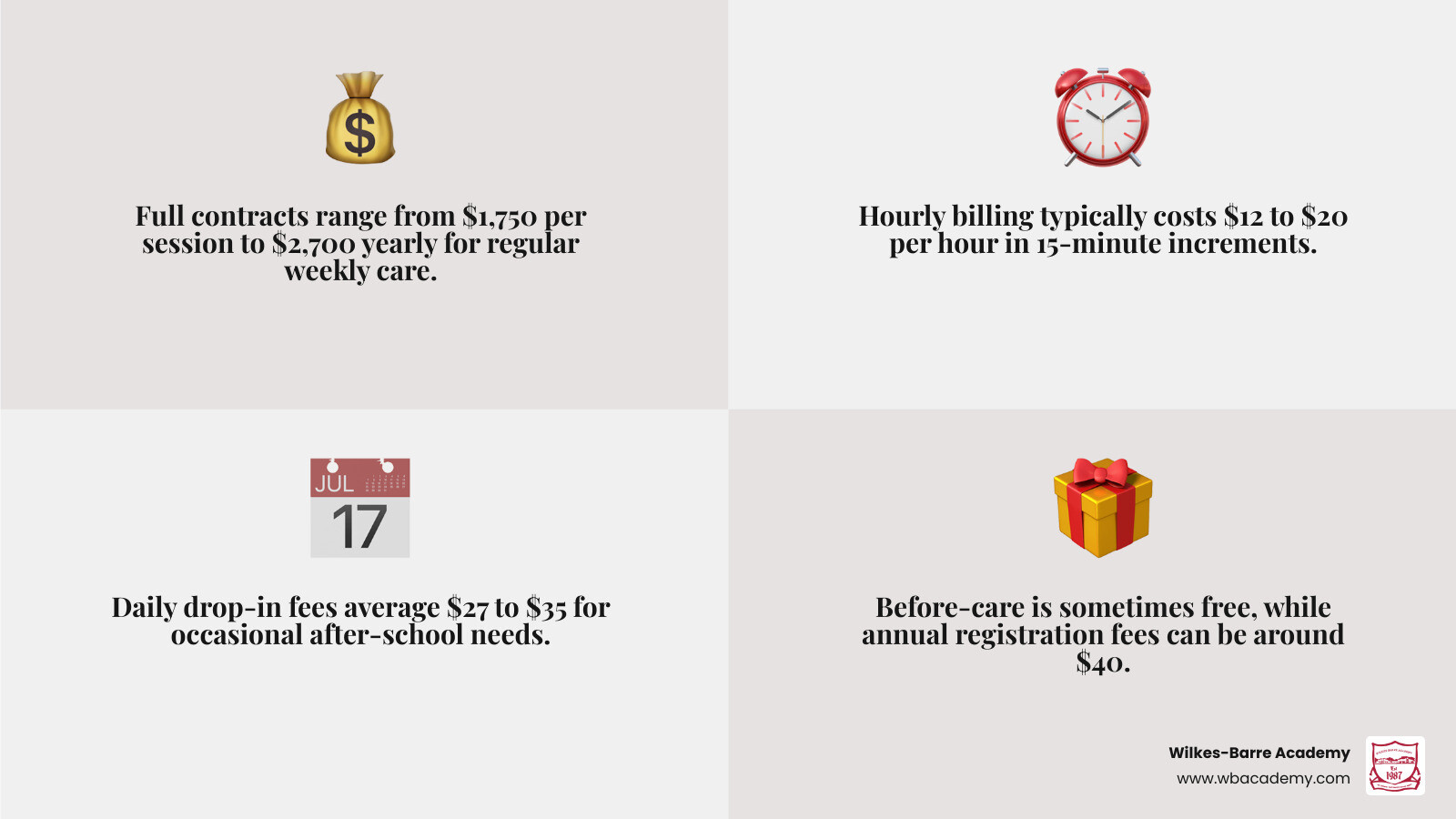
Some programs also charge annual family registration fees. In the research, one school listed a $40 annual family registration charge. Others bill monthly through school payment systems.
Registration usually involves:
- Completing a care registration form
- Selecting contracted days or estimated usage
- Providing emergency contacts
- Listing authorized pickup adults
- Reviewing late pickup and closure policies
- Pre-registering for limited-space options
Pre-registration is especially common for full-year contracts, younger age groups, or school-break camps. Some schools allow drop-in care only if arranged ahead of time.
For families comparing options in Luzerne County, we recommend looking beyond the advertised rate and asking:
- Is there a registration fee?
- Is billing monthly, semester-based, or annual?
- Is there a sibling discount?
- Is drop-in guaranteed or only if space is available?
- Are snacks included?
- Are school-break days extra?
Late Pickups and Special Circumstances
This is the section many parents skip until the day traffic turns into a parking-lot documentary.
Late pickup policies are common and usually very specific. In the research, examples included:
- $20 for every 15 minutes after closing
- $5 after 6:00 PM
- Automatic charges once a child remains past the official end time
These fees are not just about billing. They help schools cover staffing and reinforce safety procedures.
Families should also ask how programs handle:
- Early dismissal days
- Half-days
- Parent-teacher conference days
- Winter and spring breaks
- Staff development days
- Inclement weather
- Emergency closures
Pennsylvania private school research shows that many extended care programs are not offered on half-days or special early-dismissal dates. Others provide separate vacation care or break camps for an extra fee. Some provide free or reduced-cost care during parent conferences.
A few patterns from the research stand out:
- Before-care may be free, but after-care is usually fee-based.
- After-care often does not run on emergency closing days.
- Vacation camps may be separate from regular extended care registration.
- Schools often require advance sign-up for break-day care.
That is why families should always read the handbook carefully. The sentence “care available on school days” does a lot of work there.
Frequently Asked Questions about PA Extended Care
How do programs handle school breaks and holidays?
It depends on the school.
In Pennsylvania private schools, regular extended day usually follows the academic calendar. That means care is commonly available on standard full school days, but not automatically on:
- Federal holidays
- Winter break
- Spring break
- Teacher in-service days
- Some early dismissal days
Some schools offer separate vacation care, winter camps, or spring break camps. These are often:
- Open only to currently enrolled families
- Offered for an extra fee
- Limited by staffing and enrollment
- Available only with advance registration
If your family needs year-round support, ask whether the school offers:
- Vacation camps
- Conference-day care
- Care on staff development days
- Summer programs
- Flexible one-day signups
For families in our area, it can also help to compare school schedules, enrollment requirements, and care availability across local options. Even when families choose private school care, it is helpful to understand the full local landscape.
Are snacks or meals provided during extended hours?
Snacks are very common in extended care, but meals vary.
Across the Pennsylvania research, we found examples of:
- Light afternoon snacks
- Breakfast snacks in morning care
- Programs where families pack an extra snack
- Some extended day providers serving both snacks and dinner
At Wilkes-Barre Academy, families should ask about:
- Whether snacks are included
- Whether food allergies are accommodated
- Whether children may bring their own snack
- Whether care spans long enough to require a fuller meal on some days
Nutritious food support matters in after-school settings. A child who has been learning all day, moving all afternoon, and waiting for pickup at 5:45 PM is not usually at their most patient. A snack can be educational in its own way.
What happens during early dismissals or bad weather?
This is where policy matters a lot.
In the PA private school research, several programs clearly stated that after-care is not offered on:
- Early dismissal days
- Half-days
- Certain special event dates
- Some inclement weather days
Others offer separate registration for those days, while some close whenever school closes.
Parents should ask:
- If school dismisses early, does extended care still run?
- If bad weather causes a closure, is before-care canceled too?
- How are families notified?
- Are refunds or credits issued for weather closures?
- What happens if a parent is delayed due to weather?
Best practice is clear communication through:
- School apps
- Text alerts
- Email notifications
- Parent portals
- Emergency phone calls when needed
Safety and supervision are central to any quality program. Families should expect clear pickup procedures, authorized pickup lists, attendance tracking, and a plan for emergencies. In Pennsylvania, it is also wise to ask whether the program follows DHS-related guidance and what training staff receive.
Conclusion
Choosing the right extended care option is about more than filling time between dismissal and pickup. It is about finding a program that supports your child academically, socially, and emotionally while making family logistics easier.
A strong extended day program private school PA families trust should offer:
- Safe, dependable supervision
- Age-appropriate activities
- Clear hours and policies
- Transparent pricing
- Consistent communication
- A warm, familiar environment
At Wilkes-Barre Academy, we believe that every part of the school day should reflect the same values families count on from us during classroom hours: individualized learning, strong relationships, and a close-knit, diverse community in Luzerne County.
As a private, non-profit K-8 school with an academically advanced curriculum, we understand why families want care that feels connected to their child’s school experience, not separate from it.
If you are exploring extended care options for your family, we invite you to learn more and Register for Before and After School Care.