The Complete Guide to Private School Enrollment in PA
Start Your Pennsylvania Private School Enrollment Search With the Right Questions
The most common questions about enrolling in private school in PA come down to fit, paperwork, cost, and support. Start by confirming the school’s type and admissions rules, then ask about tuition aid, transportation, learning services, and the records needed for a transfer.
A simple enrollment checklist can help:
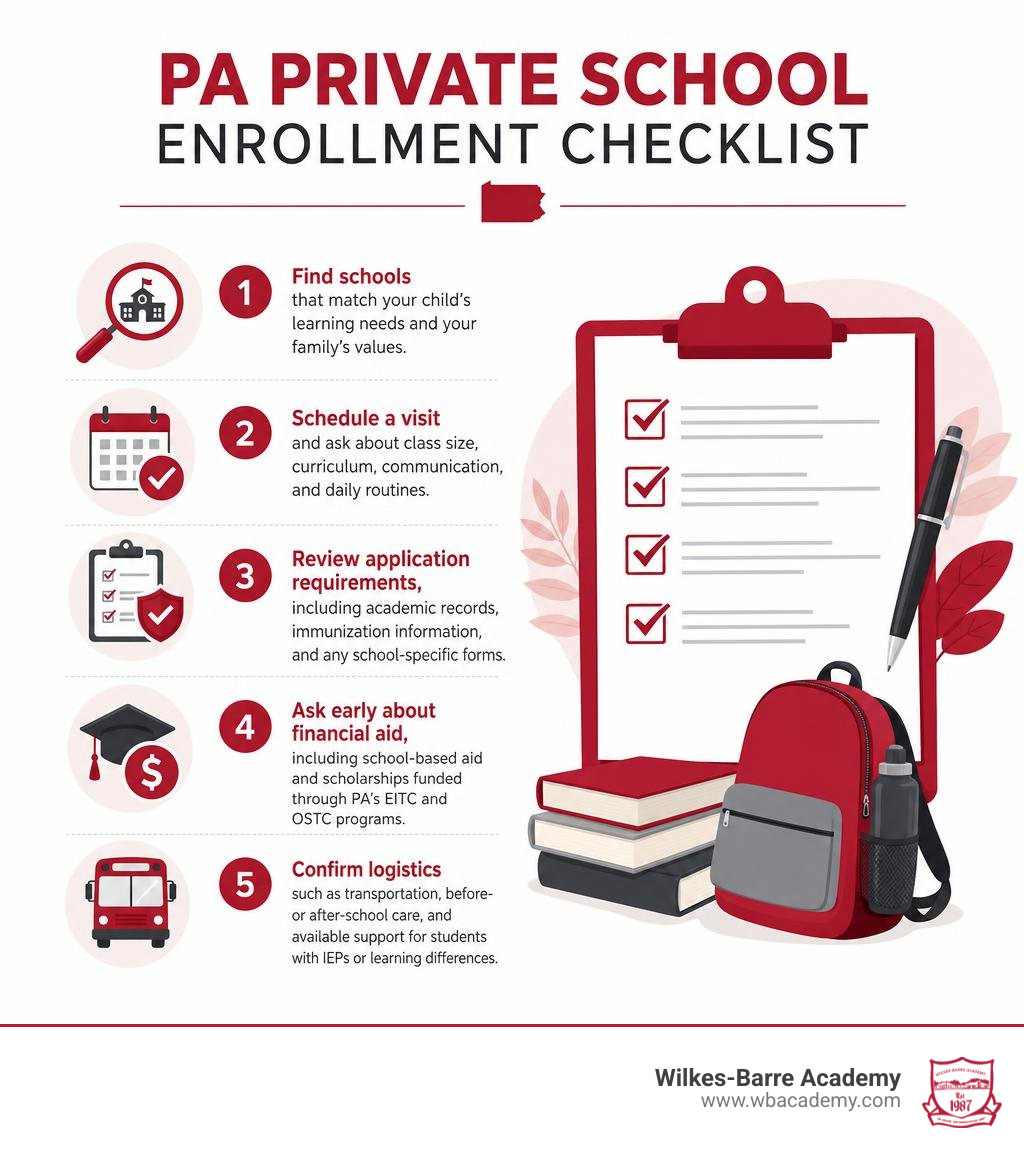
- Find schools that match your child’s learning needs and your family’s values.
- Schedule a visit and ask about class size, curriculum, communication, and daily routines.
- Review application requirements, including academic records, immunization information, and any school-specific forms.
- Ask early about financial aid, including school-based aid and scholarships funded through Pennsylvania’s EITC and OSTC programs.
- Confirm logistics such as transportation, before- or after-school care, and available support for students with IEPs or learning differences.
Pennsylvania has more than 2,000 nonpublic and private academic schools, including licensed private academic schools, religious nonpublic schools, and accredited independent schools. The rules are not identical for every school, so it pays to ask clear questions before applying or signing an enrollment contract.
For busy K-8 families, the goal is not simply to find a private school. It is to find a learning community where your child is known, challenged, and supported.
Understanding Private School Types and Regulations in Pennsylvania
Navigating school choice across the Commonwealth starts with understanding how the state regulates nonpublic education. In Pennsylvania, compulsory school attendance laws require all children between the ages of 6 and 18 to participate in an approved educational program. Families can fulfill this mandate through traditional public school districts, charter schools, licensed private academic schools, registered nonpublic religious schools, accredited independent schools, private tutoring, or home education.
The Nonpublic and Private Schools | Department of Education office oversees the licensing and registration of nonpublic institutions. Regardless of religious affiliation or governance, all private schools must comply with Pennsylvania compulsory attendance timeframes. Under state regulations, schools must provide a minimum of 180 days of instruction, or alternatively meet minimum instructional hours: 450 hours for kindergarten, 900 hours for elementary grades (1–6), and 990 hours for secondary grades (7–12).
| School Category | State Licensing Body | Governance Model | Curriculum & Standards |
|---|---|---|---|
| Licensed Private Academic School (LPAS) | State Board of Private Academic Schools | Non-profit board or private governing body | State-approved curriculum; mandatory certified faculty |
| Religious Nonpublic School | PDE Registration via Notarized Affidavit | Church, diocese, or religious board | Faith-integrated curriculum; autonomous hiring |
| Accredited Independent School | Approved Private Accrediting Association (e.g., PAIS) | Independent Board of Trustees | Self-determined advanced curriculum; peer-reviewed standards |
Licensed Private Academic Schools vs. Nonpublic Religious Schools
Understanding the legal differences between school categories helps clarify what to expect during admissions. A Licensed Private Academic School (LPAS) is legally distinct from a religious nonpublic school. LPAS institutions operate under direct licensure from the Pennsylvania State Board of Private Academic Schools, covering nursery programs through grade 12. These schools must meet specific statutory requirements concerning facility safety, administrative leadership, and approved instructional programs.
In contrast, religious nonpublic schools operate under section 1327(b) of the Public School Code. Instead of obtaining a state board license, they file an annual notarized certificate with the Pennsylvania Department of Education confirming that basic subjects are taught in English by persons of good character. Independent, non-profit institutions often operate with self-governing boards of trustees, delivering specialized academic models. Families evaluating their choices can explore all about private school options to determine which environment aligns with their educational philosophy.
State Standards, Accreditation, and Teacher Certification Rules
A common concern among parents is whether nonpublic institutions must follow Pennsylvania state academic standards and hire state-certified educators. Non-religious licensed private academic schools are required by state law to employ certified teachers or professionals who hold specialized private academic teaching certificates. In religious nonpublic schools, however, state teacher certification is not legally mandated, allowing administrators to hire based on subject expertise, institutional values, or practical experience.
Accreditation in Pennsylvania is completely voluntary. Many nonpublic schools seek independent accreditation from recognized regional organizations (such as the Pennsylvania Association of Independent Schools or Middle States Association) to validate their operational and academic standards. While private schools possess autonomy over their daily textbooks and instructional styles, reputable institutions align their core subjects—mathematics, science, English language arts, and social studies—with rigorous benchmarks to ensure students stay ahead academically.
Common Questions About Enrolling in Private School PA: Admissions and Eligibility

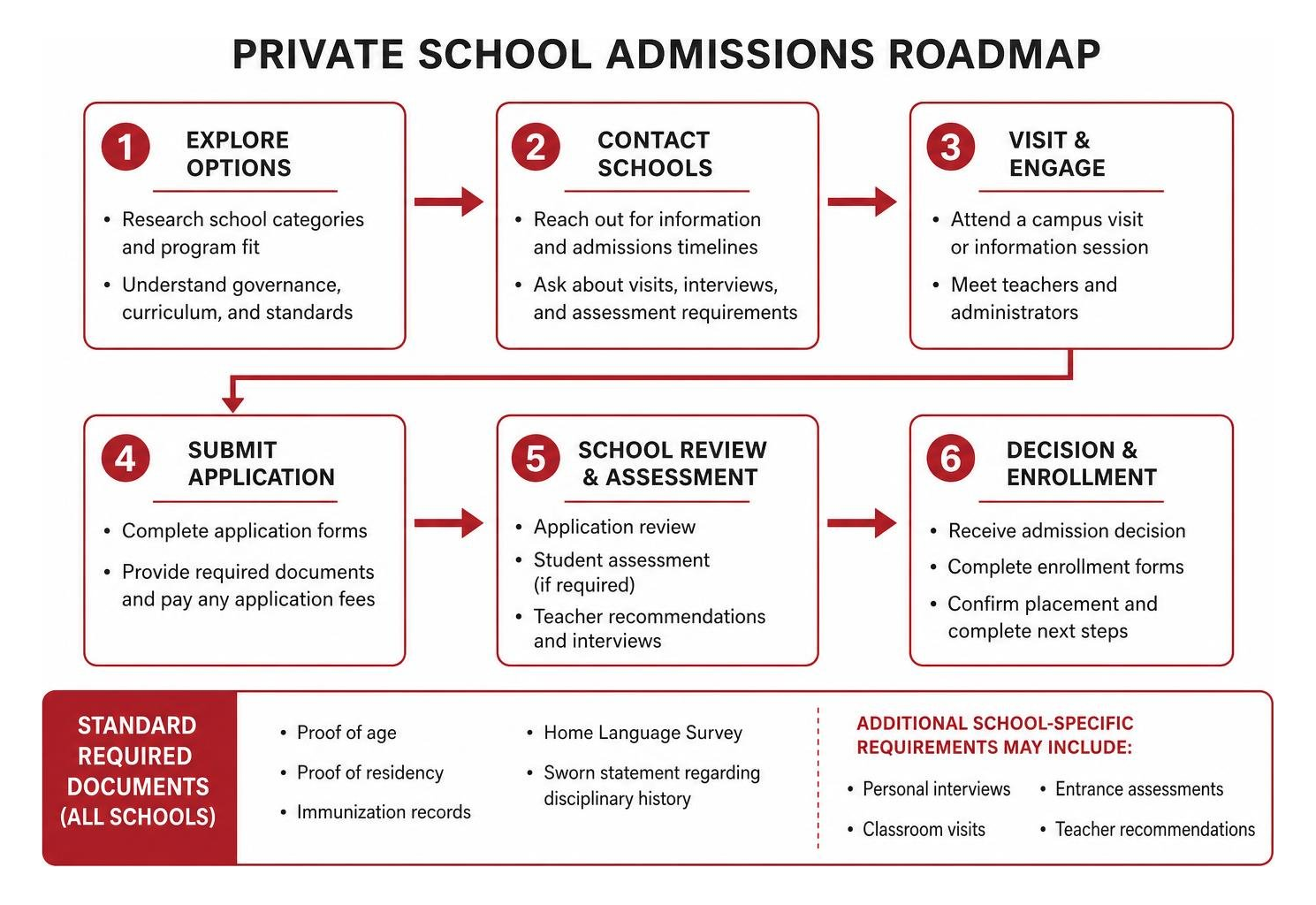
When researching common questions about enrolling in private school pa, parents frequently ask what documentation is legally required versus what individual schools request. Under the Student Enrollment FAQ | Department of Education | Commonwealth of Pennsylvania , standard public school admissions require proof of age, proof of residency, immunization records, a Home Language Survey, and a sworn statement regarding disciplinary history.
Private schools build upon these basics by setting customized admissions criteria, including personal interviews, classroom visits, entrance assessments, and teacher recommendation letters.
Essential Application Paperwork and Enrollment Requirements
Applying to a nonpublic institution requires families to stay organized. Beyond basic identification, private academies evaluate an applicant’s developmental readiness and academic foundation.
Essential paperwork typically includes:
- Proof of Age and Identification: A certified birth certificate or passport.
- Immunization Records and Health Assessments: Pennsylvania state law mandates up-to-date immunizations for school entry, alongside periodic physical and dental examinations.
- Academic Transcripts and Standardized Testing: Report cards from the past two academic years.
- Disciplinary and Attendance Records: Proof of good standing at the previous institution.
- Admissions Applications and Family Contracts: Completed application forms outlining parental commitments and tuition obligations.
To make this step stress-free, families can review our guide on no more paperwork panic for enrolling in PA private schools to ensure every document is prepared in advance.
Transferring from Public School to Private School in Pennsylvania
Switching from a traditional public school district to a private academy during the summer or mid-year is a straightforward process when handled methodically. First, apply to and receive formal acceptance from the private school. Once accepted, notify your current public school district in writing of your intent to withdraw and transfer.
Under Pennsylvania administrative practice, the receiving private school will submit a formal records request for your child’s cumulative educational file, including attendance history and health files. Parents transitioning their children mid-year should coordinate closely with teachers to align curriculum topics. You can explore practical steps in our detailed walkthrough on from public to private and navigating the PA school swap.
Financial Aid, Tuition, and State Scholarship Opportunities

Nationally, approximately 4.7 million K-12 students attend private institutions, with research showing that parents are 6% more likely to choose a private school after conducting an active school search. While Catholic elementary schools average around $4,840 nationally, independent and specialized private school tuitions vary widely based on individual classroom resources, facility amenities, and academic enrichment programs.
Common Questions About Enrolling in Private School PA: Costs and Tax Credits
Tuition covers core instruction, specialized materials, low student-teacher ratios, and facility operations. However, sticker price should not deter families. Across Pennsylvania, non-profit private schools provide need-based financial aid, sibling discounts, and structured monthly payment schedules.
When planning your household budget, investigate whether prospective schools partner with third-party financial aid assessment platforms (such as FACTS or SSS) to assess aid eligibility fairly. For a deeper breakdown of tuition dynamics, read our analysis on how can you actually afford private school in Pennsylvania.
Maximizing Tuition Assistance with EITC and OSTC Programs
Pennsylvania offers two prominent state tax-credit scholarship initiatives that provide millions of dollars in tuition relief to eligible nonpublic school families:
- Educational Improvement Tax Credit (EITC): Enables eligible businesses to receive state tax credits of 75% (or 90% for a two-year commitment) for donating to approved Scholarship Organizations. These organizations distribute need-based private school scholarships directly to qualifying families based on household income caps.
- Opportunity Scholarship Tax Credit (OSTC): Provides tuition scholarships specifically to eligible students residing within the geographic attendance boundaries of low-achieving public schools (the lowest-performing 15% of public schools in PA). Scholarships can award up to $8,500 for regular education and up to $15,000 for students with recognized special needs.
Families interested in leveraging these funds should consult our EITC Grant page to understand filing timelines and application criteria.
Student Services, Accommodations, and Daily Logistics
Beyond academics, daily logistics such as transportation, auxiliary support, and extended care programs play a major role in a smooth school experience.
Common Questions About Enrolling in Private School PA: Transportation and Support
One of the greatest legal protections for Pennsylvania families is state-mandated nonpublic school transportation. Under Pennsylvania Act 372:
- If a local public school district provides busing to its own public school students, it must provide identical, free transportation services to nonpublic school students.
- This mandate applies if the non-profit private school is located within the district’s boundaries or outside district boundaries at a distance not exceeding 10 miles by the nearest public highway.
To secure busing, parents submit an Act 372 request form to their local school district’s transportation department each spring. Discover how to arrange daily transit seamlessly through our guide: don’t miss the bus – a guide to private school busing in Pennsylvania.
Additionally, Pennsylvania nonpublic students benefit from state auxiliary programs. Through Act 89, local Intermediate Units (IUs) provide nonpublic campuses with diagnostic services, speech and language therapies, and remedial reading support. Programs under Acts 195, 90, and 35 supply state-funded textbooks, workbooks, and instructional technologies on loan.
Special Education, Services Plans, and IEP Accommodations
When a parentally-placed student with an Individualized Education Program (IEP) enrolls in a private school, federal rules under the Individuals with Disabilities Education Act (IDEA) shift. Because the child is privately enrolled, the public school district is no longer legally bound to guarantee a Free Appropriate Public Education (FAPE) on site.
Instead, students may receive equitable services via an Equitable Services Plan funded through federal IDEA funds and administered by the regional Intermediate Unit. Accommodations such as preferential seating, small group learning, and sensory strategies are integrated directly into daily instruction depending on the private school’s classroom model. For families utilizing non-traditional education pathways, the state’s Home Education and Private Tutoring Guide provides additional details regarding educational alternatives.
Frequently Asked Questions About Pennsylvania Private School Enrollment
Are private schools in PA required to administer state standardized tests?
No. Pennsylvania private and nonpublic schools are exempt from mandatory PSSA (Pennsylvania System of School Assessment) and Keystone Exam administration. While nonpublic schools may choose to participate voluntarily, most administer national standardized assessments (such as the TerraNova, Stanford Achievement Test, or ERB) to measure student progress against national cohorts rather than state-specific minimums.
How early should families begin applying to private schools in PA?
Families should begin exploring private schools in the early fall (September–November) prior to the academic year of intended enrollment. Most nonpublic schools host fall and winter open houses, conduct tours, and begin priority enrollment assessments between January and March. Applying early is essential for schools with limited seating or single-classroom-per-grade structures, as well as for meeting spring EITC scholarship deadlines. For advice on evaluating prospective campuses, consult 10 Questions to Ask a Private School Before You Enroll .
Can private schools legally withhold student academic or health records?
Under Pennsylvania Department of Education policies, private schools must release mandatory health, immunization, and medical records upon request during a student transfer. However, private schools operate under civil contract law and maintain the legal authority to withhold academic transcripts, report cards, or transfer certifications if an outstanding tuition balance or contractual fee remains unpaid.
Conclusion
Enrolling your child in a private school is an investment in their confidence, character, and lifelong academic growth. By understanding Pennsylvania’s licensing standards, securing available EITC scholarships, and confirming Act 372 busing routes, you can complete the admissions journey with complete confidence.
At Wilkes-Barre Academy, our private, non-profit K-8 school in Luzerne County is committed to nurturing academic excellence and character. Operating as a dedicated single-location institution, our single-classroom-per-grade structure guarantees individualized attention from passionate teachers within a close-knit, diverse community.
Ready to discover the ideal learning environment for your child? Explore our admissions process and view our frequently asked questions to start your enrollment journey with us today!