Fun and Effective Fitness Programs for Every Elementary Student
Why a Student Fitness Program in Elementary School Matters More Than Ever
A strong student fitness program in elementary school is one of the most powerful investments a school can make — for health, focus, and long-term success. Yet millions of children still fall short of the basic activity they need every day.
Here’s a quick overview of what you need to know:
| Key Fact | Detail |
|---|---|
| Daily activity needed | At least 60 minutes of moderate-to-vigorous physical activity |
| Childhood obesity rate | 22.4% of U.S. children (2020 data) |
| Diabetes risk | 1 in 3 males, 2 in 5 females born in 2000 face lifetime diabetes risk |
| Activity gap | Youth with disabilities are 4.5x less active than peers |
| Academic link | Physical activity improves concentration and problem-solving |
The numbers are hard to ignore. Childhood obesity has climbed steadily for decades. Type 2 diabetes — once almost unheard of in children — has increased more than tenfold among adolescents in the past twenty years.
But here’s what’s encouraging: schools don’t need a massive budget or a state-of-the-art gym to make a real difference. Programs like CHAMPS, ABC for Fitness, and the Presidential Youth Fitness Program are proving that structured, fun, and inclusive physical activity — woven into the everyday school experience — can change outcomes for kids.
This guide breaks down the best elementary fitness programs available in May 2026, how they work, and how schools like Wilkes-Barre Academy approach whole-child wellness.
The Evolution of the Student Fitness Program in Elementary School
Elementary fitness programs have changed a lot over the years, and honestly, that is a good thing.
In the 1950s, concern about youth fitness grew after the Kraus-Weber minimum muscular fitness test found that 56.6% of American children failed the assessment. During the Cold War era, school fitness was often discussed in terms of national strength, military readiness, and toughness. That historical mindset helped shape the old Presidential Fitness Test and similar PE practices that emphasized ranking, competition, and comparison.
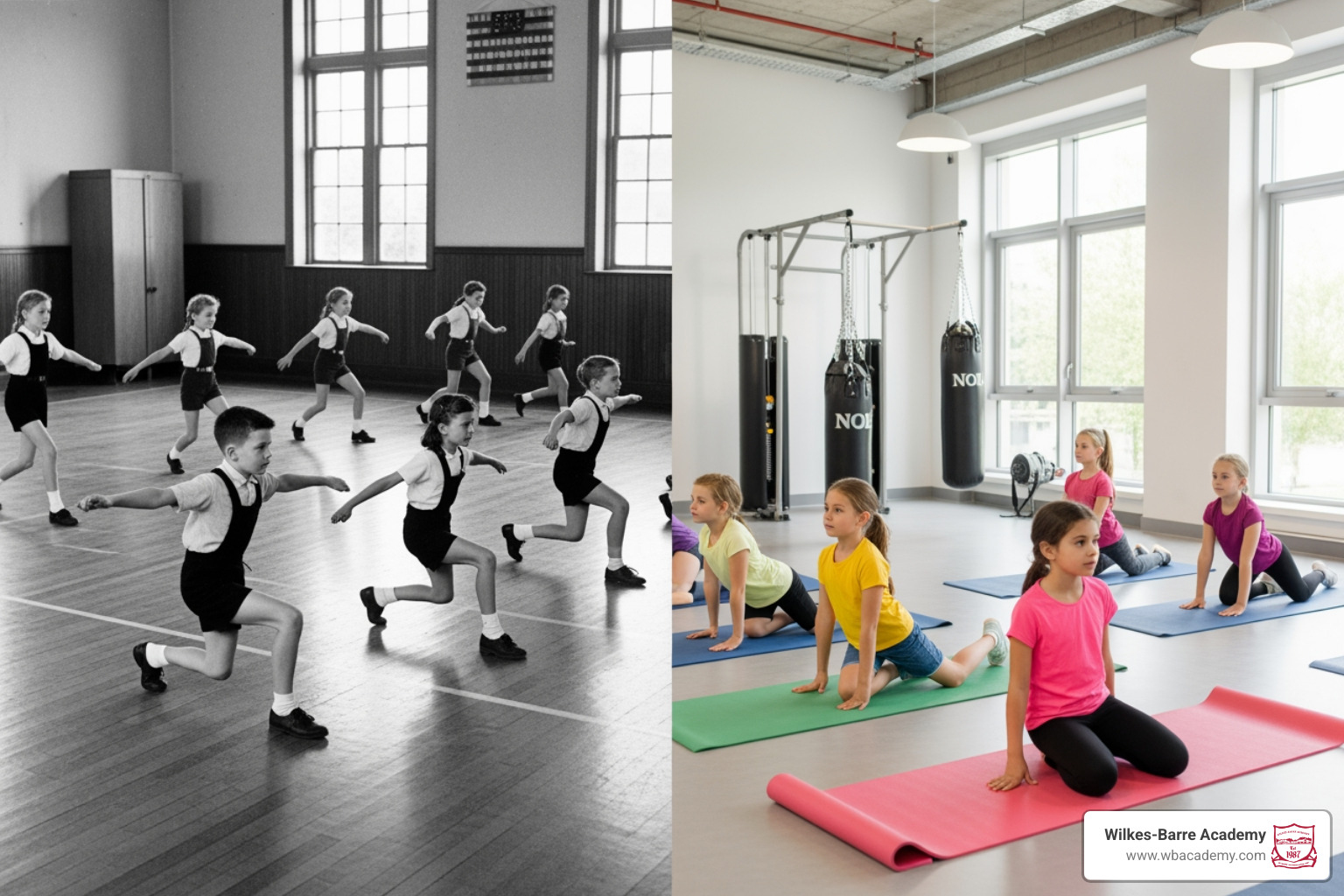
Today, most educators recognize that a child does not need to win a pull-up contest to be healthy. The modern approach is much more practical and much kinder. Instead of asking, “Who is the fittest in the class?” schools now ask, “How can every child build lifelong healthy habits?”
That shift is clear in the Presidential Youth Fitness Program, which replaced the old Presidential Fitness Test model with a health-focused framework. The program encourages:
- Health-related assessments instead of one-size-fits-all competition
- Personal goal setting instead of public comparison
- Professional development for educators
- Inclusive strategies for students with different abilities
- Recognition of progress and active lifestyles
This matters for elementary students because early experiences shape how children feel about movement for years to come. If exercise feels embarrassing, punishing, or only for athletic kids, many students will mentally check out. If it feels fun, achievable, and part of normal daily life, they are much more likely to stay active.
At Wilkes-Barre Academy, we believe that physical development should support the whole child, not just performance on a test. That is why a thoughtful wellness approach fits naturally with our focus on individualized growth and academic excellence. Families can learn more about our approach to Physical Fitness.
Leading Models for School-Based Physical Activity
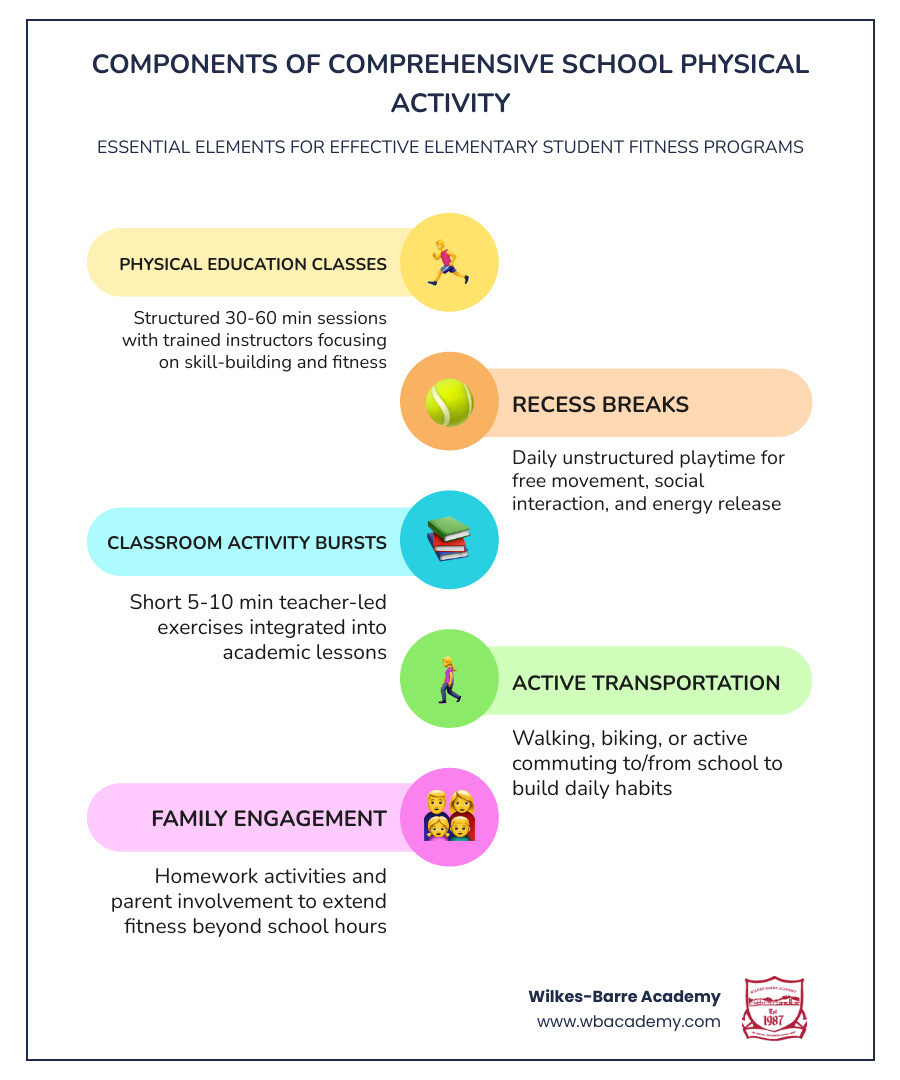
The strongest elementary fitness programs usually do not rely on one PE class alone. They spread movement throughout the day and give students multiple ways to participate.
Here are some of the most useful models schools look to in 2026.
CHAMPS
CHAMPS stands for Cooperative, Healthy, Active, Motivated, and Positive Students. It is designed to give students safe, supervised physical activity opportunities before and after school. One of its strongest features is accessibility: students do not need advanced athletic skills to join.
Key strengths of CHAMPS include:
- Structured activities supervised by school staff
- Support for students of all ability levels
- School-level flexibility in choosing activities
- Opportunities for teamwork and school connection
- Alignment with non-discrimination expectations, including Title IX
For schools, CHAMPS is a useful reminder that movement should not be limited to the official school day. Before-school walking clubs, after-school fitness games, and supervised sports sampling can all help students accumulate more activity time.
ABC for Fitness
If CHAMPS extends movement beyond class time, ABC for Fitness helps teachers build movement into the class day itself. The program uses short “activity bursts” that can be done in classrooms with little or no equipment. According to the program overview, most children can accumulate 30 minutes or more of daily classroom activity through these brief sessions.
The free ABC for Fitness Overview explains the core idea well: instead of waiting for students to get restless and then spending time redirecting them, teachers can proactively use short bursts of movement to improve energy, focus, and behavior.
Typical ABC-style bursts include:
- A quick warm-up
- A short moderate-to-vigorous activity
- A cool-down and reset
These bursts may last only a few minutes, but together they can make a major difference.
Fitness for Life and Whole-School Models
Some schools prefer a broader framework that includes PE, classrooms, recess, and family engagement. The Fitness for Life Elementary Package is one example of a total-school model. It combines lesson plans, routines, and schoolwide wellness ideas so fitness is not isolated in one room or one period.
This kind of whole-school approach often includes:
- Standards-based PE
- Classroom movement breaks
- Recess structure
- Before- and after-school activity options
- Family nights or take-home wellness ideas
- Staff support and coordinated planning
That comprehensive approach matches what public health experts recommend: physical education, recess, classroom activity, family involvement, and community support all work better together than separately.
At our school, we know that students thrive when learning and movement reinforce each other. That is one reason our broader Student Activities matter so much alongside academics.
How a Student Fitness Program in Elementary School Boosts Academic Performance
Some people still talk about movement as if it competes with learning time. Research points the other way.
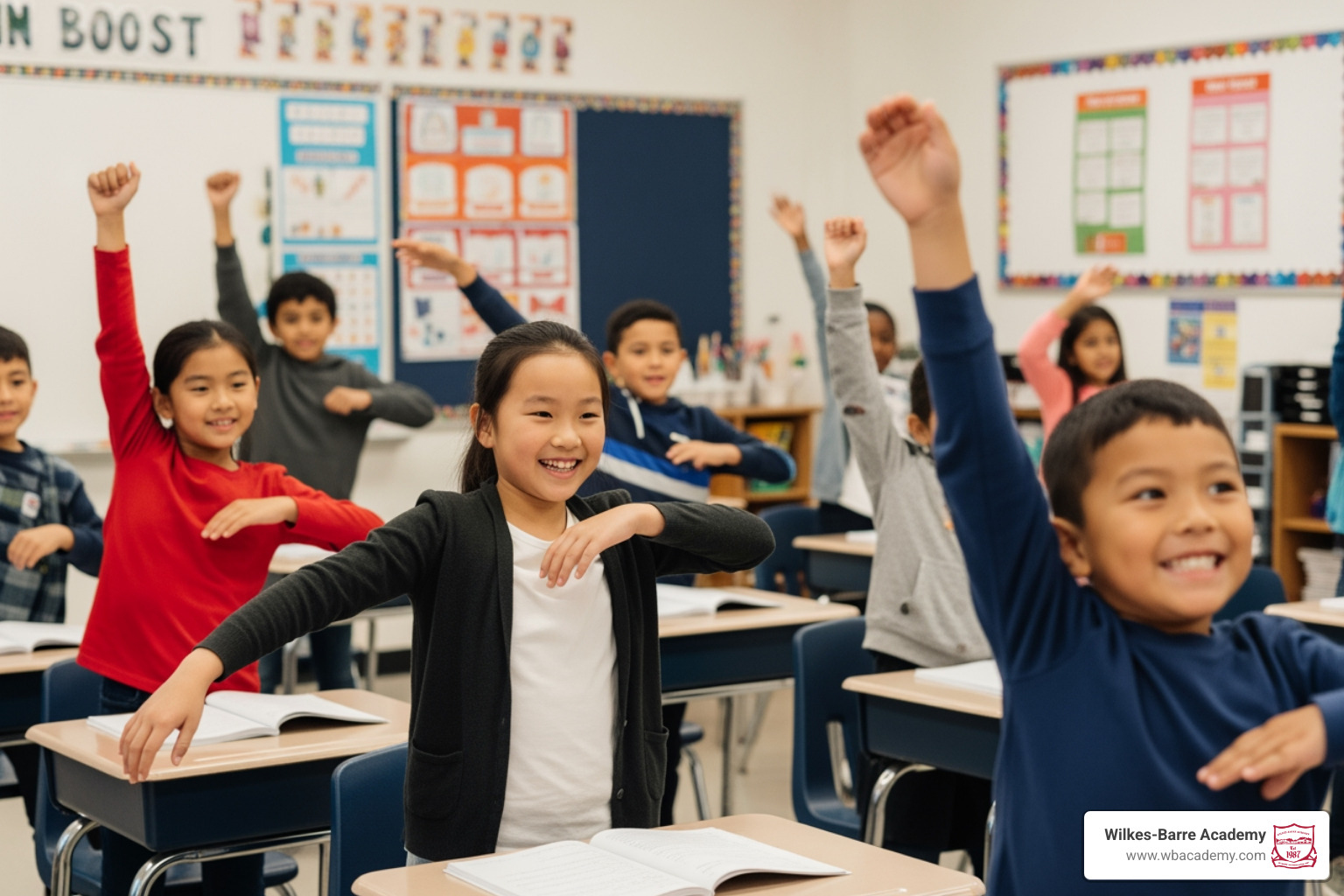
School-based physical activity is associated with better concentration, improved problem-solving, stronger classroom behavior, and more readiness to learn. Short movement breaks can help students refocus, reduce restlessness, and settle back into academic tasks with more attention.
This is especially useful in elementary grades, where sitting still for long periods is a heroic fantasy and not a realistic daily plan.
Programs such as ABC for Fitness were created partly because physical activity can support:
- Attention and on-task behavior
- Cognitive function
- Stress reduction
- Smoother transitions between lessons
- Better classroom climate
Many teachers use “brain boosts” between subjects for exactly this reason. A two- to five-minute movement session can wake students up, improve mood, and reduce the drag that often appears in the middle of long academic blocks.
Some fitness-based curricula also connect wellness directly to school success. The FitnessDAWGS Curriculum emphasizes health, movement, and age-appropriate engagement while helping schools build healthy routines early. The central idea is simple: when children feel better physically, they are better positioned to participate socially and academically.
At Wilkes-Barre Academy, we see physical wellness as part of a complete education, not an extra. Families exploring our academic philosophy can visit Academics.
Engaging Students Through Games and Technology
The best elementary fitness activities do not feel like a lecture in sneakers. They feel like play.
Games are especially effective because they reduce the pressure children sometimes feel around exercise. Instead of announcing, “Now we will all do conditioning,” teachers can build movement into familiar formats like matching games, relays, tag, scavenger hunts, or obstacle courses.
Popular game-based ideas include:
- Go Fish Fitness
- Plank Tag
- Relay races with movement cards
- Toss-and-catch activities with exercise challenges between turns
- Movement stations with visual cues
- Color or number call-out games
In “Go Fish Fitness,” for example, students try to make card matches and complete movements depending on whether they get a match or not. It sounds simple because it is simple, and that is exactly why it works. Familiar rules lower the learning curve so children spend more time moving and less time asking, “Wait, what are we doing again?”
The Move-to-Improve Guide also shows how movement can be integrated through simple actions such as jumping, squatting, lunging, climbing motions, and cross-body activities.
Technology is adding another layer of engagement. Heart rate monitors, wearable devices, and fitness apps help students see what their bodies are doing in real time. For elementary students, color-coded zones are especially useful. They turn an abstract health concept into something visual and understandable:
- Blue or low zone: easy effort
- Green zone: moderate activity
- Yellow or orange zone: more vigorous work
- Red zone: high effort
Teachers can use this data to guide pacing, help students understand target intensity, and celebrate personal progress instead of comparing children against each other. Older elementary students can also begin learning about recovery time, cardiovascular health, and how different activities affect effort level.
Here is a simple comparison:
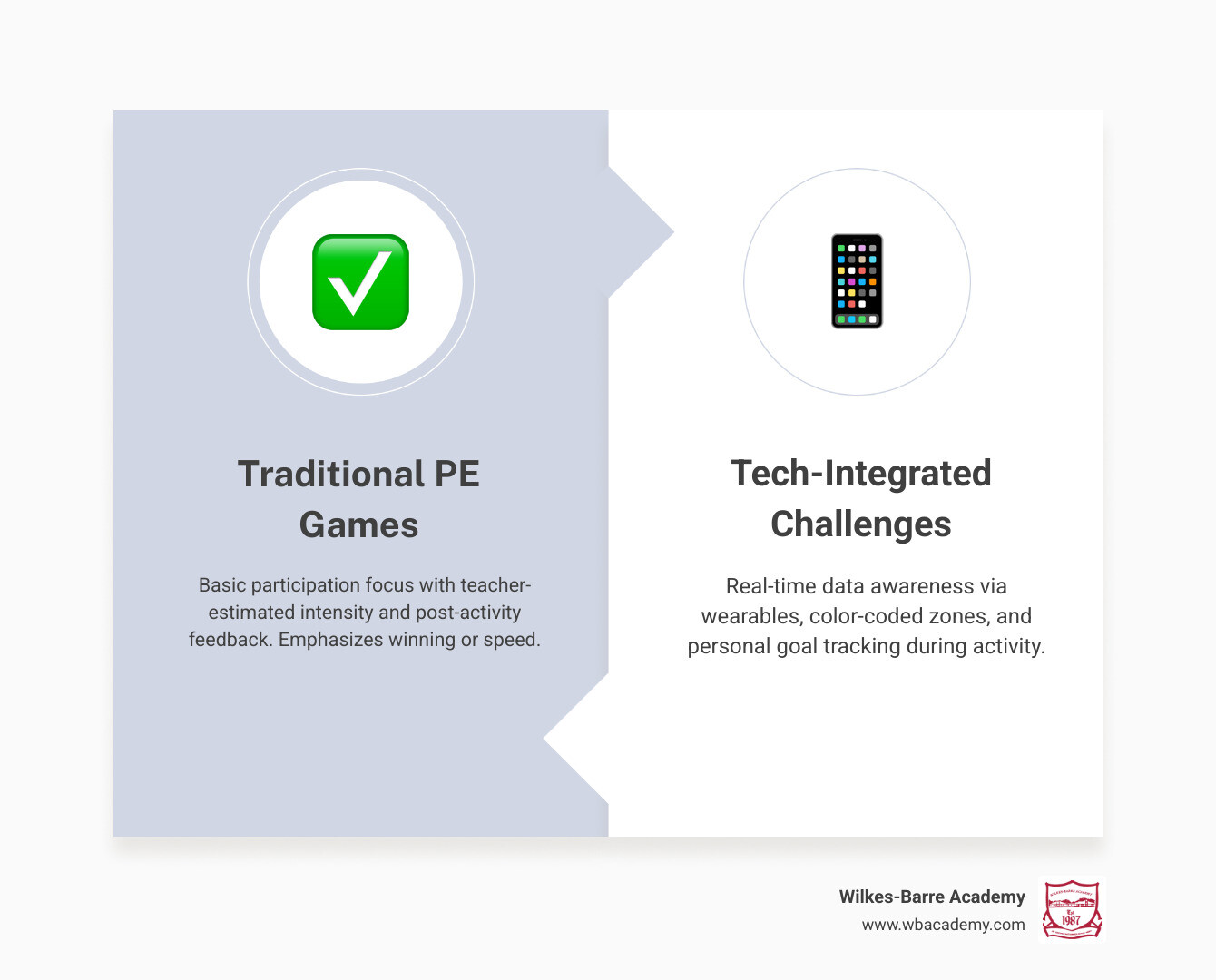
| Traditional PE Games | Tech-Integrated Fitness Challenges |
|---|---|
| Focus on basic participation | Focus on participation plus data awareness |
| Teacher estimates intensity | Students can see intensity in real time |
| Feedback often comes after the activity | Feedback happens during the activity |
| Often emphasizes winning or finishing first | Can emphasize staying in a target zone or meeting a personal goal |
| Easy to set up | Requires equipment, charging, and training |
Technology is not required for a strong fitness program, but when used well, it can modernize PE and make health concepts more concrete.
Strategies for Inclusive and Resource-Efficient Implementation
A great fitness program works for more than the naturally sporty kids.
Inclusivity starts with mindset. The goal is not to identify the future varsity captain in second grade. The goal is to help every student move, participate, and build confidence. That means programs should be designed with flexibility, multiple entry points, and non-competitive options.
Important inclusion principles include:
- Offer personal goals rather than public rankings
- Use activities with adjustable intensity
- Provide adaptive equipment or seated options when needed
- Let students demonstrate fitness in different ways
- Avoid eliminating students from games early
- Use encouraging language focused on effort and progress
This matters because youth with disabilities are reported to be 4.5 times less active than youth without disabilities. Schools can help close that gap by making movement opportunities more accessible and more welcoming.
Schools also need to pay attention to legal and ethical expectations. Title IX prohibits sex discrimination in federally funded education programs, and more broadly, strong school programs should ensure equal access, fair treatment, and inclusive participation for all students.
Resource limits are real, but they are not a reason to do nothing. Many effective activities require only:
- Painter’s tape for floor markers
- Index cards with movement prompts
- Cones
- Beanbags
- Balls
- Music
- Open wall space
- Student desks pushed into a temporary new layout
Community support can help too. Schools may work with local organizations, parent volunteers, or teacher-coaches to expand opportunities before or after school. Clear communication with families also matters, especially when schools share goals, expectations, and health forms. Families at our school can find key resources through School Year Information Paperwork.
Because Wilkes-Barre Academy is a close-knit school community, collaboration is one of our biggest strengths. Parents, teachers, and administrators can reinforce the same message: movement is part of a healthy, successful school life. If you want to learn more about who we are, visit our About page.
Implementing a Student Fitness Program in Elementary School with Limited Space
Limited space is probably the most common concern schools raise. The good news: a classroom does not need to become a mini gymnasium overnight.
The ABC for Fitness Teacher Manual offers practical ways to make activity work in ordinary classrooms. Helpful strategies include:
- Rearranging desks into horseshoe, cluster, or staggered layouts
- Having students stand behind their chairs for movement bursts
- Using hallway walking for high-knee marching or brisk movement
- Creating station corners around the room
- Using silent bursts when noise needs to stay low
- Building in warm-up, active phase, and cool-down
Examples of small-space activities:
- Marching in place
- Air writing spelling words with arm motions
- Numbered wall touches for math practice
- Desk-side squats
- Chair push-ups or seated mobility work
- Geography stretches where students make shapes with their bodies
- Slow yoga transitions for calming resets
A few practical tips make a big difference:
- Set movement rules before starting.
- Demonstrate the activity first.
- Keep sessions short at the beginning.
- Use visual cues so students can follow quickly.
- Plan a calm transition back to learning.
In other words, limited space is a planning problem, not a dead end.
Frequently Asked Questions about Elementary Fitness
How many minutes of exercise do elementary students need daily?
Elementary students should get at least 60 minutes of moderate-to-vigorous physical activity each day. That daily total should include aerobic activity, and on several days each week, activities should also support muscle and bone strength.
For younger students, that does not need to look like a formal workout. It can come from:
- PE class
- Recess
- Classroom movement breaks
- Walking clubs
- Active games
- Sports sampling
- Dance or obstacle courses
The key is regular movement across the day, not one short burst followed by hours of stillness.
Can fitness programs be integrated into regular classroom subjects?
Yes, and some of the best elementary programs are built exactly that way.
Examples include:
- Math facts with wall touches or jumping responses
- Spelling words through air writing and arm patterns
- Geography stretches that match maps or landforms
- Science lessons using heart rate tracking before and after activity
- Reading transitions with movement cues tied to story themes
This cross-curricular approach helps teachers protect academic time while still supporting student health. It also makes movement feel normal, not separate.
How do modern programs handle students with different athletic abilities?
Modern programs are moving away from public comparison and toward individual progress. That means students can work toward personal goals, participate at different intensity levels, and use modifications when needed.
Strong programs often include:
- Scaled challenges
- Choice-based stations
- Personal best tracking
- Adaptive equipment
- Seated or low-impact options
- Inclusive language and expectations
That approach supports students who are highly athletic, students who are just beginning, and students with disabilities. It also creates a healthier school culture overall.
Conclusion
The best elementary fitness programs are not about producing perfect athletes. They are about helping children build healthy bodies, confident minds, and positive habits that last well beyond elementary school.
At Wilkes-Barre Academy, we believe physical wellness belongs alongside academic challenge, strong relationships, and individualized support. In a small, connected school community, it is easier to make movement meaningful, consistent, and inclusive for every child.
Whether a school uses classroom activity bursts, game-based PE, wearable tech, or a whole-school wellness model, the biggest lesson is the same: children do better when they move.
If you would like to learn more about how we support student wellness and movement, explore More info about our physical fitness initiatives.