Apply for PA Private School Scholarships and Cut Your Education Costs
Is Financial Aid Available for Private School in PA? Overview of Aid Types
When parents wonder whether an advanced, independent education is realistic for their household budget, the answer is a resounding yes. In Pennsylvania, private school financial aid is built upon several complementary funding streams. Rather than relying on a single federal program, private K-8 schools utilize state-backed tax incentives, institutional endowments, charitable donations, and external foundation grants to make quality education accessible.
The cornerstone of Pennsylvania’s tuition assistance landscape is the state’s tax-credit infrastructure. Understanding the EITC Program in Pennsylvania and its eligibility basics is essential for any family seeking to lower their out-of-pocket costs. Through these initiatives, businesses redirect their state tax liabilities into scholarship organizations, which then distribute tuition grants directly to qualifying students.
Beyond tax credits, families can access internal tuition aid directly from non-profit schools, as well as external grants from community non-profits. The table below breaks down the primary forms of tuition assistance available across the Commonwealth:
| Aid Type | Primary Funding Source | Eligibility Focus | Typical Award Scope |
|---|---|---|---|
| EITC Scholarships | Corporate state tax credits | Household income limits adjusted by dependents | $1,000 to full tuition |
| OSTC Scholarships | Corporate state tax credits | Low-achieving school attendance zones + income | $2,000 to $8,500 |
| Need-Based School Aid | School operating budget & donations | Household net income, assets, family size | Variable partial tuition grants |
| Merit Scholarships | Endowments & academic funds | Academic performance, leadership, artistic talent | Fixed annual discount |
| External Foundations | Private non-profit organizations | Income brackets, local residency, community focus | $500 to $3,500+ |
Is Financial Aid Available for Private School in PA Through State Tax Credit Programs?
The Educational Improvement Tax Credit (EITC) and Opportunity Scholarship Tax Credit (OSTC) represent Pennsylvania’s most robust school-choice mechanisms. Both programs incentivize businesses to contribute funds to state-approved scholarship organizations rather than paying standard state business taxes.
To explore how these opportunities fit your family’s situation, reviewing your roadmap to Pennsylvania school choice and opportunity scholarships provides a clear view of how public tax policy translates into private classroom seats.
While EITC awards focus primarily on household income parameters, OSTC awards require that a child reside within the geographic attendance boundary of a designated low-achieving public school (defined as the lowest 15% of public schools based on state testing metrics). When approved, state-approved scholarship organizations issue funding credits directly to the participating private school on behalf of your enrolled child.
Need-Based Grants vs. Merit-Based Scholarships
Understanding the distinction between need-based and merit-based aid ensures you target the right applications during enrollment.
- Need-Based Tuition Assistance: These grants are calculated based on your household’s documented Expected Family Contribution (EFC). School committees evaluate your adjusted gross income, living expenses, family size, and unusual financial burdens (such as medical expenses or caring for elderly relatives). As you assess potential schools, don’t let the sticker price scare you—need-based aid is designed to bridge the gap between published tuition and what your budget can realistically sustain.
- Merit-Based Scholarships: These awards recognize student achievement rather than financial hardship. While more common in secondary grades, some elementary and middle schools offer merit grants for academic excellence, character, or community involvement.
Because many non-profit schools focus their resources on serving diverse economic backgrounds, need-based tuition assistance typically accounts for the largest share of institutional aid budgets.
State and Regional Scholarship Organizations in Pennsylvania
External, third-party scholarship organizations manage a significant portion of Pennsylvania’s private school aid distribution. These organizations operate independently of individual school admissions offices, pooling corporate contributions and dispersing them across qualifying applicants statewide. Exploring the secret to finding a non-profit private school that fits your wallet often comes down to partnering with these external groups early in the application cycle.
Major External Scholarship Programs
Several prominent non-profit scholarship organizations serve Pennsylvania families:
- AAA Scholarship Foundation: Administers substantial OSTC and EITC grants for students in grades K-12. AAA provides tiered tuition scholarships—often reaching up to $8,500 per academic year—for families residing in designated low-achieving school boundaries, with award amounts scaled based on the Federal Poverty Level.
- Children’s Scholarship Fund (CSF): CSF provides partial tuition assistance (often up to $3,350 per student) through lottery-based applications, supporting elementary-age children entering participating nonpublic schools.
- The Bravo Foundation: Partners with approved schools across the state, utilizing EITC and OSTC contributions to allocate tuition credits directly to enrolled families who meet state income guidelines.
- The Bridge Foundation & Family Choice Scholarships: Regional foundations that work alongside independent schools to fund tuition gaps for lower- and middle-income households.
For families exploring broader educational programs or secondary pathways, consulting state education portals and participating institutions helps clarify how state-approved educational frameworks interact with accredited nonpublic schooling.
How Is Financial Aid Available for Private School in PA for Middle-Income Families?
A common misconception among parents is that financial assistance is reserved solely for households near the federal poverty line. In Pennsylvania, state tax-credit income thresholds are designed with middle-class families in mind.
To understand true educational value, reviewing how much private school costs in PA alongside affordable options shows that modern income allowances comfortably include middle-income wage earners. For the 2025-2026 and 2026-2027 school years, base household income limits for EITC and OSTC exceed $108,000, with an additional allowance of over $19,000 for each dependent child in the home. A family with three children earning well over $160,000 annually can still qualify for state-supported tax-credit assistance.
Furthermore, independent non-profit schools frequently provide internal relief options:
- Multi-Child Discounts: Percentage reductions applied to tuition for second and third siblings enrolled simultaneously.
- Flexible Payment Schedules: Monthly or bi-weekly installment plans that spread tuition costs evenly across 10 or 12 months, avoiding lump-sum burdens.
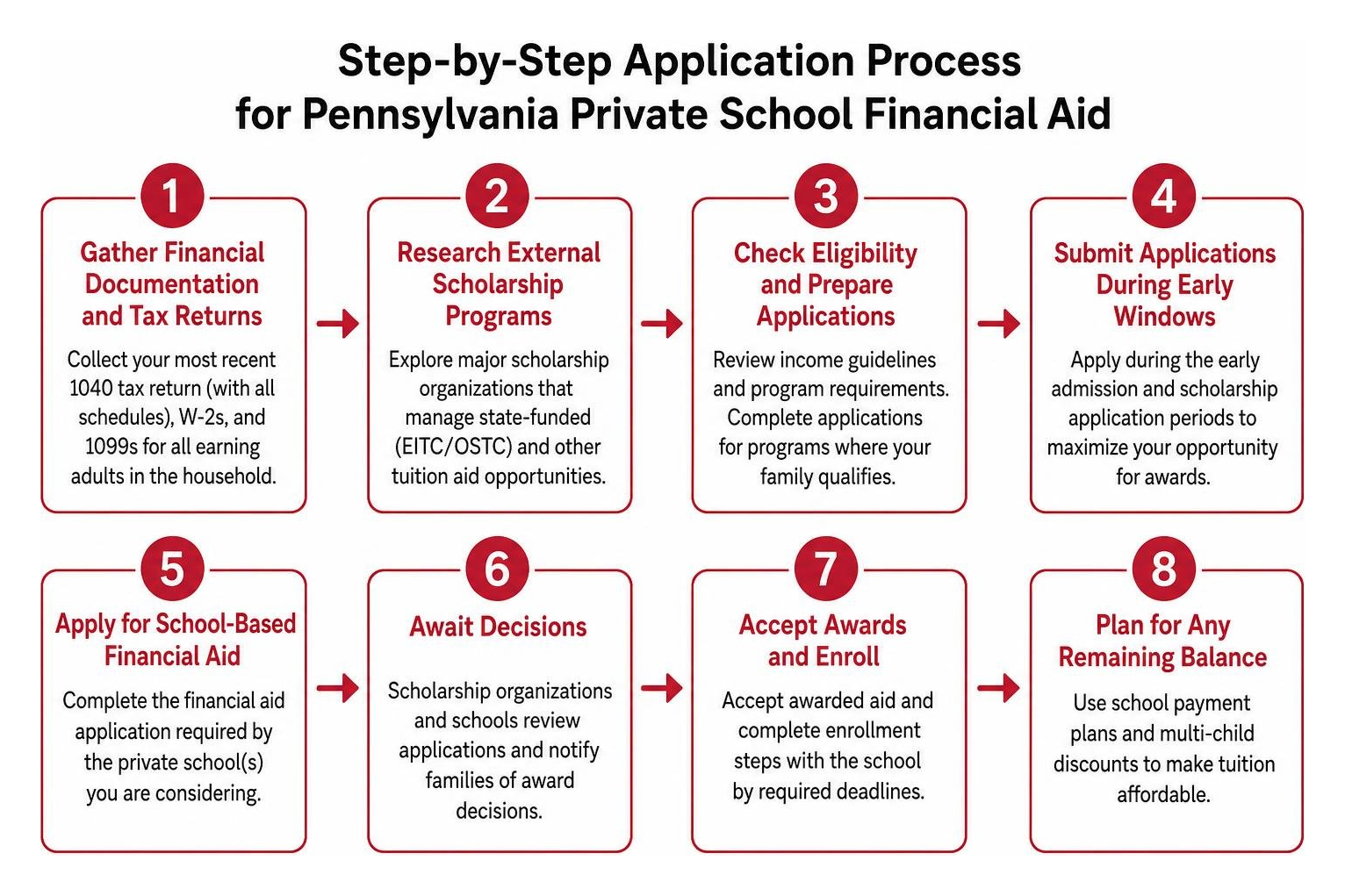
Step-by-Step Guide: How to Apply for Private School Financial Aid in PA
Securing tuition support is a systematic process. By planning ahead and submitting paperwork during early admission windows, you maximize your family’s opportunity to receive both school-based and external grants.
Step 1: Gather Financial Documentation and Tax Returns
Every scholarship and institutional aid application requires verified income documentation. Assemble a dedicated file containing:
- Federal Form 1040 tax returns from the most recent tax year (including all schedules).
- W-2 wage statements and 1099 miscellaneous income forms for all earning adults in the household.
- Non-taxable income verification (Social Security benefits, child support, or public assistance statements).
- Signed IRS verification forms, such as Form 4506-C, if required by the school’s third-party assessment platform.
Step 2: Submit Third-Party Assessment Applications
Most private non-profit schools utilize third-party financial assessment platforms—such as Clarity, FAST (Financial Aid for School Tuition), or PSAS (Private School Aid Service)—to evaluate household financial capacity objectively.
These platforms calculate your family’s discretionary income and generate a standardized recommendation for the school’s tuition committee. Completing these online forms typically takes 20 to 30 minutes, allowing you to link IRS tax data directly to streamline verification.
Step 3: Apply for State Tax-Credit Programs and External Grants
Once you have submitted your core financial profile, proceed to external scholarship organization portals. Many schools streamline this step by managing designated tax-credit funds directly through their business offices. Reviewing our school year paperwork and voucher program information ensures you meet all internal and external submission milestones.
When applying for programs like AAA or external foundations:
- Complete the organization’s online application before their published spring deadline.
- Submit your School Commitment Form (SCF) once your child is accepted.
- Monitor your email for award letters and installment verification schedules.
Step 4: Stacking Awards and Finalizing School Aid Packages
After aid determinations are released, your school’s financial office will combine your approved awards into a finalized enrollment contract.
Evaluating your net educational investment helps answer whether your family can comfortably afford private school in Pennsylvania. Stacking an EITC tax-credit scholarship, an internal school need-based grant, and a sibling discount often reduces published tuition rates by 30% to 70% or more, bringing advanced private schooling well within reach.
Understanding FAFSA and Legal Requirements for PA K-12 Schools
Parents researching financial aid often encounter references to the Free Application for Federal Student Aid (FAFSA). It is important to distinguish between post-secondary higher education rules and K-12 private school policies.
In Pennsylvania, legislative updates such as the Trial Engrossment of Amendment A00678 to Senate Bill 0310 have modernized how financial aid completion is tracked for graduating secondary students statewide. While higher education institutions and trade programs rely on FAFSA filings, K-8 private schools do not use federal Title IV FAFSA aid to fund elementary tuition.
Instead, nonpublic elementary and middle schools utilize secure private aid platforms (like Clarity or FAST) and state-approved EITC/OSTC scholarship organizations. Furthermore, Pennsylvania law includes clear privacy protections and parental opt-out mechanisms regarding state FAFSA tracking mandates, ensuring that personal household financial data remains confidential and exempt from open public records.
Frequently Asked Questions about PA Private School Financial Aid
Can multiple scholarships be combined to cover private school tuition in PA?
Yes. In Pennsylvania, “award stacking” is widely permitted. A family can combine an external EITC or OSTC tax-credit scholarship with an internal, school-funded need grant, an organizational foundation award, and a multi-child discount.
The only universal restriction is that total combined aid cannot exceed the total cost of tuition and mandatory educational fees. For details on how combined awards apply to enrollment, consult our tuition information and fee schedules.
What income qualifies a family for PA EITC and OSTC scholarships?
For the current 2026-2027 cycle, baseline household income caps for Pennsylvania EITC scholarships exceed $108,000 for a household with one child, with an allowance of more than $19,000 added for each additional dependent.
For OSTC scholarships, families must meet these same income thresholds and reside within an eligible low-achieving public school boundary. These broad parameters ensure both low-income and middle-class working families qualify for substantial tuition reduction.
Do families have to reapply for private school financial aid every year?
Yes. Because household financial situations, employment circumstances, and state tax-credit allocations change annually, families must submit a renewal application each school year.
To maintain ongoing scholarship eligibility, students must remain in good behavioral and academic standing and meet standard school attendance requirements (typically maintaining at least 90% annual attendance).
Conclusion
A child’s early educational journey shapes their confidence, curiosity, and lifelong love for learning. Investing in a structured, nurturing private school environment does not require families to compromise their financial security. Through Pennsylvania’s generous tax-credit programs, organizational foundation grants, and dedicated school-based assistance, exceptional non-profit education remains accessible to families across our region.
Wilkes-Barre Academy is a single-location private, non-profit K-8 elementary and middle school in Luzerne County. We believe in providing an academically advanced curriculum built around a single classroom per grade, ensuring individualized learning, strong family-school connections, and a close-knit community. We invite you to view our current tuition schedule and explore financial aid assistance to discover how affordable an exceptional education can be for your family.