
A Practical Guide to the Difference Between EITC and Opportunity Scholarship PA
Introduction
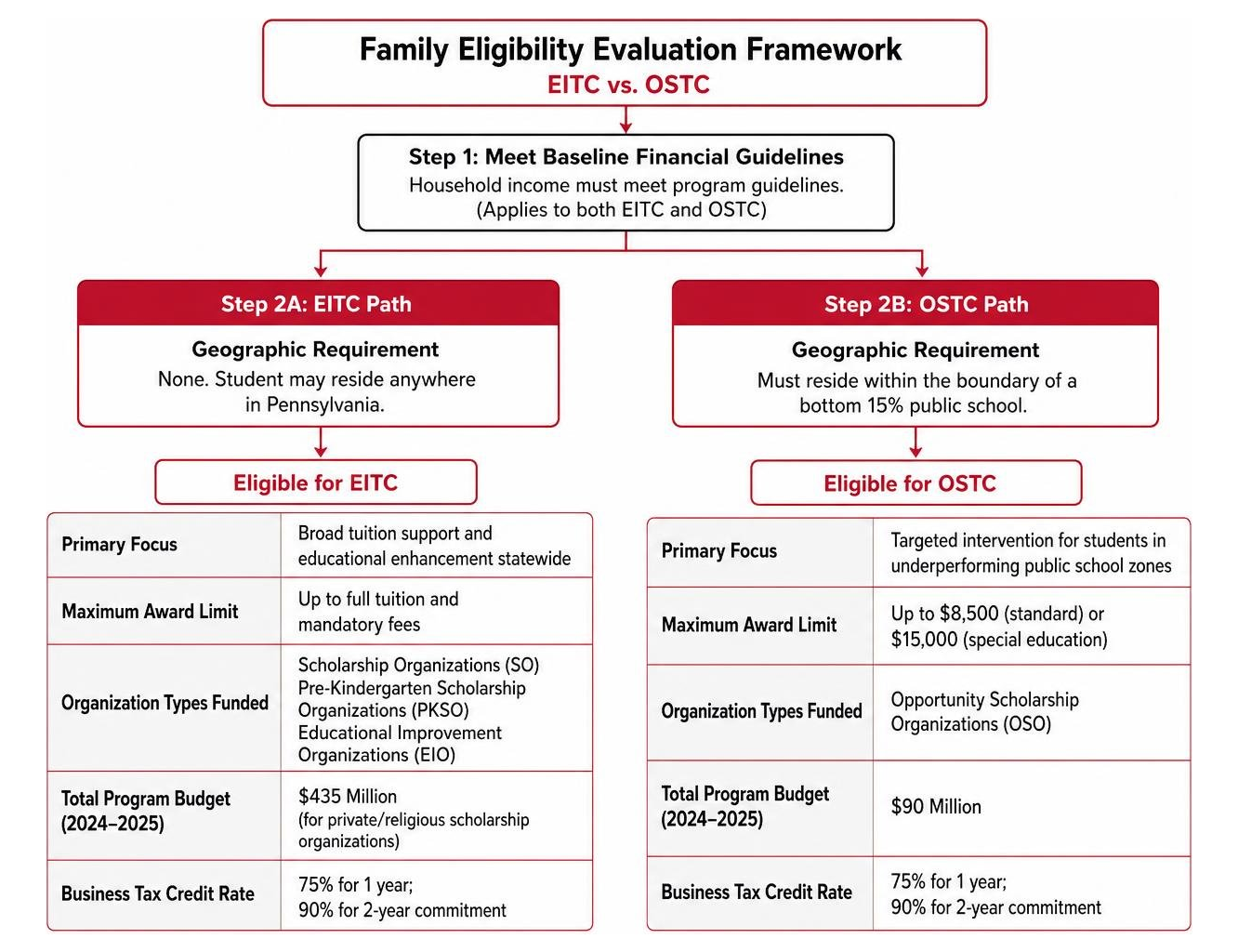
The primary difference between the Educational Improvement Tax Credit (EITC) and the Opportunity Scholarship Tax Credit (OSTC) is geographic eligibility: EITC provides income-qualified private school tuition assistance to families statewide regardless of their local school district, whereas OSTC is specifically restricted to income-eligible students residing within the attendance boundaries of Pennsylvania’s bottom 15% lowest-performing public schools.
Both initiatives allow Pennsylvania businesses and individual taxpayers to redirect state tax liabilities into meaningful K-12 tuition relief. However, they operate under distinct award structures, funding allocations, and student qualification rules. Understanding the specific mechanics behind each option helps families identify the right path forward when exploring an academically enriching private school environment.
Understanding the Core Difference Between EITC and Opportunity Scholarship PA
At its core, the primary distinction between the two initiatives lies in the targeting mechanism. Administered by the Pennsylvania Department of Community and Economic Development (DCED) in partnership with the Department of Revenue, both programs provide substantial tax incentives to businesses that support education. Yet, they serve different segments of the student population. You can explore official guidelines directly through the Educational Tax Credits | Department of Revenue | Commonwealth of Pennsylvania portal.
To understand how these programs stack up, review this side-by-side comparison:
| Feature | Educational Improvement Tax Credit (EITC) | Opportunity Scholarship Tax Credit (OSTC) |
|---|---|---|
| Primary Focus | Broad tuition support and educational enhancement statewide | Targeted intervention for students in underperforming public school zones |
| Student Geographic Requirement | None (open statewide) | Must reside within the boundary of a bottom 15% public school |
| Maximum Award Limit | Up to full tuition and mandatory fees | Up to $8,500 (standard) or $15,000 (special education) |
| Organization Types Funded | Scholarship Orgs (SO), Pre-K Orgs (PKSO), Educational Improvement Orgs (EIO) | Opportunity Scholarship Organizations (OSO) |
| Total Program Budget (2024–2025) | $435 Million (for private/religious scholarship organizations) | $90 Million |
| Business Tax Credit Rate | 75% for 1 year; 90% for 2-year commitment | 75% for 1 year; 90% for 2-year commitment |
Educational Improvement Tax Credit (EITC) Overview
Established in 2001, the EITC program is designed to expand educational opportunities for students across the entire Commonwealth. It operates as a broad-impact fund, allowing participating businesses to contribute to three distinct categories of non-profit organizations:
- Scholarship Organizations (SO): Provide tuition assistance for eligible students attending non-public elementary or secondary schools.
- Pre-Kindergarten Scholarship Organizations (PKSO): Fund tuition vouchers for young learners entering early childhood education.
- Educational Improvement Organizations (EIO): Support innovative, advanced educational curricula and public school initiatives.
For families exploring financial aid for PA private schools, EITC serves as the most widely accessible funding source. Because it does not require a student to live within a specific underperforming school district, any household meeting the baseline financial guidelines can apply through an approved scholarship organization.
Opportunity Scholarship Tax Credit (OSTC) Overview
The OSTC program was introduced to provide targeted relief for families whose assigned neighborhood schools are struggling academically. Governed by specific statutes outlined on the Opportunity Scholarship Tax Credit Program (OSTC) page, this initiative acts as an intervention tool.
Unlike the general EITC, OSTC funds can only be directed to Opportunity Scholarship Organizations (OSOs). These entities exclusively distribute tuition vouchers to students currently residing within the attendance boundaries of a low-achieving public school. The Pennsylvania Department of Education updates and publishes this list annually, ranking schools based on combined math and reading scores on the Pennsylvania System of School Assessment (PSSA) or Keystone Exams.
Student and Family Eligibility Criteria Compared

Understanding eligibility is essential for families creating a clear financial roadmap. Navigating school choice and opportunity scholarships requires evaluating two main components: school boundary residency and household income limits.
Student Eligibility and School Performance: Key Difference Between EITC and Opportunity Scholarship PA
The most critical factor distinguishing the two programs is how a student’s local school performance impacts qualification. As highlighted in the Opportunity Scholarship Tax Credit Program FAQs – PA DCED, the state defines a low-achieving school as any public elementary or secondary school ranking in the bottom 15% statewide based on standardized test scores.
- For EITC: Academic performance of the local public school district is irrelevant. A student living in an exceptionally high-performing school district has the exact same eligibility status as a student living in an underfunded district, provided household income criteria are met.
- For OSTC: School boundary residency is mandatory. The student must reside within the geographic attendance zone of a designated bottom-15% school. The student does not necessarily have to be currently enrolled in that public school; an existing private school student whose home address falls inside the qualifying public boundary can also qualify.
Household Income Guidelines and Limits for 2026
Both programs use household income ceilings to ensure funds reach families who need tuition relief. While historically the programs had slightly varying baselines, current Pennsylvania guidelines establish generous thresholds:
- EITC Income Limits: The baseline household income threshold is set at $122,322, with an additional allowance of $21,531 for each dependent child or qualifying individual residing in the home.
- OSTC Income Limits: The statutory baseline threshold is $116,055, with an additional allowance of $20,428 per dependent.
To illustrate how these calculations work for families:
- Family of 3 (1 dependent child):
- EITC Limit: $122,322 + $21,531 = $143,853
- OSTC Limit: $116,055 + $20,428 = $136,483
- Family of 4 (2 dependent children):
- EITC Limit: $122,322 + (2 × $21,531) = $165,384
- OSTC Limit: $116,055 + (2 × $20,428) = $156,911
- Family of 5 (3 dependent children):
- EITC Limit: $122,322 + (3 × $21,531) = $186,915
- OSTC Limit: $116,055 + (3 × $20,428) = $177,339
Because these income ceilings reflect roughly 500% of the federal poverty level, a broad demographic of working-class and middle-income families qualify for tuition support.
Award Amounts, Stacking Rules, and Program Structures

When considering investing in education and non-profit private schools, parents must evaluate how award structures impact actual out-of-pocket expenses.
Award Maximums and Funding Mechanics: Structural Difference Between EITC and Opportunity Scholarship PA
The two programs calculate award maximums differently:
- EITC Award Structure: EITC statutes allow scholarship organizations to award funds up to the full cost of tuition and mandatory school fees. There is no rigid statutory dollar ceiling per child, though individual scholarship organizations manage their total allocation pools to assist as many qualifying students as possible.
- OSTC Award Structure: OSTC awards are subject to strict statutory caps. For the current school year, the maximum award for a standard education student is $8,500. For a student receiving eligible special education services, the statutory cap increases to $15,000.
Statewide funding allocations reflect these structural scopes. For the 2024–2025 legislative budget cycle, Pennsylvania authorized $525 million in total tax credits across both programs, allocating $435 million to EITC scholarship organizations and $90 million to OSTC organizations.
How Families Can Stack EITC and OSTC Scholarships
One of the most valuable aspects of Pennsylvania’s tax credit architecture is the ability to combine awards. If a family meets the income criteria and resides within an OSTC-qualified school zone, they can receive awards from both an EITC fund and an OSTC fund simultaneously.
Following our non-profit private school affordability guide, here is how scholarship stacking works in practice:
- A student attends a private K-8 school with an annual tuition of $9,500.
- The family qualifies for an OSTC award capped at $8,500 based on their residential boundary.
- The remaining $1,000 tuition balance can be covered by a supplemental EITC grant.
- Rule of Stacking: The total combined scholarship funding cannot exceed the school’s actual published tuition and mandatory fees.
Business Contributions, Tax Credits, and Application Timelines
Pennsylvania’s educational tax credits represent a powerful win-win for the business community. Rather than sending tax payments into general state coffers, companies can redirect those dollars directly into student scholarships.
The tax credit mechanisms are consistent across both programs:
- One-Year Commitment: A business contributing to an approved scholarship organization receives a tax credit equal to 75% of its total donation.
- Two-Year Commitment: A business pledging to contribute the same amount for two consecutive taxable years receives a tax credit equal to 90% of its annual donation.
- Annual Cap: A single business entity can claim up to $750,000 in tax credits per taxable year.
Businesses paying Corporate Net Income Tax, Bank Shares Tax, Insurance Premiums Tax, or Personal Income Tax (for pass-through entities such as S-Corporations, Partnerships, and LLCs) are eligible to participate.
Many individual business owners participate through Special Purpose Entities (SPEs). An SPE aggregates contributions from multiple individuals with a minimum Pennsylvania personal tax liability (typically around $2,500) to secure the 90% state credit, which is then passed through via a K-1 tax form.
For families reviewing our voucher program details, it is helpful to note that businesses submit their applications online via the DCED Enterprise eGrants system. The state processes applications on a first-come, first-served basis starting July 1 for initial applicants, while renewing businesses submit by May 15.
Frequently Asked Questions About EITC and OSTC in Pennsylvania
Can individual taxpayers participate in EITC and OSTC?
Yes. While individual employees cannot submit a direct corporate application to DCED, they can join a state-approved Special Purpose Entity (SPE). The SPE makes the aggregate contribution to an approved scholarship organization, and the individual receives a Pennsylvania Schedule K-1 reflecting their 90% tax credit to offset state personal income tax liability.
What reporting requirements must participating schools and organizations fulfill?
To ensure regulatory compliance, scholarship organizations must submit comprehensive annual reports to the DCED. By November of each year, organizations must report the total number of scholarships awarded, aggregate dollar values, student grade levels (K-8 vs. 9-12), recipient disability status, and the public school district of residence for every recipient. Furthermore, scholarship organizations must distribute at least 90% of all EITC receipts (and 80% to 90% of OSTC receipts) directly into student scholarships, retaining no more than 10% for administrative overhead.
When should businesses submit their Pennsylvania tax credit applications?
Because the statewide tax credit cap is reached quickly each year, businesses must observe strict submission timelines:
- May 15: Renewal applications open for businesses completing year two of a two-year commitment.
- July 1: Application window opens for new business applicants.
- Contributions must be disbursed to approved organizations within 60 days of DCED approval, and proof of payment submitted within 90 days.
Conclusion
Both the Educational Improvement Tax Credit and the Opportunity Scholarship Tax Credit play a vital role in making quality, personalized education accessible for families across the Commonwealth. While EITC offers broad tuition support regardless of zip code, OSTC provides crucial, targeted intervention for students living in lower-performing school zones.
At Wilkes-Barre Academy, our single-location campus in Luzerne County is committed to academic excellence, individualized learning, and a close-knit school community. We work closely with families to help them understand tuition support pathways, including state-supported options. To discover how these programs can support your child’s educational journey, explore our EITC Grant details and begin planning your child’s future today.