The Rich History of Private Education in Wilkes-Barre PA
A Region Shaped by Private Education: Wilkes-Barre, PA’s Academic Legacy
The private school history in Wilkes-Barre, PA stretches back over two centuries — making this corner of Luzerne County one of Pennsylvania’s most historically rich educational landscapes.
Quick answer for parents researching Wilkes-Barre’s private school legacy:
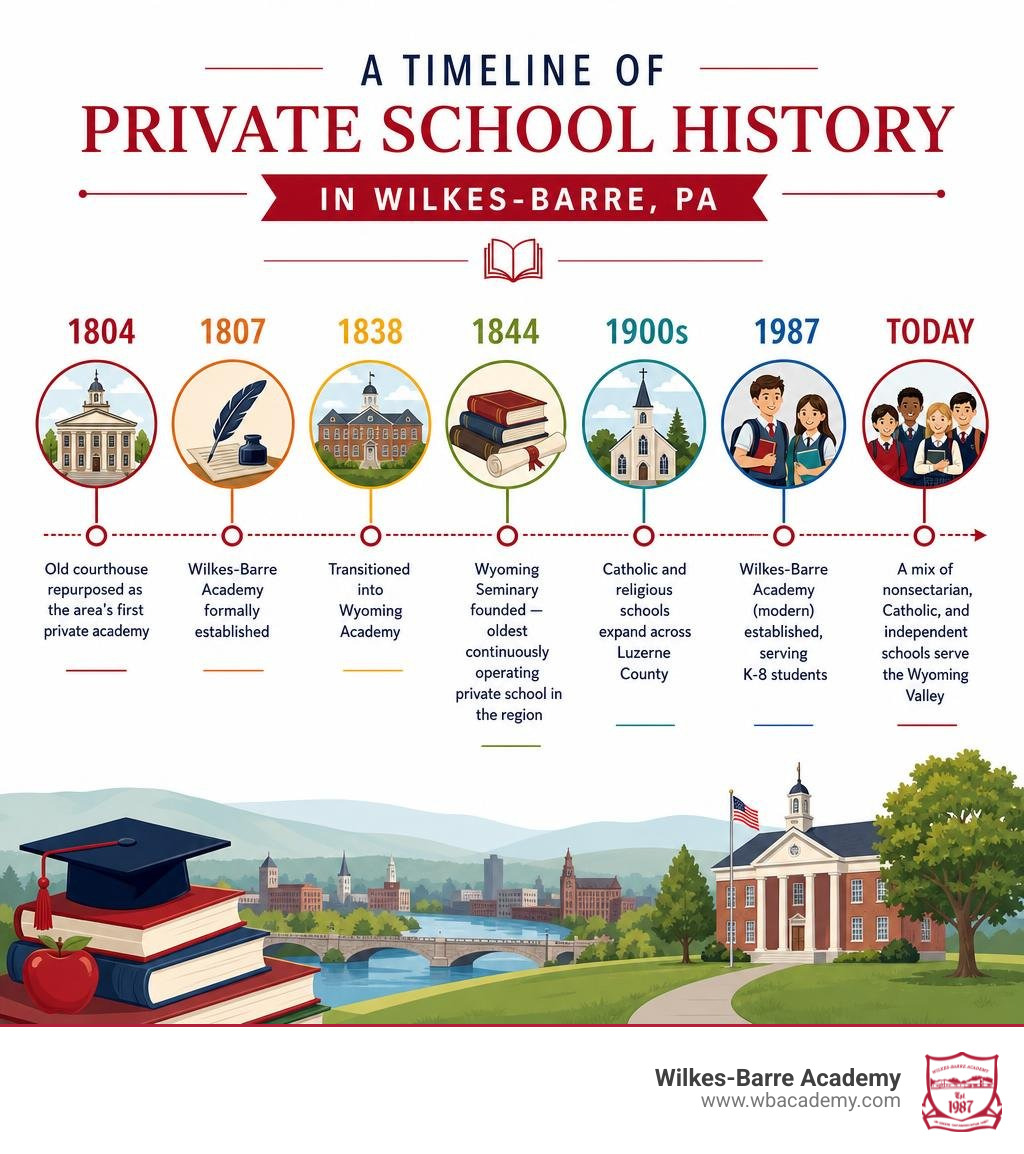
| Era | Key Development |
|---|---|
| 1804 | Old courthouse repurposed as the area’s first private academy |
| 1807 | Wilkes-Barre Academy formally established |
| 1838 | Transitioned into Wyoming Academy |
| Mid-1800s | Growth of early independent and denominational schools |
| 1900s | Catholic and religious schools expand across Luzerne County |
| 1987 | Wilkes-Barre Academy (modern) established, serving K-8 students |
| Today | A mix of nonsectarian, Catholic, and independent schools serve the Wyoming Valley |
Long before public school systems took hold, families in this region turned to private academies to give their children a serious education. Those roots run deep.
From a repurposed courthouse in the early 1800s to the college-prep traditions of early independent academies, private education here has always meant something more than textbooks. It meant community investment, high standards, and a belief that every child deserves focused attention.
That same spirit continues today — especially for parents who want more than what large public schools can offer.
Quick look at private school history wilkes-barre pa:
- small classes and big hearts at wilkes-barre academy
- certified success for pennsylvania private school students
The Legacy of Private School History Wilkes-Barre PA
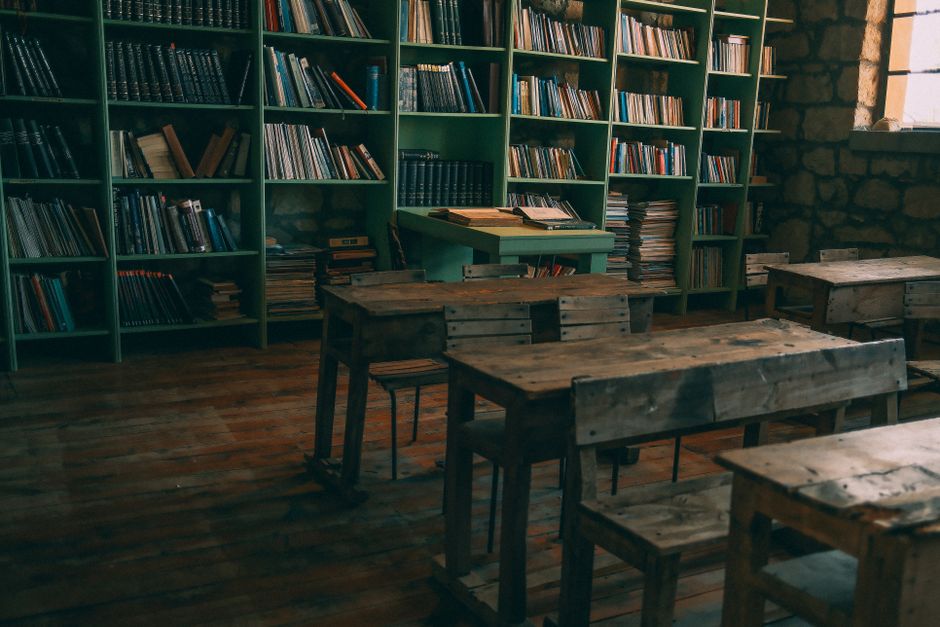
To truly understand the private school history in Wilkes-Barre, PA, we have to travel back to an era of dirt roads, coal mines, and log cabin schoolhouses. In the late 1700s and early 1800s, education in Luzerne County was a patchwork of informal neighborhood classes. If a community wanted their children to learn to read and write, they often had to hire a passing schoolmaster or pay a neighboring town to take their kids in.
As the local economy blossomed around timber, agriculture, and eventually anthracite coal, local leaders realized that a basic, haphazard education wasn’t enough. They wanted rigorous, structured institutions that could prepare young minds for leadership, commerce, and higher education. This desire sparked a golden age of independent academies.
Over the next two centuries, these schools adapted to massive cultural shifts. They navigated the transition from strictly gender-segregated institutions to coeducational campuses, survived the public school consolidations of the 1960s, and evolved to meet modern academic demands. Today, this legacy is preserved in The Complete List of Private Schools in Northeastern Pennsylvania, showcasing a diverse ecosystem of educational choices.
Early Foundations of Private School History Wilkes-Barre PA
The true cornerstone of local private education was laid in 1804. After a new courthouse was constructed in Wilkes-Barre, the old, retired courthouse building on Public Square was cleverly repurposed. Instead of tearing it down, the community transformed it into the city’s very first academy.
By 1807, this institution was formally incorporated under the style and title of the Wilkes-Barre Academy. It was a massive leap forward for the region, representing the first school in Luzerne County superior to the common log schoolhouse. Under the leadership of its first principal, Reverend Mr. Thayer, and later prominent educators like Garrick Mallery (appointed in 1809) and assistant Andrew Beaumont, the academy offered a classical curriculum. Students didn’t just study reading and arithmetic; they dove deep into Greek, Latin, higher mathematics, and English literature.
The academy was so successful that it drew students from far beyond the Wyoming Valley, including children of families associated with prominent local businesses like the Miner-Hillard Milling Company. In 1838, the school transitioned into the Wyoming Academy, continuing its tradition of excellence until a new brick building was erected in 1842. The school eventually closed its doors and the old building was demolished, but its pioneering spirit lived on. You can read more about how these early values of academic rigor still guide our mission today in Our Story.
Modern Milestones of Private School History Wilkes-Barre PA
As the 20th century progressed, the private education landscape in Luzerne County shifted dramatically. The rise of large, consolidated public school districts in the 1960s meant that neighborhood schools were disappearing. In response, families who desired a more intimate, value-centered, or specialized environment began looking to independent and nonsectarian private schools.
This period saw a rise in schools that focused on the individual child rather than standardized, large-scale instruction. Parents realized that the personalized care of the old 19th-century academies could be beautifully paired with modern, secular, and scientifically backed curricula. Today, when families explore Touring the Best Private Schools in Wilkes-Barre, they find institutions that celebrate this balance.
Modern nonsectarian schools have stepped up to fill a vital niche: providing a warm, inclusive, and academically advanced alternative to public systems. To understand why this approach continues to thrive in June 2026, check out our guide on Why a Private K-8 School in Pennsylvania Makes the Grade.
The Evolution of Independent and Nonsectarian Education in Luzerne County
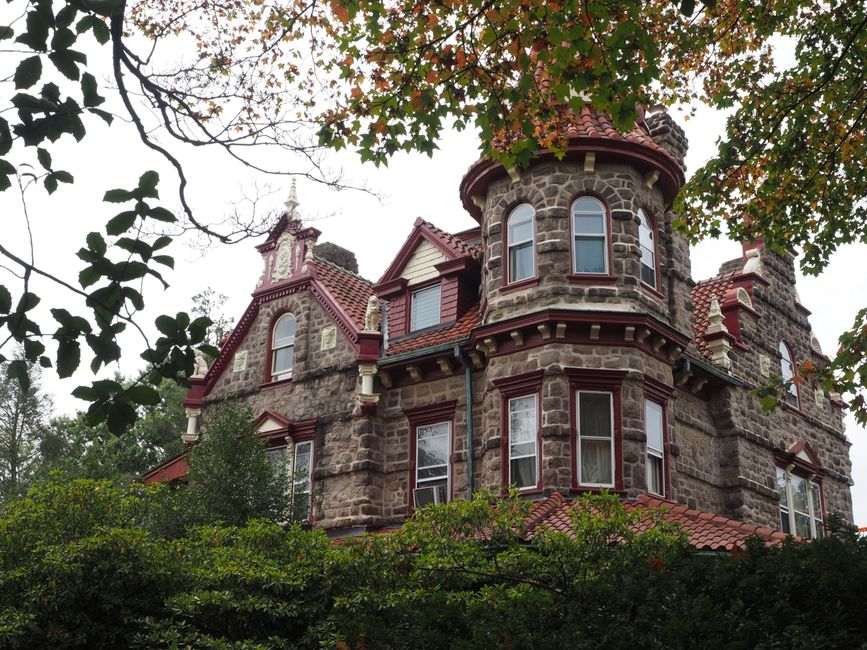
While parochial and religious schools have played a massive role in the history of Luzerne County, independent and nonsectarian schools have carved out an equally vital path. Historically, independent schools in Pennsylvania were designed to offer a level of academic freedom that public or strictly sectarian schools could not match.
By remaining independent, these schools could craft their own curricula, hire highly specialized faculty, and pivot quickly to adopt innovative teaching methods. This independence allowed schools to focus heavily on character development, public speaking, and critical thinking without being bound by rigid state-mandated testing regimes or specific religious dogmas. For families weighing their educational investments, understanding this legacy is key, as detailed in How Much is Private School in PA? Tuition Stats and Affordable Options.
Academic and Character-Building Legacies
The independent schools of the Wyoming Valley have always been synonymous with academic prestige. Historically, these institutions established a high standard of excellence that continues to influence regional education today.
Over the decades, independent education in the region has built a reputation for outstanding academic and extracurricular achievements:
- Focused Faculty and Small Classes: Historically, independent schools maintained tight student-teacher ratios, ensuring that educators could provide personalized guidance and mentorship.
- Rich, Diverse Curriculum: Rather than teaching to standardized tests, these schools offered advanced coursework, deep literary studies, and robust science programs, maintaining small average class sizes to foster discussion.
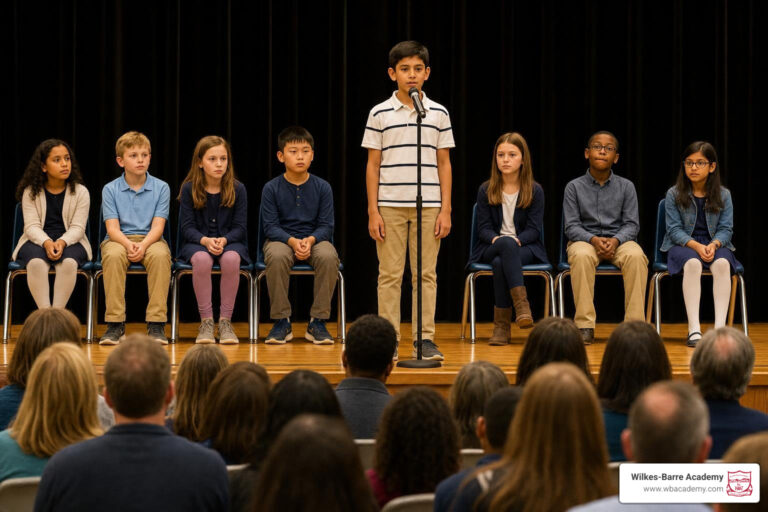
- Holistic Development: Regional independent models have long emphasized public speaking, debate, arts, and athletics, proving that a well-rounded education prepares students for leadership.
These historical models demonstrated how independent schools could adapt to changing times while keeping their core mission intact. They proved that small classes, high expectations, and a focus on the whole child—whether through public speaking, arts, or athletics—pave the way for lifelong success.
The Development of Early Childhood and Elementary Education Standards
In the early days of Wilkes-Barre’s history, early childhood education was virtually nonexistent. Children often didn’t begin formal schooling until they were older, and when they did, the focus was heavily on rote memorization and discipline.
As developmental psychology advanced in the 20th century, educators began to realize that the early years—from preschool through eighth grade—are the most critical window for cognitive, social, and emotional growth. This realization completely transformed how private elementary schools structured their classrooms.
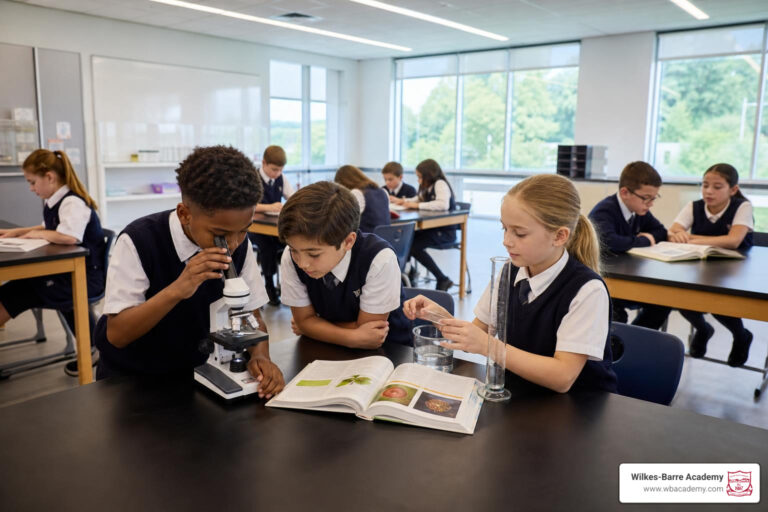
Today’s private K-8 schools in Wilkes-Barre prioritize foundational learning that goes far beyond simple memorization. They focus on inquiry-based learning, hands-on science, creative writing, and social-emotional development. For modern parents, finding a school that offers this structured yet nurturing environment is the ultimate goal. You can explore how to navigate these choices in the Wilkes-Barre Private School Guide: Finding the Perfect Fit.
Comparing Historical and Modern K-8 Educational Models
The way we teach children has come a long way since the days of the 1804 courthouse school. Let’s look at how the primary educational experience has evolved:
| Educational Feature | 19th-Century Academy Model | Modern Nonsectarian K-8 Model |
|---|---|---|
| Curriculum Focus | Heavy rote memorization, classical languages (Latin/Greek), rigid recitation. | Critical thinking, STEM integration, creative arts, and practical problem-solving. |
| Classroom Dynamic | Large, multi-age groups often crammed into single rooms with strict, lecture-style teaching. | Individualized learning, single classrooms per grade, and collaborative group projects. |
| Student Support | “One-size-fits-all” approach; students who struggled were often left behind or dismissed. | Differentiated instruction, close family-school connections, and social-emotional coaching. |
| Diversity & Community | Primarily served affluent local families or specific student demographics. | Inclusive, diverse student bodies reflecting a wide range of cultural and economic backgrounds. |
This evolution highlights why modern K-8 private schools are so highly valued. By keeping class sizes small and focusing on individual student growth, we can preserve the high academic standards of the past while utilizing the best modern, compassionate teaching strategies.
The Path to Higher Education: How Early Private Education Shapes Future Success
The ultimate goal of any strong primary education is to prepare students for the road ahead. Whether a student goes on to a local high school, an elite boarding school, or directly into advanced college preparatory programs, the foundation built during their K-8 years is the single greatest predictor of their success.
Historically, private schools in the Wilkes-Barre area have acted as powerful springboards. Alumni of regional independent programs consistently achieve exceptionally high college graduation rates, with a vast majority gaining acceptance into highly competitive colleges and universities.
This legacy of higher education preparation is also visible in our local colleges. King’s College, founded in Wilkes-Barre in 1946 by the Congregation of Holy Cross from the University of Notre Dame, was originally established to provide a high-quality, affordable liberal arts education to the sons of local coal miners. Today, King’s College continues to enrich the local community, boasting a 94% career placement rate and an average starting salary of $56,000 for its graduates.
By fostering critical thinking, a love for learning, and strong personal character in the early years, private K-8 education ensures that students are not just ready for high school—they are ready to thrive in college, careers, and community leadership. If you are ready to take the first step on this journey, we invite you to explore our Admissions page.
Frequently Asked Questions about Wilkes-Barre Private School History
What are the historical origins of private education in Wilkes-Barre?
Private education in Wilkes-Barre began in the late 18th and early 19th centuries as a community-driven response to the lack of structured public schools. Local families pooled resources to hire teachers, culminating in the historic 1804 conversion of the old Luzerne County courthouse into an academy. This laid the groundwork for a rich tradition of independent, parochial, and nonsectarian schools throughout the Wyoming Valley.
How did the original 19th-century Wilkes-Barre Academy evolve?
Established formally in 1807 in the repurposed Public Square courthouse, the original Wilkes-Barre Academy was the region’s premier secondary school. It taught classical subjects like Latin, Greek, and advanced mathematics to local students and those traveling from neighboring counties. In 1838, it transitioned into the Wyoming Academy, continuing its educational mission for several decades before eventually closing as public and other private systems expanded.
Why did nonsectarian private schools become popular in Wilkes-Barre?
Nonsectarian private schools grew in popularity because they offered families a secular alternative focused purely on academic excellence, small class sizes, and individualized instruction. Unlike large public school districts or strictly parochial schools, nonsectarian K-8 schools provide a close-knit, diverse community where curriculum can be tailored to each child’s unique strengths and needs.
Conclusion
The private school history in Wilkes-Barre, PA is a beautiful testament to our community’s enduring belief in the power of education. From the proud legacy of the 1807 Wilkes-Barre Academy to the modern, vibrant classrooms of today, this region has always championed academic excellence and personal growth.
At Wilkes-Barre Academy, we are proud to carry this historic torch forward as a single-location, non-profit K-8 school. We combine an academically advanced curriculum with our unique single-classroom-per-grade model, ensuring that every student receives the individualized attention, warmth, and guidance they need to succeed.
By fostering deep family-school connections and cultivating a close-knit, diverse student body, we aren’t just teaching lessons—we are building the leaders of tomorrow. We invite you to learn more about our philosophy, our history, and our dedicated faculty by visiting our About page today.