From Public to Private and Navigating the PA School Swap
Is Switching From Public to Private School in Pennsylvania Right for Your Family?
Switching from public to private school in Pennsylvania is more common than many parents realize — and the process is more straightforward than it looks once you know the steps.
Here’s a quick overview of how it works:
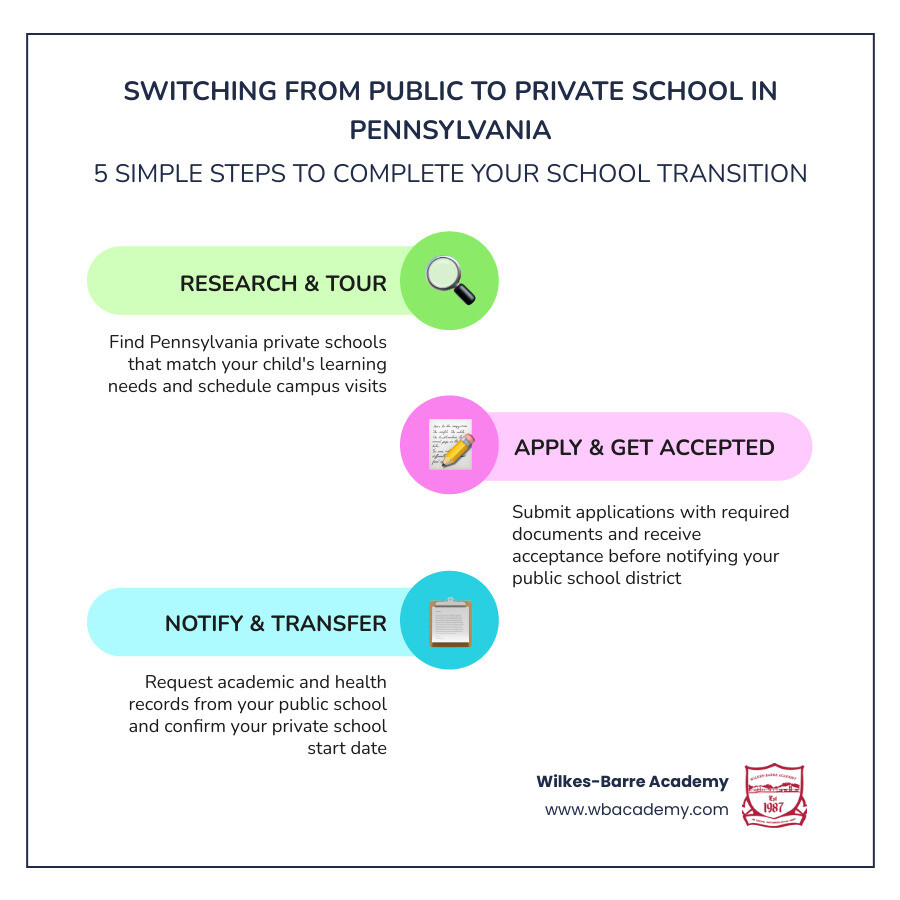
- Research and tour private schools that fit your child’s needs
- Apply and get accepted before withdrawing from public school
- Gather documents — birth certificate, immunization records, transcripts, and proof of residence
- Notify your public school district and request records
- Confirm your start date and attend any required orientation
Pennsylvania has roughly 2,000 nonpublic and private academic schools, ranging from religious institutions to independent college-prep academies. Families switch for many reasons — smaller class sizes, more individualized attention, stronger home-school communication, or simply a better fit for their child’s learning style.
One Philadelphia parent described leaving her job at a state agency to take higher-paying work elsewhere — just to cover private school tuition. Another public school teacher quietly enrolled her own daughter in private school because she wanted something different. The reasons are personal. The process is practical.
This guide walks you through everything: school types, costs, scholarships, enrollment steps, special education rights, and how to know if a private school is actually the right fit.
Switching From Public to Private School Pennsylvania: Start With the School Types and Rules
Pennsylvania gives families a lot of educational options, but the categories can feel a little alphabet-soup-ish at first. The big picture: private education in PA generally includes licensed private academic schools and nonpublic nonlicensed schools. Some are religious, some are independent, and accreditation may or may not be part of the picture.
The Pennsylvania Department of Education notes that there are about 2,000 nonpublic and private academic schools statewide. That variety is helpful for families, but it also means rules differ by school type.
Licensed private academic schools vs nonpublic nonlicensed schools
Licensed private academic schools are overseen through the state’s licensing framework and are subject to more formal requirements around staffing, curriculum descriptions, health and safety, and attendance. In general, they operate with clearer state-facing compliance expectations.
Nonpublic nonlicensed schools are different. Many are religious schools, and some operate based on religious status or accredited status rather than state licensing. That does not automatically make them lower quality. It simply means the legal structure is different.
A few practical takeaways for families:
- Religious affiliation is common in Pennsylvania private education, but not universal.
- Accreditation can be a useful quality marker, but it is not required for every private school to operate.
- Teacher certification rules can differ from public schools and may differ by private school type.
- Admissions, curriculum style, and school culture can vary a lot, even between schools only a few miles apart.
That is why tours, questions, and careful comparisons matter more than labels alone.
What Pennsylvania actually requires from private schools
One of the most important statewide rules is attendance time. Licensed private academic schools must provide at least:
- 180 days of instruction, or
- 450 kindergarten hours, or
- 900 elementary hours, or
- 990 secondary hours
So yes, private school calendars still have to do real work. No, they cannot replace math with vibes.
Schools using instructional hours rather than the traditional 180-day structure may need to file the appropriate exception paperwork. Families usually do not handle that form themselves, but it is worth asking how a school structures its calendar.
Pennsylvania also distinguishes between health and academic records:
- Health records must be released
- Academic records can, in some cases, be withheld by a nonpublic or private academic school
That matters most when students transfer again later. Before enrolling, it is smart to ask how records are handled and how quickly transcripts are sent.
Transportation, textbooks, and auxiliary services families should know about
Private school tuition is only part of the picture. Families should also ask about support services that may be available through public programs.
Pennsylvania offers certain state-supported benefits for eligible nonpublic students and schools, including:
- Auxiliary services under Act 89
- Textbook loans through state programs
- Transportation in some approved situations
If you want to understand one specific transportation rule, especially for students in approved private school placements, the state guidance here is useful: Transportation to approved private schools.
When comparing schools, we recommend asking:
- Does the school participate in Act 89 services?
- Are textbooks loaned through state programs?
- Is transportation available, and if so, through whom?
- What happens if weather, holidays, or schedule changes affect transportation?
These details are not glamorous, but they can absolutely make or break the morning routine.
Public vs Private in PA: The Biggest Differences Families Notice
Families usually feel the difference before they can fully describe it. A private school may feel more close-knit, more mission-driven, or more tailored. A public school may feel broader, more standardized, or more extensive in certain offerings.
Here is a simple comparison:
| Factor | Public School in PA | Private School in PA |
|---|---|---|
| Tuition | No direct tuition for residents | Tuition and fees usually apply |
| Curriculum | Must follow state requirements closely | Often more flexible in design and pacing |
| Class size | Often larger | Often smaller |
| Teacher certification | Usually required by law | May vary by school |
| Extracurriculars | Often broad, especially in larger districts | Can be strong, but may be smaller in scope |
| Discipline and culture | District-wide systems | School-specific philosophy |
| Parent communication | Can vary by district and school | Often more direct and frequent |
| Values alignment | Tied to district structure | Often mission-centered or faith-based |
Curriculum, class size, and teacher certification differences
Curriculum is one of the biggest reasons families switch. Public schools work within state standards and district frameworks. Private schools often have more flexibility in pacing, emphasis, and instructional style.
That can mean:
- More advanced or enriched coursework
- More room for interdisciplinary learning
- Faster intervention if a student is struggling
- Better pacing for students who need challenge
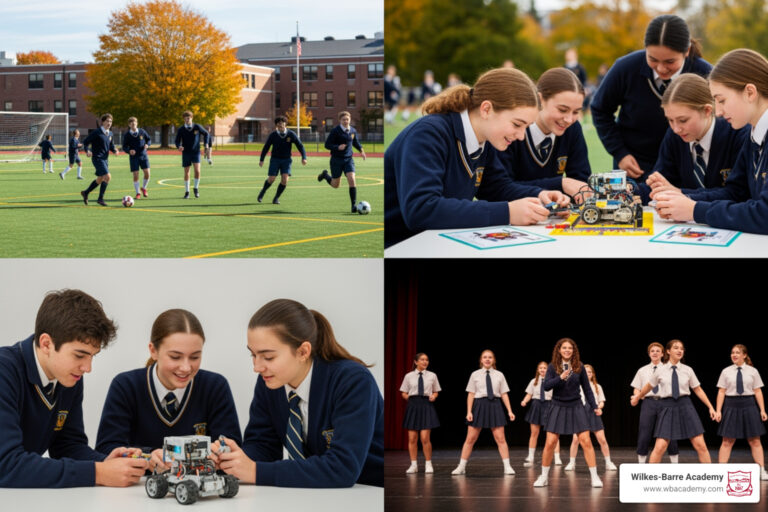
At Wilkes-Barre Academy, our focus on individualized learning is tied to our single classroom per grade model and strong family-school connection. Families who want to learn more about our academic approach can explore our academics page and read about small classes and big hearts at Wilkes-Barre Academy.
Teacher certification is another important distinction. Public school teachers are generally required to hold state certification. In private schools, certification requirements may be different depending on the school’s type and structure. That does not mean families should ignore credentials. It means you should ask direct questions about teacher experience, subject expertise, and classroom support.
Extracurriculars, PE, and school-home communication
Public schools, especially large ones, may offer more sheer volume in sports, electives, and clubs. Private schools may offer fewer total options, but often with more personal participation and easier access.
Families should look beyond the brochure and ask:
- Are clubs open to most students or highly selective?
- How often do students have PE, arts, and field trips?
- How does the school communicate with families?
- Are conferences and updates proactive or only when something goes wrong?
Strong communication is a major reason many families move. If you want a better sense of how modern school-family communication works, see Stay Connected with Pennsylvania School Communication Apps and Portals. For families comparing wellness and physical education expectations, this guide on PE programs in PA schools is also helpful.
Pros and cons of switching from public to private school pennsylvania
There is no perfect school type. There is only a better fit for a specific child.
Common pros families mention:
- Smaller class sizes
- More individualized attention
- Stronger sense of community
- Tighter parent-school partnership
- More mission or values alignment
- Sometimes less classroom disruption
Common concerns families mention:
- Tuition and fees
- Transportation or commute issues
- Fewer course options in some grade levels
- Social adjustment, especially mid-year
- Less socioeconomic diversity in some schools
- Variable special education support
Parent experiences also remind us that fit is not just academic. Some children thrive immediately. Others do well academically but struggle with belonging, friend groups, or culture. That is why the right question is not “Is private school better?” It is “Is this school better for our child right now?”
Cost, Tuition, and Scholarships When Switching From Public to Private School Pennsylvania
This is the part where many families take a deep breath, open a spreadsheet, and suddenly become amateur financial planners.
What private school may cost compared with “free” public school
Public school is tuition-free for district residents, but “free” does not mean every family experience feels equal. Private school introduces direct tuition, but public school families often already pay for aftercare, activity fees, transportation workarounds, tutoring, or enrichment outside school.
When comparing costs, include:
- Tuition
- Registration or enrollment fees
- Uniforms or dress code items
- Lunch costs
- Transportation or fuel
- Before- or after-care
- Field trips and activity fees
- Technology or supply expectations
It is smart to think in annual terms, not just monthly ones. Some families can handle tuition but get surprised by the extras. Others find that a private school’s structure reduces outside costs they were already paying elsewhere.
For a local example of how tuition information is presented, families can review the Tuition Schedule 2024-2025.
How EITC and OSTC work for Pennsylvania families
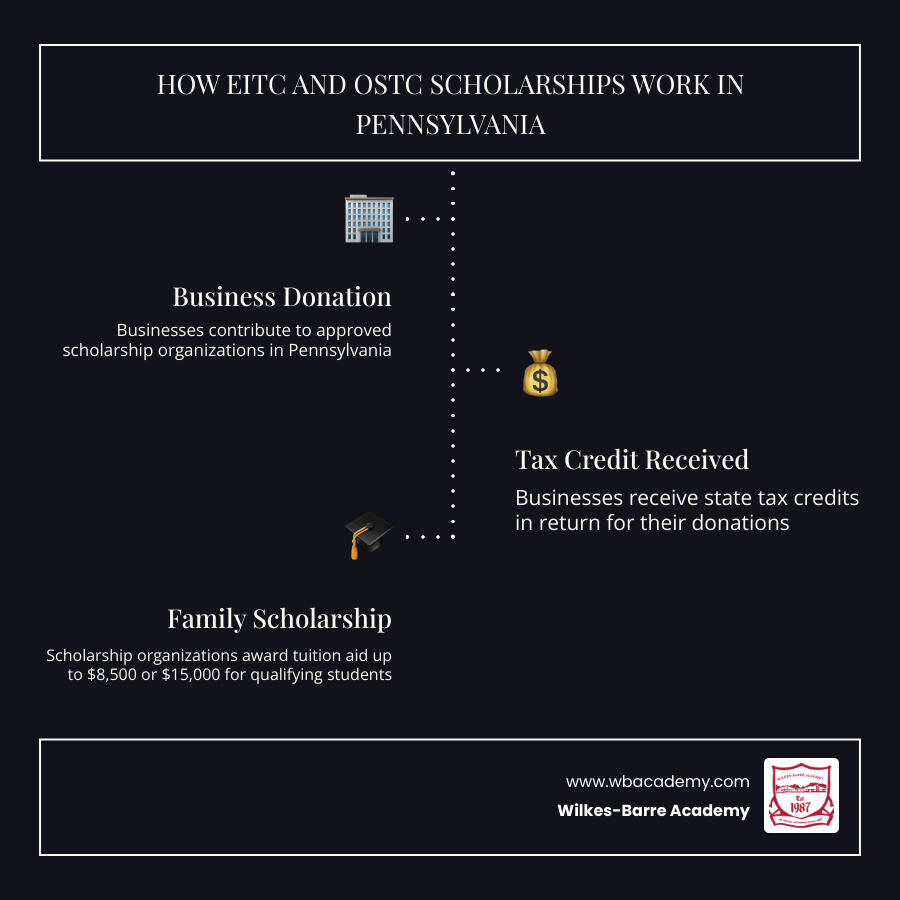
Pennsylvania does not directly give state tuition grants to all private school families. Instead, the main assistance tools are tax-credit scholarship programs funded through business donations.
The two major programs are:
- EITC, the Educational Improvement Tax Credit program
- OSTC, the Opportunity Scholarship Tax Credit program
A helpful overview is available here: Pennsylvania school choice overview.
In plain English:
- Businesses donate to scholarship organizations
- Businesses receive tax credits
- Scholarship organizations award tuition assistance to eligible families
OSTC is generally tied to students who live in the attendance boundaries of low-achieving public schools and who meet income requirements. Research in your source set notes commonly cited scholarship caps of up to:
- $8,500 per year for general education students
- $15,000 per year for students with special education needs
But there is a catch: “up to” does a lot of heavy lifting. Awards may be lower, funding is limited, and admission to a private school is still separate from scholarship approval.
This is why we recommend reading What to know about Opportunity Scholarships carefully, especially if you are counting on aid before making a move.
Questions to ask before counting on scholarship money
Scholarships can help, but they should not be treated like guaranteed magic beans.
Ask these questions first:
- Does the school have an open seat in your child’s grade?
- Does the school accept EITC or OSTC funds?
- What is the real deadline for scholarship applications?
- Are awards first-come, first-served?
- Is the scholarship amount enough to make the move affordable?
- Does aid renew every year automatically, or must you reapply?
- Are transportation and other costs still on you?
It is also fair to know that scholarship programs are debated in Pennsylvania. Critics raise concerns about accountability, access, and who benefits most. For a policy-focused view of those concerns, see Pennsylvania’s Track Record on Private School Vouchers: Still No Accountability.
For families, the practical takeaway is simple: apply early, verify everything, and never withdraw from your current school until the financial picture is clear enough to proceed.
Enrollment Steps: How to Move Your Child From Public to Private in Pennsylvania
This is the nuts-and-bolts section. The good news: the process is manageable when done in order.
Step-by-step switching from public to private school pennsylvania checklist
- Research schools that match your child’s academic, social, and practical needs.
- Tour the campus and ask detailed questions.
- Submit the application.
- Provide any requested records and forms.
- Wait for acceptance.
- Confirm tuition, aid, and start timing.
- Notify your public school and request records transfer.
- Complete withdrawal only after private enrollment is secured.
- Attend orientation and prepare for the first day.
Common enrollment documents include:
- Birth certificate
- Immunization records
- Health forms
- Report cards or transcripts
- Standardized test results, if requested
- Proof of residence
- Parent or guardian identification
- Recommendation letters, if required
- Prior school contact information
Admissions timelines, required forms, and common paperwork
Every school sets its own admissions calendar, but many private schools accept applications well before the new school year. Some can also accommodate mid-year transfers if space allows.
Expect possible requirements such as:
- Online or paper application
- Student interview or classroom visit
- Parent meeting
- Records release form
- Placement or readiness assessment
- Health and immunization paperwork
For practical help, see No More Paperwork Panic for Enrolling in PA Private Schools and our enrollment page.
Mid-year transfers, record requests, and what if a school withholds academics
Mid-year transfers do happen in Pennsylvania. They can work well, especially if the current setting is clearly not a fit. But they require careful timing.
A few key points:
- Keep your child attending the current school until the new start date is confirmed.
- Ask how the new school handles placement gaps or differences in curriculum pacing.
- Request records early.
- Health records must be released.
- Academic records may, in some situations, be withheld by a private school, so families should clarify policies upfront.
If you are comparing admissions expectations or planning a transfer, our admissions page can help you map out next steps.
Special Education, Attendance, and Student Transition Support in Pennsylvania Private Schools
This is often the section families worry about most, and understandably so.
Special education after leaving public school: what changes and what does not
If your child has an IEP in public school, moving to a private school changes the legal framework.
The most important distinction is this:
- A parentally placed private school student does not automatically keep the same public school IEP protections inside the private school setting.
- Private schools are not required in the same way public schools are to implement a public school IEP.
- A student may need reassessment or a different accommodation process after transferring.
For students publicly placed in approved private schools, Free Appropriate Public Education, or FAPE, responsibilities can work differently. In those cases, the public system may still carry obligations. But for a family choosing private school on its own, support may look more like accommodations, school-designed plans, or limited equitable services rather than a full public-school IEP model.
That is why families should ask very specific questions:
- What learning support services are offered in-house?
- Does the school create accommodation plans?
- Will current evaluations be reviewed?
- Is a new assessment needed?
- What services, if any, come through the public district?
Attendance flexibility and the 180-day requirement
Private schools in Pennsylvania still operate under compulsory attendance expectations. As noted earlier, licensed private academic schools must provide either 180 instructional days or the required yearly hours.
That does not mean every private school calendar looks identical to a public district calendar. Some schools build in flexibility through instructional hours or different scheduling structures, but they still must meet legal minimums.
Families who want the state’s broader nonpublic education guidance can review Home Education and Private Tutoring | Department of Education | Commonwealth of Pennsylvania. While that page focuses on home education and tutoring, it is useful context for understanding Pennsylvania’s larger compulsory attendance framework.
Helping children adjust academically and socially after the switch
The transfer paperwork is the easy part. The human part matters just as much.
Some students are thrilled on day one. Others need time to adjust to:
- New routines
- Different expectations
- Smaller peer groups
- A more rigorous pace
- Different social dynamics
Schools can support transitions through:
- Orientation visits
- Teacher check-ins
- Placement review
- Buddy systems or peer support
- Parent-teacher conferences
- Regular communication in the first few weeks
Questions we encourage families to ask when evaluating school fit:
- Will my child be challenged without feeling overwhelmed?
- How does the school help new students make friends?
- How often do teachers communicate with parents?
- What happens if a student needs extra support after enrollment?
- How diverse and welcoming is the school community?
- Does the school’s mission align with our family’s values?
- Can we realistically manage the commute and cost long term?
How to Compare Pennsylvania Private Schools and Make the Right Choice
Not every private school is the right fit for every child, and that is okay. The goal is not to pick the fanciest option. It is to choose the school where your child can learn, belong, and grow.
What to evaluate before you decide
As you compare schools, look at both the obvious and the easy-to-miss factors:
- Mission and values alignment
- Academic depth and pacing
- Student-teacher ratio
- Classroom structure
- Discipline philosophy
- Communication style
- Diversity and school culture
- Learning support availability
- Extracurricular balance
- Commute and transportation
- Long-term fit through future grade transitions
At Wilkes-Barre Academy, we know families often care most about whether a child will be known well, taught well, and supported consistently. Our single-location school model, one classroom per grade, and close-knit community are central to that experience. Families interested in who we are can learn more through Our Story.
Where to find and compare schools in your area
Families in Luzerne County can compare schools by using:
- School websites
- In-person tours
- State information pages
- Local school directories
- Parent conversations
- Admissions materials and handbooks
Two helpful starting points from our own site are Wilkes-Barre Private School Guide: Finding the Perfect Fit and Why Going Private is the Ultimate Grade Upgrade.
The more schools you compare, the clearer your priorities usually become.
When private school is a strong fit — and when another option may be better
Private school may be a strong fit when:
- Your child needs smaller classes
- You want stronger home-school partnership
- The school’s mission clearly fits your family
- Your child would benefit from more individualized attention
- The financial plan is realistic, even beyond year one
Another option may be better when:
- The cost creates too much strain
- The school cannot meet your child’s support needs
- The commute would be unsustainable
- Your child strongly prefers a larger environment or broader activity menu
- A public, charter, or home education option better fits your goals
In other words, choosing wisely is better than choosing quickly.
Conclusion
Switching from public to private school in Pennsylvania is not just an administrative move. It is a family decision about learning, support, community, and long-term fit.
If you are considering the change, we recommend keeping the process simple:
- Clarify what is not working now
- Identify what your child needs most
- Compare schools carefully
- Confirm costs and aid early
- Complete enrollment steps in the right order
If you are exploring a private K-8 option in Wilkes-Barre, we invite you to learn more about our community and next steps through our admissions page. The right school switch should feel informed, realistic, and hopeful – not like a leap into the unknown.