Is Private School Worth the Pennies in Pennsylvania?
Is Private School Worth It in Pennsylvania? Here’s What Parents Need to Know
Is private school worth it in Pennsylvania? For most families, the answer depends on a few key factors: your child’s learning needs, your local public school options, and what you can realistically afford after scholarships.
Quick answer:
- Private school can be worth it if your child needs smaller classes, more individualized attention, or a curriculum your local public school doesn’t offer
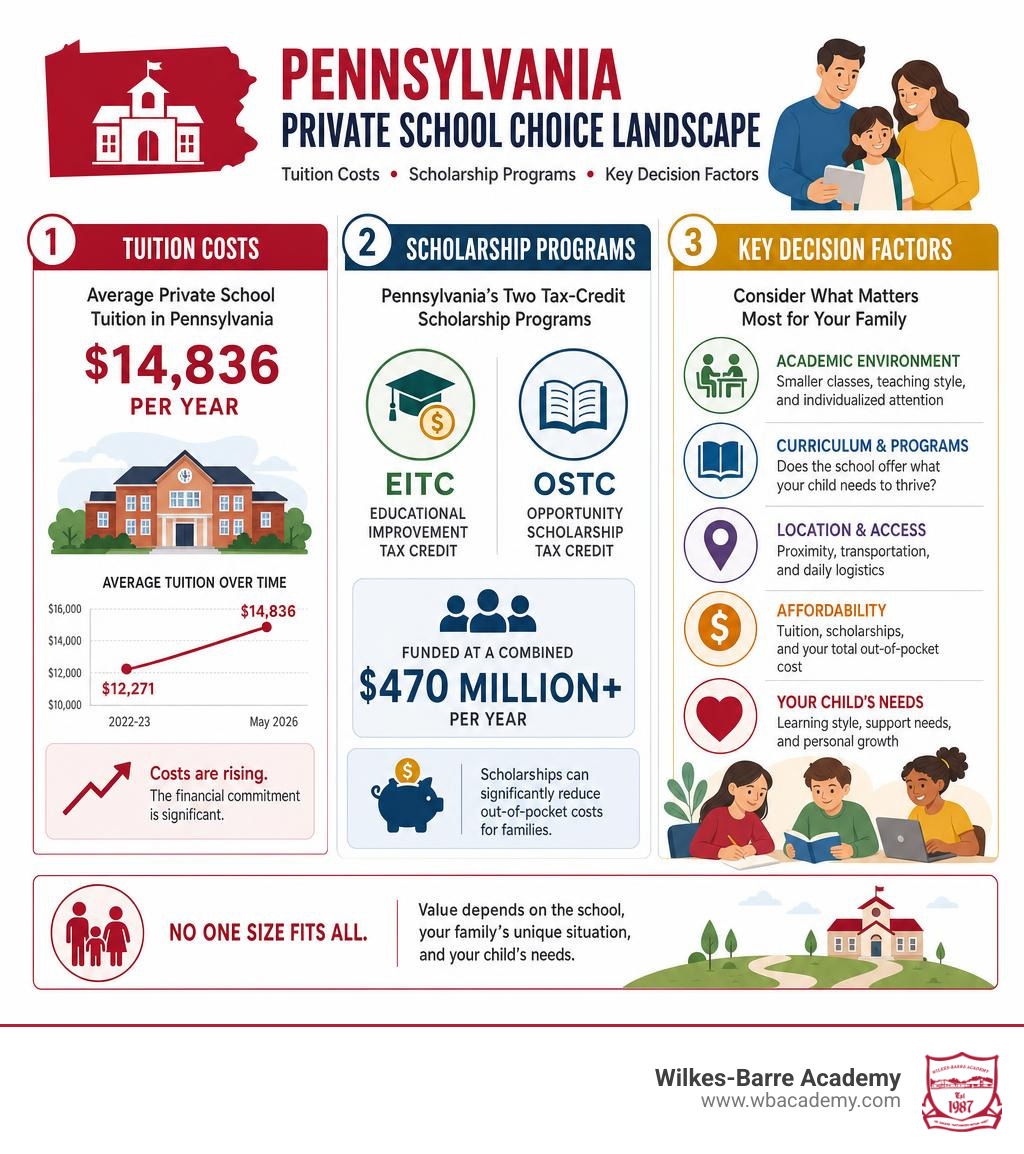
- Pennsylvania’s average private school tuition is $14,836 per year — but tax-credit scholarship programs can significantly reduce that cost
- The state runs two scholarship programs (EITC and OSTC) funded at a combined $470 million+ per year
- Value varies widely depending on the specific school, your family’s income, and where in Pennsylvania you live
Few decisions feel as personal — or as expensive — as choosing where your child goes to school. You want your kid to thrive. You want them seen, challenged, and supported. And you’re wondering whether paying private school tuition is a smart investment or a financial stretch that doesn’t pay off.
Pennsylvania parents are asking this question more than ever. The state has nearly 2,000 nonpublic and private academic schools, a growing set of scholarship programs, and an ongoing public debate about how education dollars should be spent. That’s a lot of noise to cut through.
This guide breaks it all down — costs, scholarships, academic outcomes, and what actually matters when you’re deciding whether private school is the right move for your family.
Weighing the Cost: Is Private School Worth It in Pennsylvania?

When we sit down to look at our family budgets, the sticker shock of private school tuition can make us gasp. In May 2026, the average private school tuition in Pennsylvania sits at $14,836 per year. If you look back a few years, the average private school tuition for 2022-23 was $12,271. Costs are rising, and the financial commitment is undeniable.
However, looking at the average doesn’t tell the whole story. Elementary tuition averages $13,113 per year, while private high school averages climb to $19,166 per year. On the extreme ends, prestigious boarding schools in the state can exceed $70,000 annually.
So, why do so many Pennsylvania families decide that writing this check every month is actually worth it?
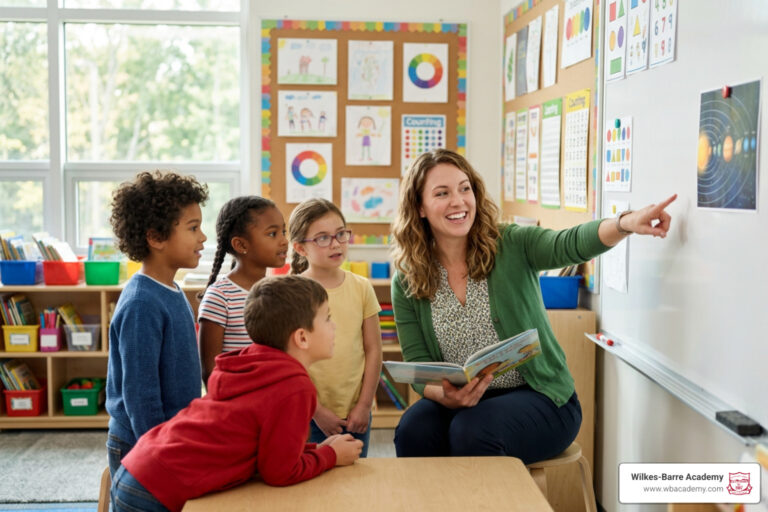
Often, it comes down to what you get in return for those dollars. When you choose a private education, you are investing in a completely different educational environment. For many, the primary driver is class size. In a smaller classroom setting, teachers aren’t just managing crowd control—they are actually teaching to each individual child’s strengths and weaknesses.
At Wilkes-Barre Academy, we have always believed that a single classroom per grade is the ultimate recipe for individualized learning. It allows us to build deep, meaningful family-school connections that simply aren’t possible in massive public school systems. When we discuss Why Going Private is the Ultimate Grade Upgrade, we are talking about shifting the focus from standardized test prep to genuine, holistic student growth.
To put the financial picture into perspective, let’s look at how private school tuition averages compare to what the public system spends per student:
| School Type / Funding Metric | Average Annual Cost in PA (2026) | Key Focus Areas |
|---|---|---|
| Private Elementary School Tuition | $13,113 | Small class sizes, tailored curriculum, character development |
| Private High School Tuition | $19,166 | College preparation, specialized electives, advanced facilities |
| Statewide Private School Average | $14,836 | Balanced extracurriculars, community-driven environments |
| Public School Per-Pupil Spending (Statewide) | ~$19,000 – $22,000+ | Mandated programs, special education, district-wide services |
While public school is funded through our tax dollars, the per-pupil spending in public districts is often higher than the average private school tuition. The difference is that in a private school setting, those funds are directed specifically toward classroom resources, specialist teachers, and maintaining low student-to-teacher ratios rather than administrative overhead.
The Real Cost of Private Education: Tuition vs. Tax-Credit Scholarships
While the average tuition figures give us a baseline, the “sticker price” of private school is rarely what families actually pay. Thanks to robust financial aid programs, sliding-scale tuition structures, and state-backed scholarships, a private education is often much more accessible than it appears on paper.
For instance, when looking at a school’s Tuition Schedule 2024-2025, parents can often find multi-child discounts, pre-payment incentives, and specialized local scholarship opportunities. But the biggest game-changer for many Pennsylvania families comes from the state’s unique tax-credit programs.
How EITC and OSTC Determine If Private School Is Worth It in Pennsylvania
Unlike states that have traditional school voucher programs where public funds are handed directly to parents, Pennsylvania uses a tax-credit system. The state operates two primary programs:
- The Educational Improvement Tax Credit (EITC)
- The Opportunity Scholarship Tax Credit (OSTC)
These programs allow local businesses and individuals to redirect their state tax liabilities directly to approved Scholarship Organizations (SOs). In turn, these organizations award private school scholarships to eligible families. Combined, these programs are funded at over $470 million per year (reaching up to $630 million in recent budget cycles). This represents over four times what the programs received back in 2012-13.
While supporters praise these programs for giving middle- and low-income families a choice, they are also the subject of intense political debate. Critics argue that these tax credits divert essential resources from an already underfunded public school system. In fact, the $630 million tax-credit program represents about 7.7% of the state’s $8.16 billion contribution through its Basic Education Funding formula.
Organizations like the Keystone Research Center argue that this system lacks oversight. For a deeper dive into this policy debate, you can read Pennsylvania’s Track Record on Private School Vouchers: Still No Accountability ‣ KRC.
Geographic and Demographic Realities of PA Scholarship Programs
Who actually benefits from these tax-credit scholarships? The data shows a mixed picture:
- Low-Income Families: The OSTC program is highly targeted. It is designed specifically for students who live within the boundaries of the lowest-achieving 15% of public schools in the state. Data shows that 78% of nearly 11,000 OSTC scholarships (totaling over $30 million) went to families living below 185% of the federal poverty level.
- The Reporting Gap: On the other hand, the larger EITC program has much higher income limits, meaning middle- and upper-middle-class families often qualify. A major point of criticism is that more than a third (57 of 151) of private schools administering their own tax-credit scholarship programs reported enrolling zero low-income students or claimed they could not determine how many low-income students they served.
- The Rural vs. Urban Divide: If you live in a rural part of Pennsylvania, finding a scholarship can be tough. In 2022-23, 29 rural Pennsylvania counties had zero scholarship organizations linked with the EITC program. The vast majority of these funds are concentrated in suburban and urban areas like Philadelphia, Pittsburgh, and Harrisburg.
For families in Luzerne County, however, the local landscape is highly active. There are excellent local scholarship organizations that help bridge the gap, making the decision of whether is private school worth it pennsylvania a highly practical “yes” for families who thought private school was out of reach.
Academic Outcomes and the True Value of Independent Education

Beyond the dollars and cents, the real value of a private education is measured in student growth, confidence, and long-term readiness.
Public schools are bound by rigid state mandates, standardized testing timelines, and strict curriculum guidelines. Private schools, however, enjoy curriculum flexibility. This allows us to design advanced academic pathways, integrate hands-on STEM projects, and offer robust arts and physical education programs that aren’t restricted by state test prep.
If you are trying to navigate the local educational landscape, our Wilkes-Barre Private School Guide: Finding the Perfect Fit offers a comprehensive look at how to evaluate these academic differences.
Beyond the Classroom: Why Private School Is Worth It in Pennsylvania for Long-Term Success
The benefits of private school extend far past elementary and middle school. When children learn in an environment with low student-teacher ratios, they develop a strong sense of self-advocacy. They aren’t afraid to ask questions, they learn how to collaborate, and they build a lifelong love of learning.
This close-knit support system is central to what we do. By focusing on Small Classes and Big Hearts at Wilkes-Barre Academy, we ensure that our K-8 students transition into high school with exceptional academic foundations and the emotional maturity required to excel in advanced placement (AP) courses and leadership roles.
Accountability, Accreditation, and Admissions Policies
When evaluating whether private school is worth the investment, parents should also understand how these schools are regulated in Pennsylvania:
- Accreditation: Interestingly, private schools in Pennsylvania are not required to be accredited; accreditation is entirely optional. However, reputable independent schools choose to undergo rigorous accreditation processes through recognized regional bodies to prove their academic quality.
- School Licensing: The state categorizes nonpublic options into Licensed Private Academic Schools (LPAS)—which must follow strict state guidelines regarding teacher certification, safety, and curriculum—and Nonpublic Nonlicensed Schools (which are typically faith-based or accredited by approved independent associations).
- Admissions and Rights: Parents must also be aware that private schools have different legal standards than public schools. Because they are privately governed, they can set their own admissions criteria. If you want to understand the legal protections and safety regulations governing nonpublic institutions, check out our guide on Private School Student Safety Pennsylvania: A Parent’s Guide to the Law.
How to Evaluate and Choose the Right Private School in PA
If you’ve weighed the costs and decided to take the leap, the next step is finding the school that matches your child’s personality and your family’s values. Here is a quick checklist of how to evaluate your options:
- Look at Class Size and Structure: Does the school have multiple classrooms per grade, or do they utilize a single-classroom-per-grade model to foster a tight-knit community?
- Assess the Curriculum: Is the curriculum advanced, or does it simply mirror the local public school? Look for foreign languages, science labs, and creative arts.
- Visit the Campus: Nothing replaces the “gut feeling” of walking the halls. Observe how the teachers interact with students. Are the kids engaged, or are they just going through the motions?
- Evaluate the Communication: How does the school keep parents in the loop? Modern private schools utilize dedicated portals to keep families connected. Learn more about what to expect in our review of how to Stay Connected with Pennsylvania School Communication Apps and Portals.
- Understand the Admissions Process: Don’t let the paperwork scare you off. We’ve simplified the steps in our guide: No More Paperwork Panic for Enrolling in PA Private Schools.
Frequently Asked Questions About PA Private Schools
Do Pennsylvania private schools provide free transportation?
Yes! Under Pennsylvania law, if a school district provides busing for its public school students, it must also provide free transportation to local private school students. This applies as long as the private school is located within the district boundaries or not more than 10 miles outside the district border. For a complete look at how this works, read our guide: Don’t Miss the Bus: A Guide to Private School Busing in Pennsylvania.
Are private schools in Pennsylvania required to be accredited?
No. In Pennsylvania, accreditation is optional. Nonpublic schools can operate as nonlicensed, nonpublic schools (often religious schools or those accredited by approved private associations) or as Licensed Private Academic Schools.
What is the average cost of private school tuition in PA?
As of 2026, the average private school tuition in Pennsylvania is $14,836 per year. Elementary schools are typically more affordable, averaging $13,113, while high schools average $19,166. However, local K-8 non-profit schools often offer highly competitive rates compared to these statewide averages.
Conclusion
At the end of the day, deciding whether is private school worth it pennsylvania isn’t just about analyzing state test scores or staring at a tuition spreadsheet. It is about your child. It is about finding a place where they feel safe, seen, and excited to learn every single day.
For families in Luzerne County, we built Wilkes-Barre Academy to be exactly that place. As a single-location, non-profit K-8 school, we focus our resources directly on our classrooms. With our unique single-classroom-per-grade structure, advanced academic curriculum, and exceptionally strong family-school connections, we provide an environment where your child won’t just get an education—they will find a community.
Ready to see the difference for yourself? We invite you to explore our Admissions and Enrollment processes, or Explore Academics at Wilkes-Barre Academy to see how we help our students build a foundation for a lifetime of success.