
A Practical Guide to the PA Opportunity Scholarship Tax Credit Program
Student and Family Eligibility Criteria
The Pennsylvania Opportunity Scholarship Tax Credit (OSTC) program is a state initiative that provides tuition scholarships to eligible K-12 students residing within the attendance boundaries of designated low-achieving public schools. Funded by private businesses that receive state tax credits for their contributions, the Opportunity Scholarship Tax Credit Program | Department of Education | Commonwealth of Pennsylvania was established under Act 85 of 2012 and codified under 24 Pa. Stat. Section 2002-B to expand nonpublic school access. Whether families seek smaller class sizes, focused instruction, or tuition assistance, navigating Your Roadmap to Pennsylvania School Choice and Opportunity Scholarships starts with understanding how the state funds these educational grants.
Program History and Legislative Background
The Pennsylvania General Assembly enacted and launched the OSTC program in 2012 as an expansion of the Commonwealth’s broader educational tax credit framework. Lawmakers recognized that thousands of students were assigned to neighborhood schools facing significant academic hurdles.
To solve this without straining general taxpayer coffers, the legislature established a dedicated $50 million statewide annual program cap within the Public School Code. This structure invites private enterprise into state educational reform, directing corporate capital straight into classroom seats.
What Is the PA Opportunity Scholarship Tax Credit Program Low-Achieving School Rule?
Geography sits at the center of the OSTC model. Unlike general financial aid, this program requires that a student’s home address falls within the attendance boundary of a designated low-achieving public school.
The Commonwealth defines a low-achieving school as a traditional public elementary or secondary school ranking in the lowest 15% statewide based on combined math and reading/English Language Arts (ELA) PSSA or Keystone assessment scores from the previous school year.
A few critical details apply:
- Exclusions: Under state law, charter schools, cyber charter schools, and area career and technical centers (CTCs) are excluded from the low-achieving designation.
- Annual Updates: The Pennsylvania Department of Education (PDE) recalculates and releases the updated list of low-achieving schools annually on or before June 6.
- Accountability Status: A school appearing on the OSTC bottom 15% list is strictly a state tax credit designation and does not equate to federal accountability statuses (such as CSI or TSI).
Qualifying for an OSTC award involves two main checkpoints: your residential school zone and your household income. Students entering kindergarten through 12th grade—including those currently in public school, cyber school, homeschool, or already enrolled in a private school—can apply as long as they reside within an eligible boundary.
When asking Can You Actually Afford Private School in Pennsylvania?, reviewing the statutory income guidelines helps put real numbers to your family’s budget.
| Eligibility Tier | Base Household Income Limit | Allowance Per Dependent | Maximum Annual Scholarship Award |
|---|---|---|---|
| Standard (Non-Special Education) | $116,055 | $20,428 | $8,500 |
| Special Education (Support Factor 1.50) | $174,083 | $30,642 | $15,000 |
| Special Education (Severe Support Factor 2.993) | $347,353 | $61,141 | $15,000 |
Household Income Thresholds and Disability Adjustments
Income parameters are set by the Opportunity Scholarship Tax Credit Program (OSTC) – PA Department of Community & Economic Development. For the 2025–26 school year, the base household income cap is $116,055, with an additional $20,428 allowance for each dependent child residing in the home.
For children with disabilities, Pennsylvania applies statutory multipliers to adjust household income caps upward:
- Standard Disability Support: An adjustment factor of 1.50 applies for eligible students with an IEP attending a standard nonpublic school.
- Specialized Placement: An adjustment factor of 2.993 applies for students attending approved specialized private academic schools.
State guidelines also instruct scholarship organizations to prioritize low-income families whose household income falls at or below 185% of the federal poverty guidelines, alongside prior-year recipients.
Retaining Eligibility if School Status Changes
Parents often worry about what happens if their neighborhood public school improves its test scores and exits the PDE bottom 15% list.
Pennsylvania built a safeguard into the statute: the five-year continuation provision. If your assigned public school is removed from the low-achieving list, your child can continue receiving OSTC scholarship renewals for up to five consecutive years, or through the completion of 12th grade (whichever comes first), provided your family continues to meet general income guidelines.
Award Amounts and Qualified Educational Expenses
When exploring options, Don’t Let the Sticker Price Scare You: Financial Aid for PA Private Schools. Scholarships awarded through the OSTC program are treated as non-taxable grant funding, providing straightforward tuition relief without increasing your state or federal tax burden.
Maximum Scholarship Caps for General and Special Education
Scholarships are capped at statutory maximums or the school’s actual tuition and mandatory fees, whichever is less:
- General Education Maximum: Up to $8,500 per school year.
- Special Education Maximum: Up to $15,000 per school year for students with documented disabilities.
- Economically Disadvantaged Schools: Schools where at least 75% of the student body receives OSTC funding can qualify for expanded caps ranging between $10,500 and $19,000.
Participating private schools cannot charge higher tuition rates to scholarship recipients than to non-scholarship students.
Approved School Costs and Transportation Coverage
OSTC funds cover essential educational expenses, including:
- Standard tuition charges
- Mandatory school fees (such as registration and lab fees)
- Textbooks and instructional materials
- Instructional technology fees
- Required school uniform costs
Transportation is another advantage. Under Pennsylvania law, if your resident public school district provides busing to its own public students, it is legally mandated to provide identical transportation services to resident students attending an accredited, non-profit private school located within 10 miles of the district boundary lines.
How Businesses Fund the OSTC Program
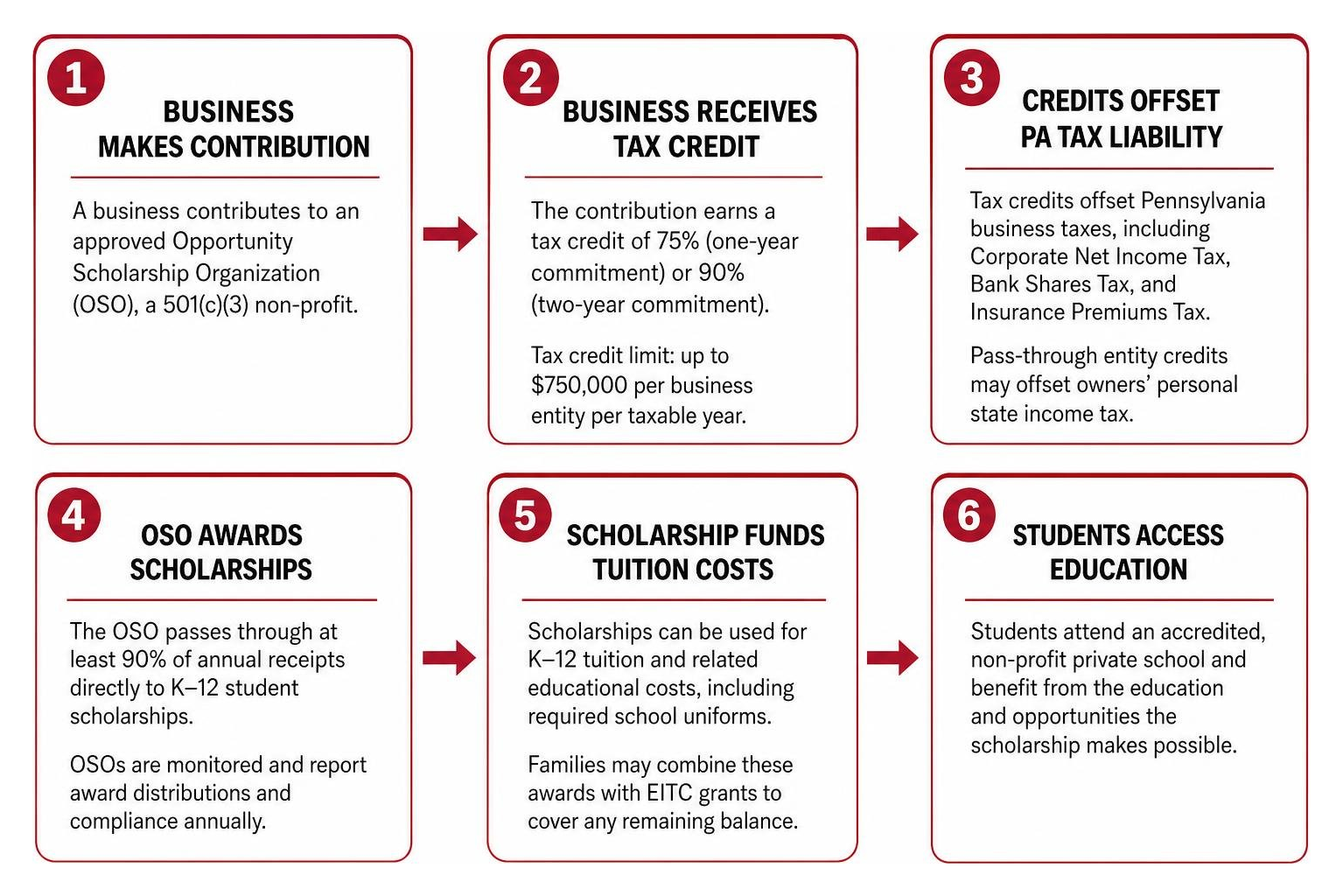
The OSTC initiative is fueled by private businesses redirecting state tax liabilities into scholarship organizations. Rather than sending all corporate tax payments to Harrisburg, companies can allocate those dollars to fund K-12 tuition grants.
The Educational Tax Credits | Department of Revenue | Commonwealth of Pennsylvania program offers direct tax credits to participating businesses.
Tax Credit Percentages and Annual Limits
Pennsylvania offers generous tax credit rates to incentivize corporate giving:
- 75% Tax Credit: For a single-year contribution commitment.
- 90% Tax Credit: If the business commits to contributing an equal amount for two consecutive years.
- Annual Cap: Up to $750,000 in tax credits per business entity per taxable year.
These credits offset various Pennsylvania business taxes, including Corporate Net Income Tax, Bank Shares Tax, and Insurance Premiums Tax. Pass-through entities (S-Corporations, LLCs, and Partnerships) can distribute these credits to individual shareholders or owners using PA Department of Revenue Form REV-1123 to offset personal state income tax.
Opportunity Scholarship Organizations and Compliance
Businesses make their contributions to approved non-profit Opportunity Scholarship Organizations (OSOs). To maintain DCED approval, an OSO must:
- Hold 501(c)(3) non-profit status.
- Pass through at least 90% of annual receipts directly to student scholarships (or 85% if their IRS Form 990 program expense ratio exceeds 90%).
- Submit annual monitoring reports detailing award distributions and financial compliance through the state’s Enterprise eGrants portal.
Many families also pair these awards with opportunities from our School Year Information Paperwork: Tuition / EITC Grant funds to cover any remaining balance.
How Parents Apply for OSTC Scholarships
Because scholarships are not awarded directly by the state, parents do not apply to the Department of Education or the DCED. Instead, you apply directly through approved Opportunity Scholarship Organizations or the financial aid office of your chosen participating school.
What Is the PA Opportunity Scholarship Tax Credit Program Application Timeline?
Timing is essential because scholarship organizations process requests quickly:
- May 15: Business renewal applications open for two-year corporate pledges.
- June 6: PDE publishes the updated list of bottom 15% low-achieving schools for the upcoming academic year.
- July 1: New business donor applications open, and OSOs confirm available scholarship funding.
- Mid-Summer: Families submit financial aid forms, income documentation, and proof of residency to participating scholarship organizations.
- Late Summer / August: Award determination letters are issued to families before the fall semester begins.
Connecting with Participating Schools and SGOs
To apply for an OSTC scholarship:
- Verify School Eligibility: Review the PDE list to confirm your neighborhood public school is designated as low-achieving.
- Gather Documents: Prepare your most recent PA state tax return (Form PA-40 or federal 1040), proof of residence (utility bill or lease), and any relevant IEP paperwork.
- Contact the School: Connect with the admissions or tuition office at your desired private school to identify which partner OSOs manage their scholarship funds.
- Submit Application: Complete the OSO application form before local deadlines.
Frequently Asked Questions About the OSTC Program
Can a Student Keep an OSTC Scholarship After Moving Out of a Low-Achieving Zone?
No. If your family moves to a new residence located within the boundary of a public school that is not on the bottom 15% list, the student becomes ineligible for future OSTC funding. The five-year continuation rule applies only when your residence stays the same and the school itself improves off the list.
Are OSTC Scholarship Awards Considered Taxable Income in Pennsylvania?
No. Under Commonwealth law, educational scholarships provided through the OSTC program are fully exempt from Pennsylvania Personal Income Tax and are not considered gross income.
How Does the OSTC Program Differ from EITC?
While both programs utilize business tax credits, the Educational Improvement Tax Credit (EITC) is open to eligible low- and middle-income students statewide, regardless of where they live. The OSTC program specifically requires students to reside within the attendance zone of a public school in the bottom 15% of performance.
Conclusion
Every child deserves an educational environment where they can thrive, be challenged, and build lifelong confidence. The Pennsylvania Opportunity Scholarship Tax Credit program bridges the financial gap, turning state tax dollars into personal academic opportunities for Luzerne County families.
At Wilkes-Barre Academy, our single-location K-8 non-profit school offers an academically advanced curriculum paired with a dedicated single classroom per grade. This structure ensures your child receives individualized attention within a close-knit, supportive community. We welcome you to explore tuition assistance options and learn how easy it is to apply through our School Year Information Paperwork: Tuition / Voucher Program.