Certified Success for Pennsylvania Private School Students
Why Certified Teachers in Pennsylvania Private Schools Matter More Than You Think
If you’re a parent researching certified teachers in private school Pennsylvania, here’s the quick answer:
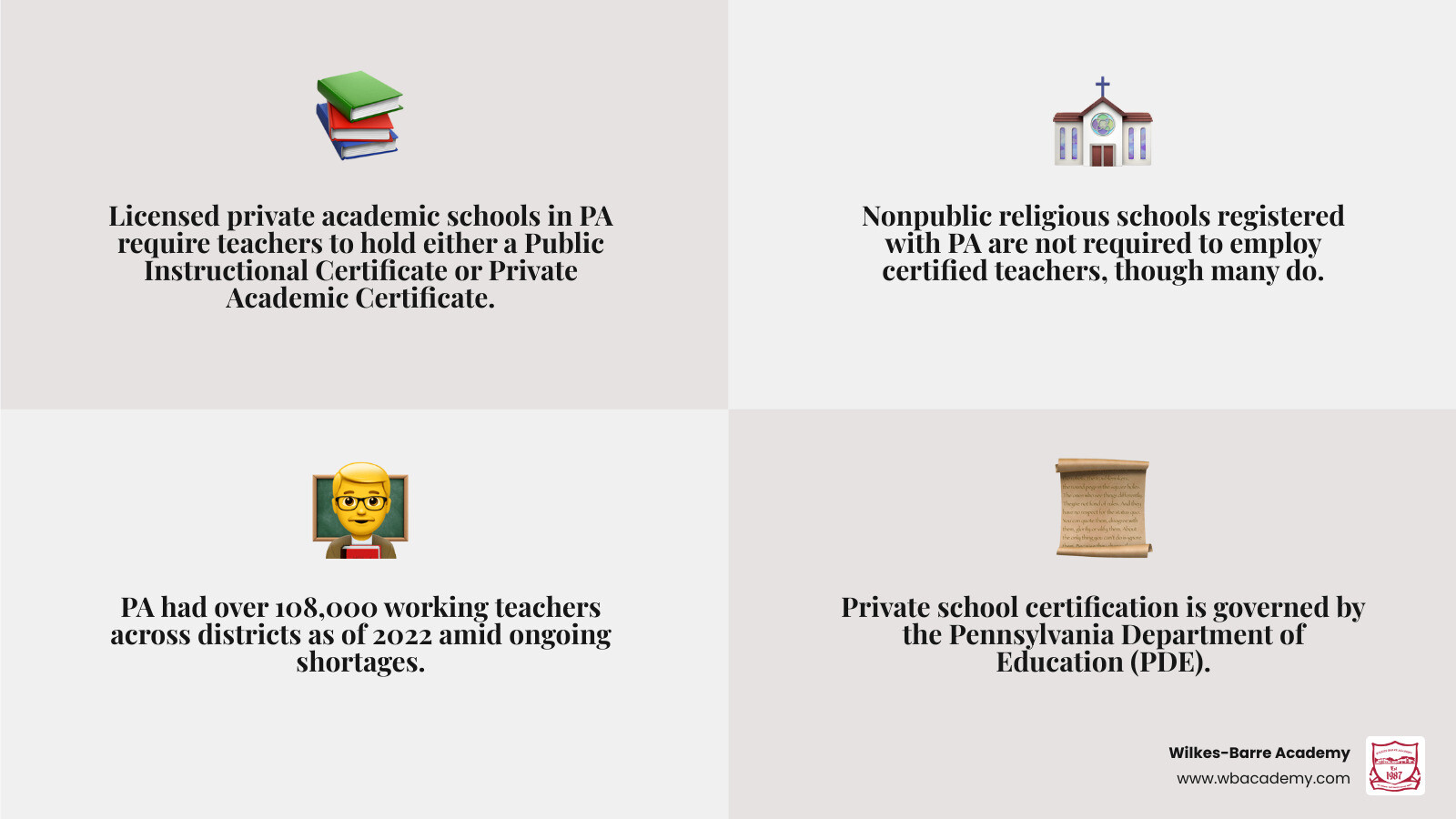
Pennsylvania law requires teachers in licensed private academic schools to hold Pennsylvania certification — either a public school instructional certificate or a Private Academic Certificate. However, nonpublic religious schools registered with the state are not required to employ certified teachers, though many choose to.
Quick Reference: PA Private School Teacher Certification
| School Type | Certification Required? | Governed By |
|---|---|---|
| Licensed private academic school | Yes | PA Dept. of Education |
| Nonpublic/religious school | No (optional) | School’s own policy |
| Approved private special ed school | Yes | PA Dept. of Education |
For parents choosing a private K-8 school in Pennsylvania, teacher quality is everything. You want to know the person standing in front of your child every day has been properly trained, vetted, and credentialed — not just well-intentioned.
Pennsylvania had over 108,000 working teachers across its school districts as of 2022, and the state has been actively working to address a reported teacher shortage. In that environment, understanding exactly what certification means — and what it doesn’t — helps you ask the right questions when evaluating schools.
This guide breaks down the full certification landscape clearly, so you can make a confident, informed decision for your child.
Understanding Certified Teachers Private School Pennsylvania Requirements
When families search for certified teachers private school Pennsylvania, they usually want to know one thing: who is actually required to be certified, and what kind of certification counts?
In Pennsylvania, the answer depends on the type of private school.
According to the state’s Private Academic Certification guidance, teachers in licensed private academic schools must hold Pennsylvania certification in the subject area they teach. That can be either:
- A public school instructional certificate, such as Instructional I or II
- A Private Academic Certificate issued for private academic schools
By contrast, nonpublic religious schools registered with the Pennsylvania Department of Education are not legally required to employ state-certified teachers. Some still prefer or require certification because it signals preparation, subject knowledge, and professionalism.
Approved private special education schools are another category. These schools operate under stronger state oversight and typically require Pennsylvania-certified teachers because they serve students with identified educational needs.
For parents, this distinction matters. Two schools may both be called “private,” but they may operate under very different staffing rules.
Here is a simple comparison:
| Certificate Type | Where It Commonly Applies | Typical Purpose | Ongoing State Maintenance |
|---|---|---|---|
| Public Instructional I | Public schools, also accepted in licensed private academic schools | Entry-level public school teaching | Time-limited pathway to higher level |
| Public Instructional II | Public schools, also accepted in licensed private academic schools | Advanced public school credential | Must remain active under state rules |
| Private Academic Certificate | Licensed private academic schools | Private school teaching in a specific area | Different maintenance rules than public certs |
One important point: a private academic certificate is not just a “lighter” version of public certification. It is a separate state-recognized pathway designed specifically for licensed private academic schools.
That means parents should not assume all private school teachers are uncertified, and they also should not assume every private school follows the same standard. Asking what type of school it is, and what teacher credentials it requires, is a smart place to start.
Core Educational Standards for Certified Teachers in Private School Pennsylvania
At the most basic level, Pennsylvania expects certified private academic teachers to have real college-level preparation in the grades or subjects they teach.
For most Private Academic Certificates, the applicant needs:
- A bachelor’s degree
- Appropriate coursework in the relevant area
- Evidence of good character and legal work authorization
- A completed application through the state system
There is one major exception: Assistant Nursery/Kindergarten certification can be earned with an associate degree or at least 60 college credits rather than a full bachelor’s degree.
The credit requirements vary by certification area. Common examples include:
- Nursery/Kindergarten: 24 semester credits
- Elementary K-8: 18 semester credits in elementary education
- Secondary or K-12 subject areas: 6 semester credits in education theory plus 18 semester credits in the teaching subject
- Special education: generally follows the same pattern of 6 education credits plus 18 credits in the specialty area
The state guidance also notes that coursework used for certification generally must be passed with at least a C. CLEP credit may be accepted in limited amounts, but not as a complete substitute for formal coursework.
While a 3.0 GPA is often associated with admission into many post-baccalaureate teacher certification programs, it is important for families and aspiring teachers to understand that program admission standards and state private academic certification rules are not always identical. Some certification programs may expect that GPA; the state’s private academic pathway focuses more directly on degree completion and required credits.
That distinction matters when evaluating teacher preparation. A teacher may come to the classroom through a traditional undergraduate education program, a post-baccalaureate route, or a targeted private academic pathway. What matters is whether the teacher meets Pennsylvania’s standards for the role.
Professional biographies of Pennsylvania educators often reflect this progression: undergraduate preparation, years of classroom experience, and in many cases graduate coursework or advanced study. That kind of continued learning is one reason many families look closely at a school’s faculty credentials. At Wilkes-Barre Academy, families can learn more about our educational approach on our Academics page.
Subject-Specific Competencies and Grade Levels
Pennsylvania does not use a one-size-fits-all rule for teacher qualification. The requirements change based on what a teacher will actually teach.
For elementary grades, the focus is broad instructional preparation. Teachers need training in how children learn across core subjects such as reading, math, science, and social studies.
For secondary and K-12 subject areas, the state expects deeper subject knowledge. A future science, Spanish, or art teacher in a licensed private academic school typically needs:
- 6 semester credits in education theory
- 18 semester credits in the content area
That structure makes sense. We probably do not want someone teaching chemistry because they once survived chemistry. Pennsylvania agrees.
Special education also has its own competency expectations. Because these roles involve specialized instructional methods, student support planning, and often legal compliance around services, schools generally seek educators with dedicated preparation in that area.
Grade level also shapes the pathway:
- Early childhood roles emphasize child development and foundational learning
- Elementary certification supports broad K-8 teaching
- Secondary certification focuses on a distinct subject field
- K-12 specialty areas cover disciplines taught across multiple grade spans, such as art, music, world languages, or physical education
This is one reason parents should look beyond the phrase “certified teacher” and ask a more precise question: certified in what?
A teacher with strong credentials in one area may not be certified for another. Subject alignment matters just as much as having a certificate at all.
Navigating the TIMS Application and Certification Process
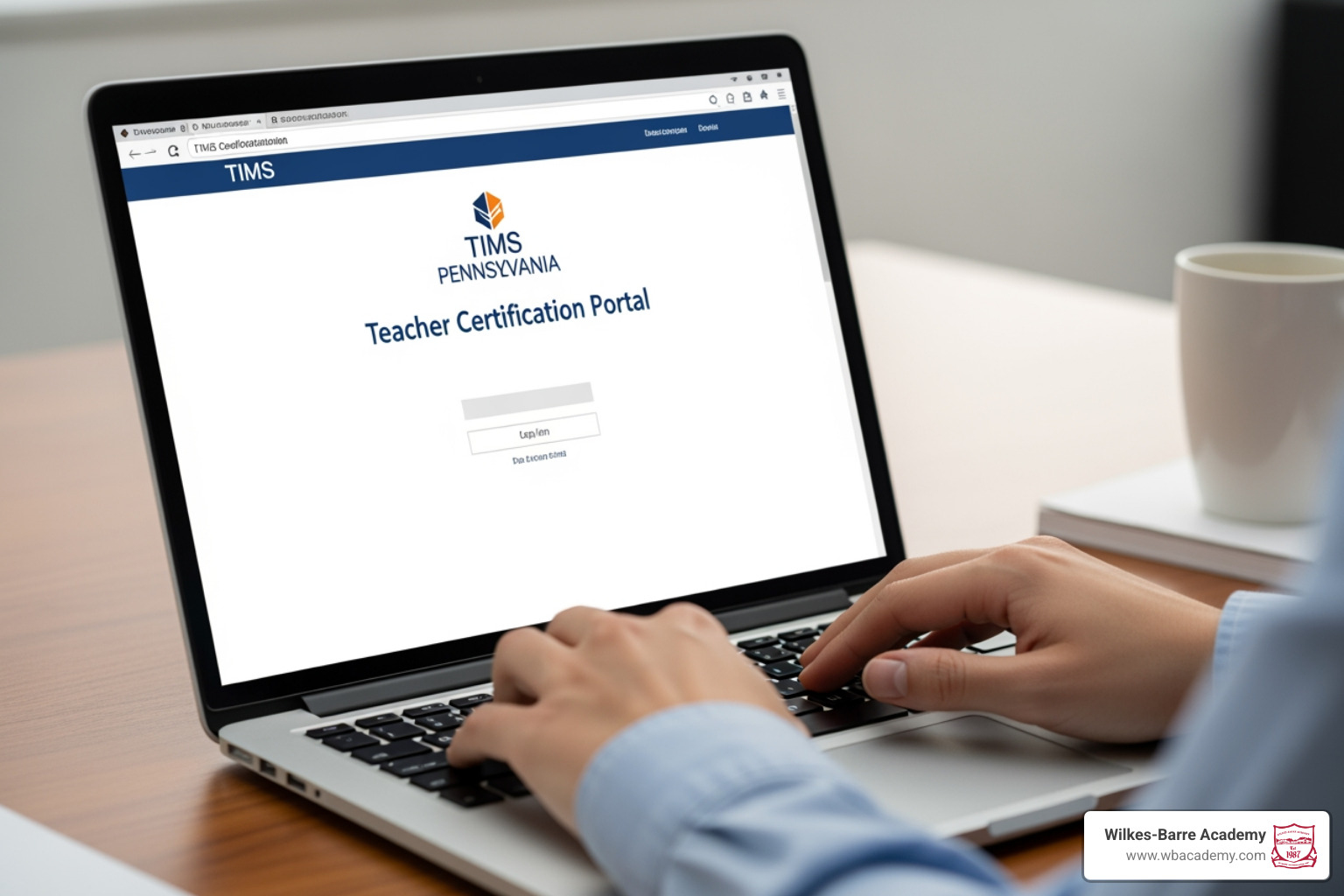
Pennsylvania handles educator certification through TIMS, the Teacher Information Management System. If someone wants a Private Academic Certificate, this is the official application route.
In broad terms, the process looks like this:
- Create or log into a TIMS account.
- Select the correct Private Academic certification area.
- Complete the online application.
- Pay the fee electronically.
- Print the TIMS cover sheet if required.
- Submit supporting documents identified by the system.
Applicants generally need documentation such as:
- Official transcripts
- A health certificate, if required
- Experience verification, when applicable, often using PDE form 338 V
- Any additional identity or credential materials requested in TIMS
A few practical points matter here:
- Applicants usually must file one application per certification area.
- Paper certificates are no longer mailed; approved certificates are accessed electronically.
- The TIMS dashboard is where applicants can check comments and status updates.
This process can feel bureaucratic because, well, it is. But it is also how the state verifies that teachers meet minimum academic and professional standards.
For aspiring teachers in Luzerne County, local workforce and teacher pipeline initiatives can also help clarify pathways into education. The Teach in NEPA Project – Luzerne County Community College highlights regional interest in growing the educator pipeline, which is especially relevant during Pennsylvania’s continuing teacher shortage conversations.
For families evaluating a school, the application process itself is less important than what it represents: there is a formal state system for reviewing credentials in licensed private academic settings. That is meaningful oversight.
At Wilkes-Barre Academy, families who want to get to know the people behind the classroom experience can visit our Faculty/Staff Directory.
Temporary and Assistant Certification for Private School Teachers in Pennsylvania
Pennsylvania does allow some flexibility, particularly for private schools trying to hire during staffing shortages.
A temporary Private Academic Certificate may be issued when:
- The school requests it
- The applicant holds at least a bachelor’s degree
- The applicant has at least 6 credits in the content area
- The candidate does not yet meet the full credit requirements for the standard private academic certificate
This temporary route helps schools fill positions while teachers finish the rest of their coursework. It is not meant to bypass standards forever. It is more like a “you may start, but you still have homework” arrangement.
The school usually plays an active role in this request, often through a letter from the education director or administrator.
Pennsylvania also offers an Assistant Nursery/Kindergarten certificate. This pathway differs from most others because it does not require a bachelor’s degree. Instead, the applicant needs:
- An associate degree, or
- At least 60 college credits
That makes this assistant-level credential distinct from full teaching certification.
For families, temporary and assistant credentials are not automatically red flags. They are recognized pathways under Pennsylvania rules. Still, they are worth understanding. A parent can reasonably ask:
- Is the teacher fully certified or temporarily certified?
- If temporary, what is the timeline for completion?
- Is the teacher working in the right subject or grade span?
Those are fair questions, especially in a market where private schools may be hiring for immediate openings across elementary, specialty, and middle school roles.
Evaluations for Out-of-State and Foreign-Educated Educators
What happens if a teacher earned a degree somewhere else?
For out-of-state teachers, Pennsylvania may recognize prior certification under reciprocity frameworks, including agreements commonly associated with the NASDTEC Interstate Agreement. However, reciprocity is not always automatic. An educator may still need to show:
- Comparable preparation
- Valid prior certification
- Relevant experience
- Additional testing or documentation, depending on the case
For private academic certification specifically, the state still wants proof that the applicant’s academic background matches Pennsylvania requirements.
For foreign-educated applicants, Pennsylvania requires a credential evaluation from an approved evaluator, such as a NACES member or AICE. The evaluation must show the U.S. equivalency of the degree and coursework.
This is especially important because the state cannot simply guess whether a degree from another country is equivalent to a Pennsylvania bachelor’s degree with the right subject preparation. Translation and evaluation are part of the process.
Applicants must also be either U.S. citizens or otherwise legally authorized to work in the United States.
For families relocating to Luzerne County or considering local private school options, teacher hiring can include educators from outside Pennsylvania. That is not a problem in itself. The important question is whether their credentials have been properly reviewed and accepted.
Families exploring school fit more broadly can learn about our community and enrollment process through Admissions.
Career Growth and Maintaining Your Professional Standing
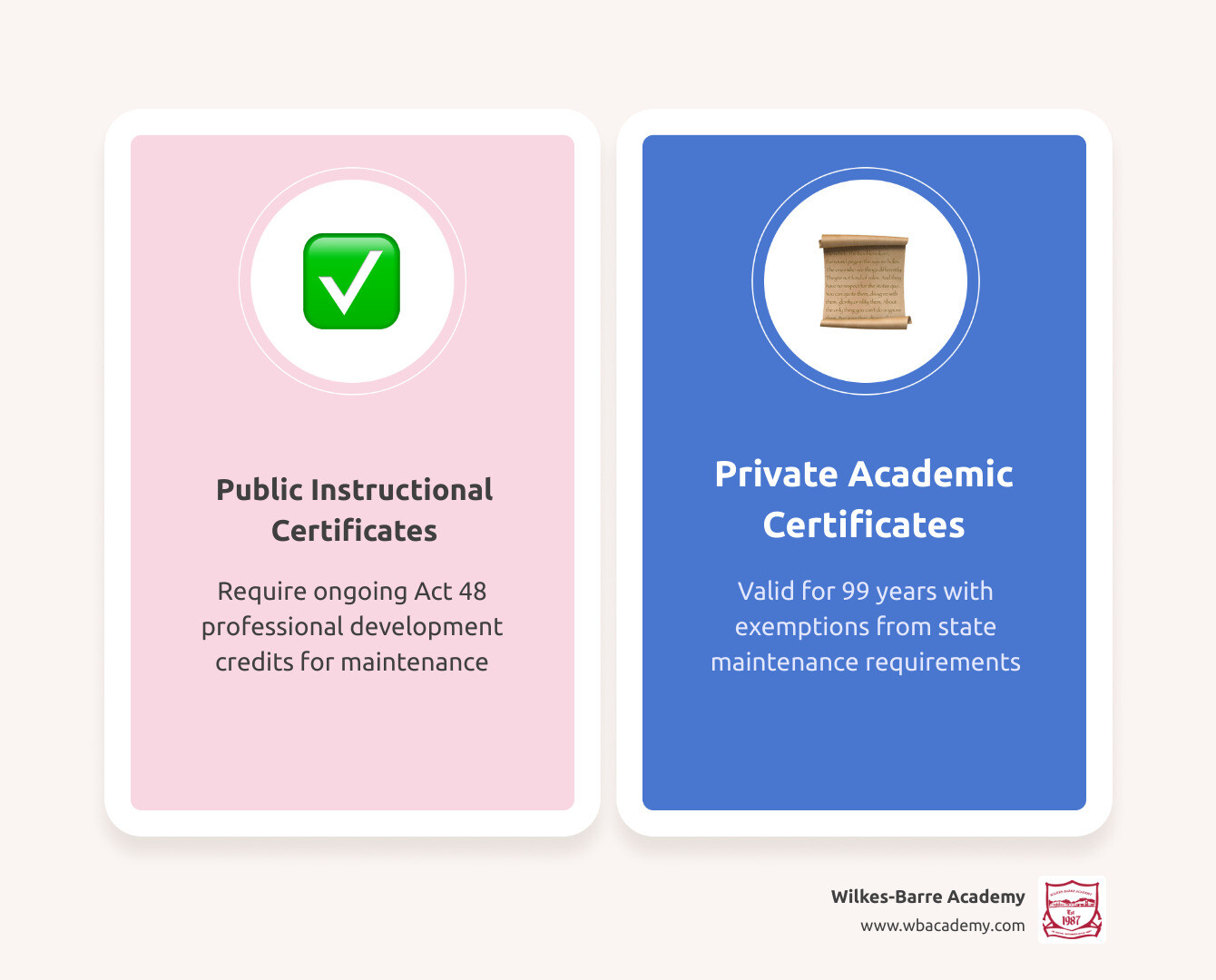
One of the more surprising facts about Pennsylvania’s Private Academic Certificate is that it is valid for 99 years. Yes, really. It may be the closest thing education has to a “set it and don’t lose the PDF” credential.
Just as important, the research indicates that Act 48 continuing education requirements do not legally apply in the same way to private academic certificate holders as they do to public school instructional certificate holders.
That creates a major distinction between public and private pathways:
- Public instructional certificates carry specific ongoing state maintenance requirements
- Private academic certificates are long-validity credentials with different compliance expectations
However, families should not confuse fewer state maintenance rules with lower professional standards. Many excellent private schools still expect faculty to pursue professional development, curriculum training, and ongoing growth because strong teaching does not stand still.
This is especially true in K-8 environments, where teachers must respond to changing academic expectations, student needs, and instructional best practices.
For aspiring teachers who already hold a bachelor’s degree but need certification, post-baccalaureate programs can be a practical route. Pennsylvania institutions offer these programs in areas such as:
- Early childhood education
- Elementary education
- ESL
- Health and physical education
- Other instructional fields
Some are online or hybrid, though student teaching requirements may still need to be completed in person in Pennsylvania. As always, the key is making sure a program aligns with Pennsylvania certification requirements before enrolling.
Private school job opportunities across Pennsylvania often show demand in:
- Elementary classroom teaching
- Special education
- Art
- Science
- World languages such as Spanish
- Montessori and early childhood roles
That demand reflects both ongoing hiring and the broader teacher shortage environment. For schools and families alike, certification supports confidence that an educator has met a baseline professional standard before stepping into the classroom.
For parents comparing school value, faculty quality is one part of the larger picture alongside program design, class size, and community fit. You can explore our school details through our Tuition Schedule 2024-2025 page.
Frequently Asked Questions about Private School Certification
Do religious schools in Pennsylvania require state-certified teachers?
Not by state law, in general, if they are nonpublic religious schools registered rather than licensed as private academic schools. These schools may set their own hiring standards, and many still prefer certified educators. But the legal requirement that teachers hold Pennsylvania certification applies to licensed private academic schools.
How does a Private Academic Certificate differ from a Public Instructional I license?
A Public Instructional I certificate is part of Pennsylvania’s public school certification structure and typically serves as an entry-level public school teaching credential. It comes with progression rules and time-based expectations.
A Private Academic Certificate is specifically for teaching in licensed private academic schools. It is a separate state-recognized certificate, usually based on degree and coursework requirements in the grade or subject area. It also has a much longer validity period and different maintenance expectations.
In short:
- Public Instructional I is for the public school certification ladder
- Private Academic certification is for licensed private academic school teaching
- Both can satisfy the certification requirement in a licensed private academic school
Can I teach in a private school while completing my certification credits?
Sometimes, yes.
If the school is a licensed private academic school, a temporary Private Academic Certificate may be possible if the school requests it and the candidate has a bachelor’s degree plus at least 6 credits in the content area. This is designed for applicants who do not yet meet the full coursework requirement.
If the school is a nonpublic religious school, state certification may not be legally required at all, though the school can still impose its own rules.
The key is not to assume that “private school” means “no certification needed.” In Pennsylvania, the school category determines the answer.
Conclusion
For families in Wilkes-Barre and across Luzerne County, understanding teacher certification is an important part of choosing the right school. The phrase certified teachers private school Pennsylvania is not just a search term. It points to a real question about quality, accountability, and student support.
At Wilkes-Barre Academy, we believe strong teaching and individualized learning go hand in hand. As a private, non-profit K-8 school, we are committed to an academically advanced environment, close family-school relationships, and a warm, diverse community where students are known well.
If you want to learn more about who we are and how we support students in a close-knit educational setting, visit our About page.