How Much is Private School in PA? Tuition Stats and Affordable Options
What Does Private School Tuition in Pennsylvania Actually Cost?
If you’re researching private school tuition in Pennsylvania, here’s a quick overview of what families are paying in 2026:
| School Level | Average Annual Tuition (PA) |
|---|---|
| All K-12 Private Schools | $14,823 |
| Private Elementary Schools | $13,096 |
| Private High Schools | $19,148 |
| Lowest-Cost Option (Penn Foster) | $1,199 |
| Top-End Schools (e.g., Philadelphia area) | $45,000-$51,000+ |
Pennsylvania ranks 35th highest among all U.S. states for average private school tuition – meaning it’s slightly above the national average of $12,790, but far from the most expensive states like Connecticut.
The range is wide. A family in Northeast Pennsylvania may find options well below the state average. A family in Philadelphia looking at elite day schools could face tuition north of $45,000 per year.
And that’s just the base tuition. Uniforms, technology fees, transportation, and activity costs can add thousands more each year.
For parents weighing whether private school is the right move – and how to afford it – understanding the full picture matters. Pennsylvania also has financial aid programs, tax-credit scholarships, and school-based assistance that can significantly reduce what families actually pay out of pocket.
This guide breaks it all down: what schools cost, how costs vary by region and grade level, what financial help is available, and what to budget for beyond the sticker price.
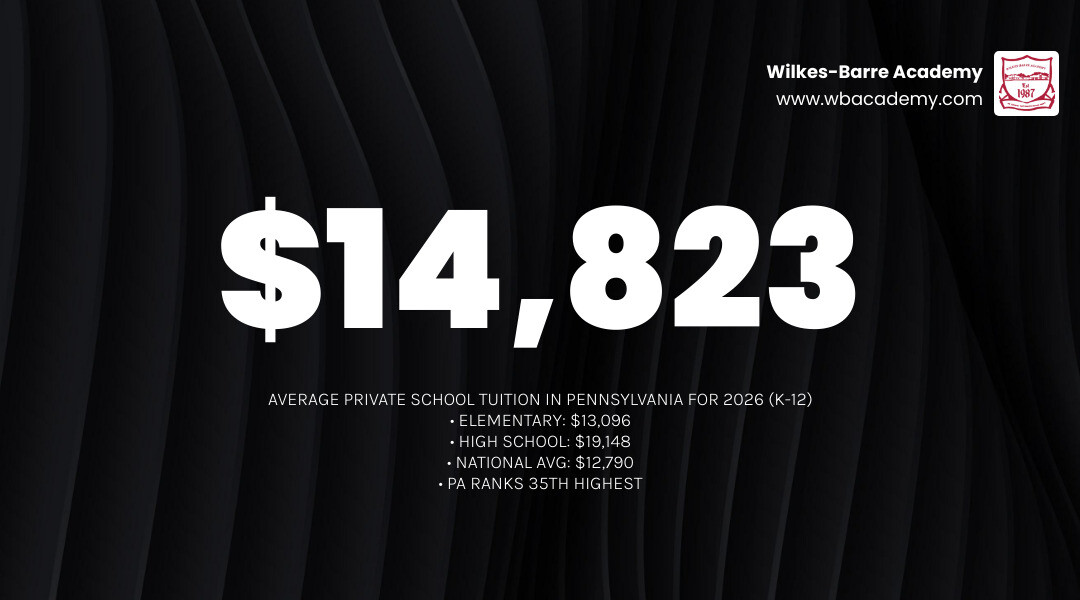
Average Private School Tuition Pennsylvania 2026
In 2026, the average private school tuition across Pennsylvania is about $14,823 per year, based on statewide tuition data compiled here: Pennsylvania Private Schools By Tuition Cost (2026).
That statewide number is useful, but it is only a starting point. Tuition can vary a lot depending on:
- Grade level
- School type
- Religious affiliation
- Location
- Whether a school is day-only or boarding
- What is included in tuition
For families in Luzerne County and the Wilkes-Barre area, that variation matters. In our part of Northeast Pennsylvania, many families find more budget-friendly tuition than they would in Pennsylvania’s largest metro markets.

A few key 2026 benchmarks to know:
- Average all-private-school tuition in Pennsylvania: $14,823
- Average private elementary school tuition: $13,096
- Average private high school tuition: $19,148
- Pennsylvania’s tuition rank nationally: 35th highest
That elementary-to-high-school jump is important. High school tuition is usually significantly higher because schools often offer more specialized faculty, college counseling, athletics, labs, arts programming, and advanced coursework.
For K-8 families, that means elementary and middle school costs often sit below the headline-grabbing prices people associate with private high schools. In plain English: when people say, “Private school in PA costs a fortune,” they are often thinking of top-tier high schools in bigger cities, not every K-8 school across the state.
Comparing Private School Tuition Pennsylvania to National Averages
Pennsylvania is a bit more expensive than the national average, but not dramatically so.
| Tuition Category | Pennsylvania Average | National Average |
|---|---|---|
| All Private Schools | $14,823 | $12,790 |
| Elementary Private Schools | $13,096 | Lower than PA average |
| Secondary Private Schools | $19,148 | Lower than PA average |
Using an older statewide figure of $14,807 instead of $14,823 leads to the same conclusion: Pennsylvania sits modestly above the U.S. average.
What does that mean for families?
- Pennsylvania is not among the cheapest states for private school.
- It is also not among the highest-cost states.
- The biggest issue is not the state average itself, but how widely tuition varies inside the state.
That is why comparing one school to the statewide average can be a little like comparing apples to backpacks. A school may be above average but still offer strong value if tuition includes materials, activities, and support services. Another school may look affordable up front but charge extra for everything short of breathing.
For a family budgeting over many years, it also helps to think in terms of total educational investment. A difference of even $2,000 per year becomes substantial over 9 years of K-8 or 13 years of K-12.
Regional Variations in Private School Tuition Pennsylvania
Where you live in Pennsylvania can make a major difference in what you pay.
In general:
- Private schools in and around major metro areas tend to be among the most expensive in the state.
- Suburban independent schools near large population centers usually cost more than rural or smaller-market schools.
- Northeast Pennsylvania often offers more affordable options than southeastern Pennsylvania.
At the top end, some Pennsylvania private schools charge well above $40,000 per year for older students. Research examples for 2026-27 show middle and upper school rates in the mid-$30,000s to low-$50,000s in some higher-cost Pennsylvania markets. Those schools are real parts of the Pennsylvania landscape, but they are not representative of what every family in Luzerne County should expect.
Closer to home, lower-cost examples in the Wilkes-Barre area and Luzerne County show a very different picture. Listings for local private schools and county-level directories suggest that Northeast Pennsylvania includes schools with tuition far below the statewide average, especially among faith-based schools and smaller community schools.
You can explore broader affordability data statewide at Pennsylvania Private Schools By Tuition Cost (2026) and a county snapshot at Best Private Schools in Luzerne County (2026).
For many families, this is the good news: private school in Northeast Pennsylvania is often more attainable than the statewide headlines make it sound.
Financial Aid and the Pennsylvania EITC Program
Sticker price is not always the final price. In Pennsylvania, many families lower their out-of-pocket tuition through financial aid, school-based grants, and scholarship programs.
One of the biggest programs to know is Pennsylvania’s Educational Improvement Tax Credit, or EITC.
The EITC program works by giving businesses tax credits when they donate to approved scholarship organizations. Those scholarship organizations then help eligible students attend participating private schools. So while it sounds like tax code soup, the result for families can be simple: lower tuition bills.
At Wilkes-Barre Academy, families can learn more through our EITC Grant page. For a broader overview of Pennsylvania private education aid options, Private Education Programs – PaFEC is also helpful.
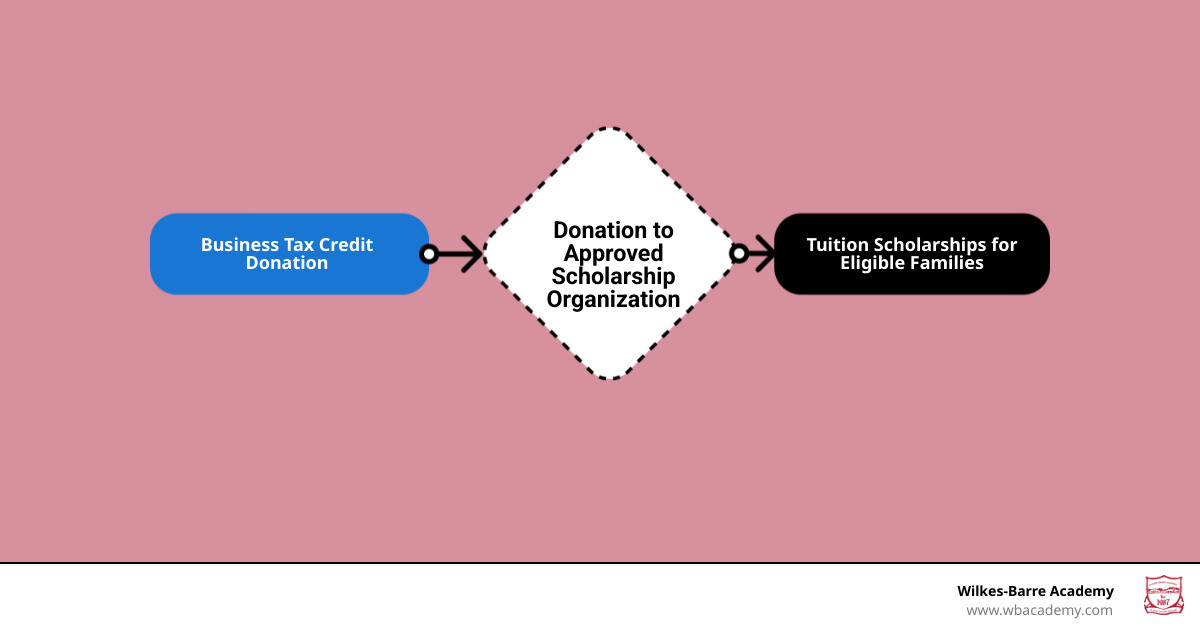
Pennsylvania scholarship support may include:
- EITC scholarships
- OSTC scholarships in qualifying circumstances
- School-based need-based aid
- Family-funded payment plans
- Sibling discounts at some schools
- Community or church-supported aid at some religious schools
For many families, combining more than one strategy works best.
Income Eligibility for EITC and OSTC
Based on the 2026 research provided, EITC household income eligibility starts with:
- $92,160 base household income
- Plus $16,222 for each dependent child
That means a family with two children may qualify with household income up to $124,604.
These numbers matter because they show that EITC is not limited only to the lowest-income households. Middle-income families may qualify too, which surprises a lot of parents.
A few practical points:
- Eligibility depends on current program rules and household circumstances.
- Scholarship funds are generally sent directly to the school, not to the parent.
- Schools often guide families through the application process.
- There is no reason to assume you earn too much without checking first.
Families can also review our Voucher Program page for additional guidance tied to tuition assistance options.
School-Based Scholarships and Grants
Beyond state-supported scholarship programs, many private schools offer their own assistance. This may include:
- Need-based financial aid
- Limited merit scholarships
- Sibling discounts
- Payment flexibility instead of direct discounting
Most school-based aid requires an application, and timing matters. In many cases, families have the best chance of receiving aid when they apply early and submit all required documents.
A smart family budgeting strategy usually includes:
- Asking for the full cost of attendance, not just tuition
- Requesting deadlines for aid applications
- Checking whether discounts stack with other aid
- Confirming what happens if family income changes mid-year
- Building a buffer for fees, supplies, and events
Private school finances can feel intimidating at first, but they get much more manageable once the numbers are laid out clearly. Spreadsheets are less scary when they are not hiding in the shadows.
Legal Obligations: Private School Tuition in PA Child Support Cases
When parents are separated or divorced, a common question is: who pays private school tuition?
In Pennsylvania family law, private school tuition is generally treated as an extra expense added on top of basic child support, not something automatically covered by the standard support amount.
Research on Pennsylvania child support guidance points to a few core principles:
- Private school tuition is usually an add-on expense
- It is not automatically split 50/50
- Courts often allocate it based on each parent’s share of combined income
- The court may consider whether private school is reasonable under the circumstances
That last point matters. A court may look at issues such as:
- Whether the child attended private school before the parents separated
- Whether the family has the income to support the expense
- Whether financial aid options have been explored
- Whether the cost is reasonable compared to the parents’ resources
Support court focuses heavily on financial numbers. Disputes about school choice itself may be handled elsewhere, such as in custody-related proceedings.
Allocation Between Parents in Family Law
Pennsylvania does not require a simple 50/50 split for private school tuition.
Instead, a common approach is proportional allocation based on income. For example:
- If Parent A earns 80% of the combined income
- And Parent B earns 20%
- Then tuition may be divided 80/20
This same principle can apply to other approved add-on expenses.
Important distinctions:
- Basic child support usually covers routine costs like clothing, meals, and ordinary school items
- Private school tuition is often treated separately
- Payment may be handled through direct reimbursement or folded into support payments
- Clear records are important
Families in this situation should keep:
- Tuition invoices
- Proof of payment
- Scholarship or aid notices
- Any written agreements about cost sharing
The practical takeaway is simple: if private school tuition is part of a child support case, the actual legal question is usually not “Who wants this school more?” but “What is financially reasonable, and what percentage should each parent pay?”
Beyond the Base Rate: Additional Costs and Payment Strategies
Base tuition is important, but it is not the whole budget.
Many Pennsylvania private schools charge extra for some combination of:
- Registration or enrollment fees
- Technology fees
- Books and supplies
- Uniforms or dress code items
- Lunch
- Transportation
- Athletics
- Clubs and activities
- Field trips
- Before- and after-school care
- Testing or exam fees
That is why families should always ask for the total annual cost, not just the advertised tuition.
At some schools, tuition is relatively inclusive. At others, fees come in layers. One bill for tuition can quietly become five smaller bills with surprisingly good timing if your goal is to ruin a Tuesday.
At Wilkes-Barre Academy, families can review our Tuition Schedule 2024-2025 and our main Tuition page to better understand planning and payment expectations.
Common non-tuition costs in Pennsylvania can include:
- Uniforms: often a few hundred dollars annually
- Textbooks and supplies: varies by grade
- Transportation or van service: can add a meaningful annual amount
- Extended day programs: especially relevant for working families
- Tuition protection or refund plans
- Activity and exam fees in older grades
These extra costs are one reason why two schools with similar listed tuition can feel very different in real life.
Payment Plans and Tuition Insurance
Fortunately, many private schools offer payment structures that make costs easier to manage.
Common options include:
- One annual payment
- Two-payment plans
- Ten-month payment plans
- Third-party billing systems such as FACTS at some schools
Monthly plans can be especially helpful for families who do not want one large tuition payment landing all at once.
Families should also ask about tuition insurance or refund plans. These plans often cost a small percentage of tuition and may help if a student withdraws because of certain qualifying circumstances. They do not fit every family, but they are worth understanding before signing an enrollment contract.
Other cost-reduction tools may include:
- Sibling discounts
- Early payment discounts
- Scholarship renewal programs
- Church subsidies at religious schools
- Fundraising or rebate programs
For example, some schools and families use gift-card or shopping rebate programs to earn tuition credits over time. These savings usually will not erase tuition altogether, but they can help with books, fees, or a portion of the annual bill.
If you are comparing schools, ask these questions:
- What is included in tuition?
- What fees are mandatory?
- Are payment plans interest-free?
- Is tuition insurance required or optional?
- Are discounts available for siblings?
- What is the likely total annual out-of-pocket cost?
Frequently Asked Questions about Private School Tuition Pennsylvania
What is the average cost of private elementary vs. high school in PA?
In 2026, the average private elementary school tuition in Pennsylvania is $13,096, while the average private high school tuition is $19,148.
That means high school is roughly $6,000 more per year on average.
Why the gap?
- High schools often have more specialized teachers
- Science labs, athletics, arts, and counseling cost more
- College-prep programming adds expense
- Older students may have access to broader extracurricular offerings
For families looking at K-8 schools in Luzerne County, this is encouraging. K-8 tuition often aligns more closely with the elementary average than with the much higher private high school average.
Are religious schools more affordable than secular schools in Pennsylvania?
Often, yes.
Many religious schools in Pennsylvania charge less than non-religious independent schools. That is commonly because they may receive support from a church, parish, or faith community, which can reduce the amount families must pay directly.
As a result:
- Faith-based schools are often among the lower-cost options
- Independent secular schools often charge more
- Religious affiliation is one of the biggest factors affecting tuition
That said, affordability should be considered alongside fit. Families should still look at:
- Academic program
- Classroom size
- School culture
- Communication with parents
- What tuition includes
- Available financial aid
The cheapest option is not always the best value, and the most expensive option is not automatically the best fit.
How do day school costs vary across Pennsylvania?
Day school costs vary widely by region and grade level.
In broad terms:
- Northeast Pennsylvania day schools often cost less than schools in the Philadelphia market
- Elementary and middle grades are usually less expensive than high school
- Schools with highly specialized programs or premium facilities usually cost more
- Tuition may or may not include technology, activities, and supplies
For local families, the most useful comparison is often not “What is the richest school in Pennsylvania charging?” but “What does a strong school in our region cost, and what do we get for that price?”
That is where mission and model matter. As a private, non-profit K-8 school in Luzerne County, we know many families are looking for a balance of academic quality, personal attention, and manageable cost. Smaller communities and a single classroom per grade can support a more individualized experience without imitating the price structure of large urban campuses.
Conclusion
Private school tuition in Pennsylvania covers a wide range. In 2026, the statewide average is $14,823, but actual costs depend on grade level, region, school type, and what is included beyond base tuition.
For families in Wilkes-Barre and Luzerne County, the takeaway is reassuring: local private school options may be more affordable than the statewide headlines suggest, especially when you consider financial aid, EITC-related assistance, payment plans, and school-specific support.
Just as important, the best tuition decision is not only about the sticker price. It is about value, fit, and whether a school gives your child the academic and personal environment they need to thrive.
At Wilkes-Barre Academy, we are proud to offer a private, non-profit K-8 education with an academically advanced curriculum, individualized learning through a single classroom per grade, and strong family-school connections in a close-knit community.
If you would like to learn more, explore our More info about tuition and enrollment.