Step-by-Step Guide to Becoming a Private School Teacher in PA
How to Become a Teacher at a Private School in PA: Start With the School Type
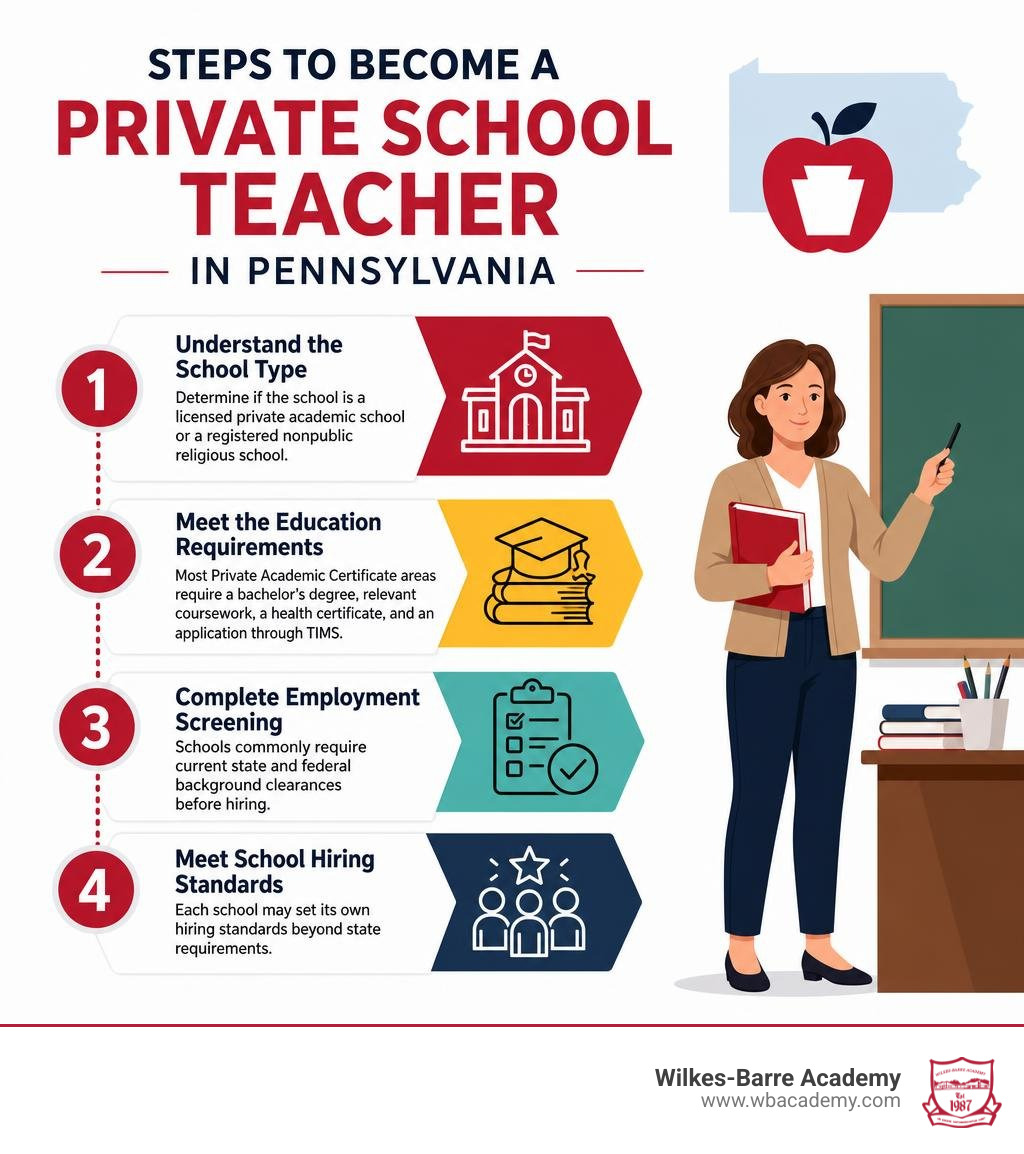
To learn how to become a teacher at a private school in PA, first find out whether the school is a licensed private academic school or a registered nonpublic religious school.
- For a licensed private academic school: You need a Pennsylvania public-school certificate, a Private Academic Certificate, or a temporary private academic certificate.
- For a registered nonpublic religious school: Pennsylvania does not require state certification, although the school may set its own hiring standards.
- Meet the education requirements: Most Private Academic Certificate areas require a bachelor’s degree, relevant college coursework, a health certificate, and an application through Pennsylvania’s Teacher Information Management System (TIMS).
- Complete employment screening: Schools commonly require current state and federal background clearances before hiring.
The key difference matters. A strong subject background may be enough for some nonpublic schools, while licensed private academic schools must employ teachers who hold an appropriate state-recognized credential. Pennsylvania also offers a one-year temporary private academic certificate for eligible bachelor’s-degree holders who are still completing required coursework.
This guide explains the certification path, application paperwork, temporary options, and what private-school employers may look for beyond state rules.
Understanding the Legal Framework: How to Become a Teacher at a Private School in PA
Teaching in Pennsylvania’s private education sector offers immense professional freedom, smaller class sizes, and strong relationships with families. However, navigating the legal requirements can feel daunting without a clear roadmap. The regulatory foundation for non-public education in the Commonwealth is governed by the Pennsylvania Department of Education (PDE), the State Board of Private Academic Schools, and statutory provisions under 22 Pa. Code § 51.34.

The State Board of Private Academic Schools oversees nine appointed members who establish minimum qualifications for teachers, specialists, and administrators across licensed nursery, kindergarten, elementary, secondary, and special education institutions.
| Feature / Requirement | Licensed Private Academic School | Registered Nonpublic (Religious) School | Public School District |
|---|---|---|---|
| Mandatory State Certification | Yes (PA Public or Private Academic Certificate) | No (Determined by individual school policy) | Yes (PA Instructional I or II Certificate) |
| Credential Validity | 99 Years (Private Academic Certificate) | N/A | 6 Service Years (Level I conversion required) |
| Act 48 Continuing Ed Mandate | Exempt (Unless holding public certificate) | Exempt | Mandatory (180 hours every 5 years) |
| Minimum Degree Level | Bachelor’s Degree (Associate for Assistant Nursery) | Set by School Policy | Bachelor’s Degree + Approved Ed Program |
| State Testing (Praxis / PAPA) | Not required for Private Academic Certificate | Not required | Mandatory |
Licensed Private Academic Schools vs. Registered Nonpublic Religious Schools
Understanding school categorization is the single most important step for your career path:
- Licensed Private Academic Schools: These non-sectarian, secular private schools are licensed directly under the Private Academic Schools Act. By law under 22 Pa. Code § 51.34, every classroom teacher must hold either a valid Pennsylvania public teaching certificate (Chapter 49), a Pennsylvania Private Academic Certificate, or an approved temporary permit. These institutions maintain rigorous academic benchmarks that create certified success for Pennsylvania private school students.
- Registered Nonpublic Religious Schools: Schools operated by religious organizations and registered with the PDE are legally exempt from state teacher certification mandates. These schools retain complete institutional autonomy over hiring criteria. While many choose to hire certified educators to uphold academic excellence, state law does not require it.
- Approved Private Schools (APS): Specialized private schools serving students with severe disabilities under 22 Pa. Code § 171.23 or receiving Pre-K Counts funding must employ educators holding active public school instructional certificates.
Certificate Validity, Act 48 Exemptions, and Level I/II Rules
One of the greatest advantages of securing a dedicated Pennsylvania Private Academic Certificate is its longevity and flexibility:
- 99-Year Validity: Unlike provisional public school teaching credentials that expire after several years, a Private Academic Certificate is officially valid for 99 years.
- Act 48 Exemption: Holders of a Private Academic Certificate are not legally mandated to fulfill Act 48 requirements (180 continuing professional education hours every five years) to keep their credential active.
- No Mandatory Level II Conversion: In Pennsylvania public schools, teachers holding an Instructional I (provisional) certificate must complete 24 post-baccalaureate credits, three years of satisfactory service, and a state induction program within six service years to convert to Level II permanent status. Under state regulations, private academic school teachers are explicitly exempt from this conversion mandate—an Instructional I certificate remains valid for continuing employment in a private academic school without lapsing.
Educational Requirements and Subject Competency Standards
To earn a full Private Academic Certificate through the Pennsylvania Department of Education, candidates must satisfy specific educational baselines.
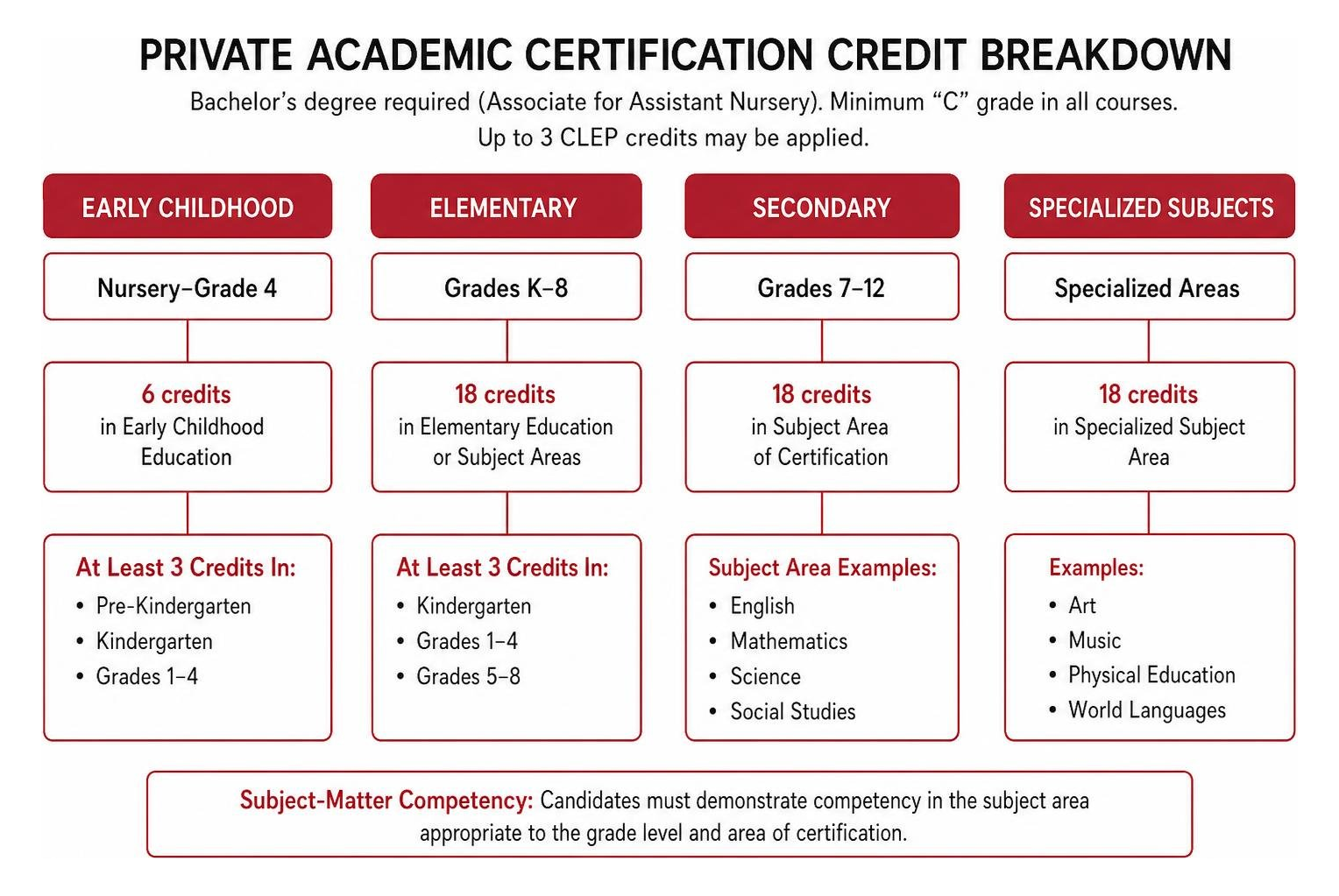
Every applicant must hold a bachelor’s degree from an accredited four-year college or university (with one exception for early childhood assistants), maintain at least a “C” grade in all qualifying coursework, and demonstrate subject-matter competency. A maximum of 3 college credits earned via College-Level Examination Program (CLEP) tests can be applied toward content requirements.
Grade-Level and Specialized Subject Competencies
Credit requirements vary across grade levels and disciplines:
- Nursery and Kindergarten (Ages 3–6): Requires a bachelor’s degree including 24 semester hours in early childhood education, child development, or elementary education.
- Assistant Nursery / Kindergarten Teacher: Requires an associate degree or completion of at least 60 postsecondary college credits, including 24 semester hours in early childhood or child development.
- Elementary Education (Grades K–8): Requires a bachelor’s degree and either 18 semester hours in elementary education content/theory, a valid PA public elementary certificate, or a bachelor’s degree paired with 2 years of verified, successful elementary teaching experience.
- Secondary Education (Grades 9–12) and K–12 Subjects: Candidates preparing for secondary roles (such as English, Mathematics, Biology, Chemistry, Social Studies, or Foreign Languages) or K–12 special subjects (Art, Music, Physical Education) must document:
- 18 semester credits in the specific content discipline (e.g., historical periods, biological sciences, higher-level mathematics). Programs like the Secondary Education Major and Minor provide a direct foundation for these content distributions.
- 6 semester credits in education theory (such as adolescent development, curriculum design, or educational psychology) OR 1 year of documented, successful teaching experience in that subject area.
- Special Education: Requires 24 semester credits in special education theory, consisting of 6 foundational theory credits, 6 credits focused on the specific exceptionality (e.g., learning disabilities, autism spectrum, emotional disturbance), and 12 specialized elective credits.
- Reading and Psycho-Educational Testing Specialists: Requires a master’s degree or advanced specialist coursework in diagnostic educational testing, remediation, and clinical literacy evaluation.
Career Changers: How to Become a Teacher at a Private School in PA with a Non-Education Degree
If you hold a bachelor’s degree in a non-education field—such as English, Chemistry, History, or Engineering—you do not need to repeat an entire four-year undergraduate program.
Pennsylvania’s private academic certification standards recognize your subject-area degree coursework directly. Provided your official transcripts display at least 18 credits in the subject discipline with grades of “C” or better, you only need 6 credits of foundational educational theory. Alternatively, if you have accumulated classroom experience in an independent or out-of-state institution, your employing administrator can verify your classroom hours using official state verification forms (PDE 338 V) to satisfy pedagogy credit requirements.
Application Steps and Administrative Requirements
Applying for your official credential is an orderly, digital process managed through the Pennsylvania Department of Education.
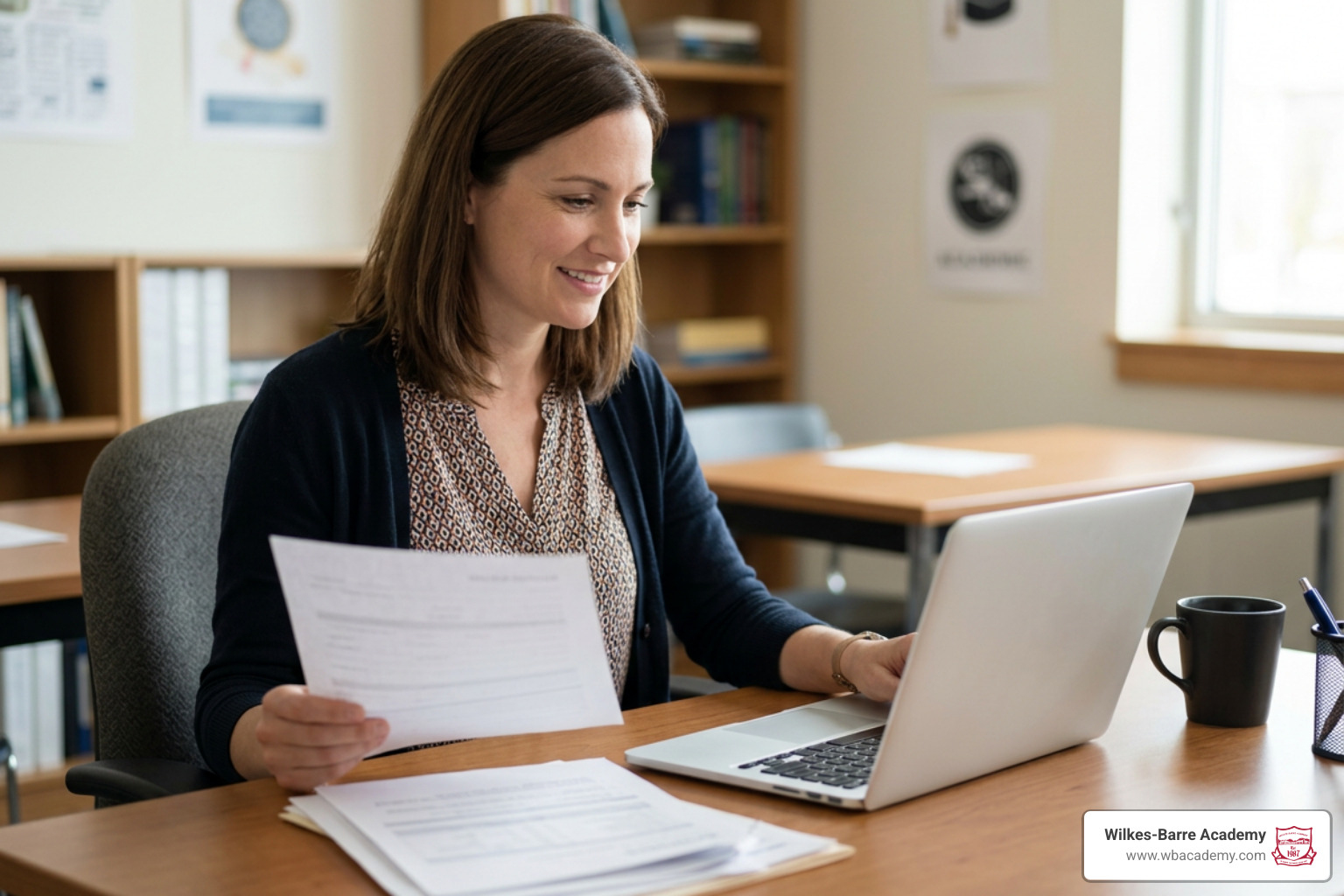
- Create a Keystone Login: Register an account on the Pennsylvania Department of Education portal to access TIMS (Teacher Information Management System).
- Initiate Application in TIMS: Select “Private Academic Certificate” and specify your single intended subject or grade band. (Note: Separate applications must be submitted if applying for multiple distinct subject areas).
- Enter Educational History: Input all undergraduate and graduate coursework, degrees conferred, and institutional details.
- Print Application Cover Sheet: Once submitted online and application fees are paid, generate and print your customized TIMS cover sheet.
- Submit Supporting Documentation: Mail or electronically transfer your official college transcripts, completed Health Certificate, and PDE 338 V experience forms to the Bureau of School Leadership and Teacher Quality.
Temporary Pathways: How to Become a Teacher at a Private School in PA via One-Year Permits
If a licensed private academic school wants to hire you immediately, but you still need coursework to satisfy the full 18- or 24-credit requirement, Pennsylvania offers an accessible stepping stone: the Temporary Private Academic Certificate.
- Eligibility: You must hold a baccalaureate degree and have completed at least 6 college credits in the requested content area.
- Sponsorship: The temporary permit must be requested via TIMS on official school letterhead and signed by the licensed school’s PDE-approved Education Director.
- Validity and Renewal: The temporary certificate is valid for exactly one calendar year. It can be renewed annually upon demonstrating that you have completed an additional 6 credits of relevant coursework toward your full credential during that school year.
Clearances, Health Forms, and Foreign Degree Evaluations
All educators working in direct contact with children in Pennsylvania schools must clear comprehensive state and federal background checks:
- Act 34: Pennsylvania State Police Criminal Record Check.
- Act 151: Pennsylvania Child Abuse History Clearance.
- Act 114: FBI Criminal Background Check with fingerprinting.
- Act 168: Sexual Misconduct/Abuse Disclosure release forms from all prior school employers.
- Health Certificate: A physical medical examination and tuberculosis (TB) screening signed by a licensed physician using the state-provided health certificate form.
- Foreign Credential Evaluation: Applicants educated outside the United States must provide a professional, course-by-course evaluation verifying U.S. degree equivalency through an approved agency accredited by the National Association of Credential Evaluation Services (NACES) or the Association of International Credential Evaluators (AICE).
These procedures align with broader statewide child safety and school health mandates outlined in private school student safety Pennsylvania resources, reflecting our shared legal commitment to PA private school non-discrimination across all hiring practices.
Career Outlook, Salaries, and Teaching Environment in PA
Pennsylvania has a robust educational ecosystem, supporting over 108,000 working teachers across 788 school districts alongside hundreds of independent and private institutions.
While public school secondary teachers earn a statewide median salary of $75,940 (with regional Scranton–Wilkes-Barre medians around $75,050), starting and mid-career salaries in private schools generally range from $45,000 to $55,000+ for instructional faculty, with leadership compensation scaling considerably higher.
Many educators intentionally choose private school environments for reasons beyond base pay. Private schools offer an average student-teacher ratio of 15:1 (and often lower in specialized classrooms), significantly reduced standardized testing pressures, curricular autonomy, and tight-knit learning communities. With acute teacher shortages across Pennsylvania in disciplines such as mathematics, science, foreign languages, and special education, qualified candidates enjoy strong placement prospects.
Frequently Asked Questions About Teaching in Pennsylvania Private Schools
Do all private schools in PA require state certification?
No. Only private academic schools licensed by the Pennsylvania Department of Education are legally mandated to hire certified teachers (holding either a standard PA public certificate or a Private Academic Certificate). Nonpublic religious schools registered with the state are legally exempt and establish their own faculty hiring criteria.
Do private academic certificate holders need to fulfill Act 48 requirements?
No. The Pennsylvania Department of Education does not mandate Act 48 continuing professional education hours (180 hours every 5 years) for educators who teach exclusively under a Private Academic Certificate. The certificate remains permanently valid for 99 years.
Can foreign-educated applicants teach in PA private schools?
Yes. Candidates with international degrees can obtain certification by submitting their academic credentials for a detailed course-by-course evaluation through a recognized NACES or AICE credentialing service, confirming lawful U.S. work authorization, and completing standard PA health and criminal clearances.
Conclusion
Becoming a private school teacher in Pennsylvania offers a rewarding career path where you can inspire students through academic rigor, small class sizes, and meaningful community involvement. Whether you are an experienced educator transitioning from another state, a recent graduate, or a professional changing careers with a passion for subject-matter mastery, the Commonwealth provides clear, flexible routes to certification.
At Wilkes-Barre Academy, a single-location institution, we take pride in fostering an academically advanced environment where our single-classroom-per-grade model empowers educators to truly know each child. If you are passionate about instructional excellence and personal mentorship, explore current teaching careers at Wilkes-Barre Academy and take the next step in your Pennsylvania teaching journey today.