The Ultimate Guide to Pennsylvania Literacy Competitions
Why Pennsylvania Spelling Bees Are Worth Your Child’s Attention
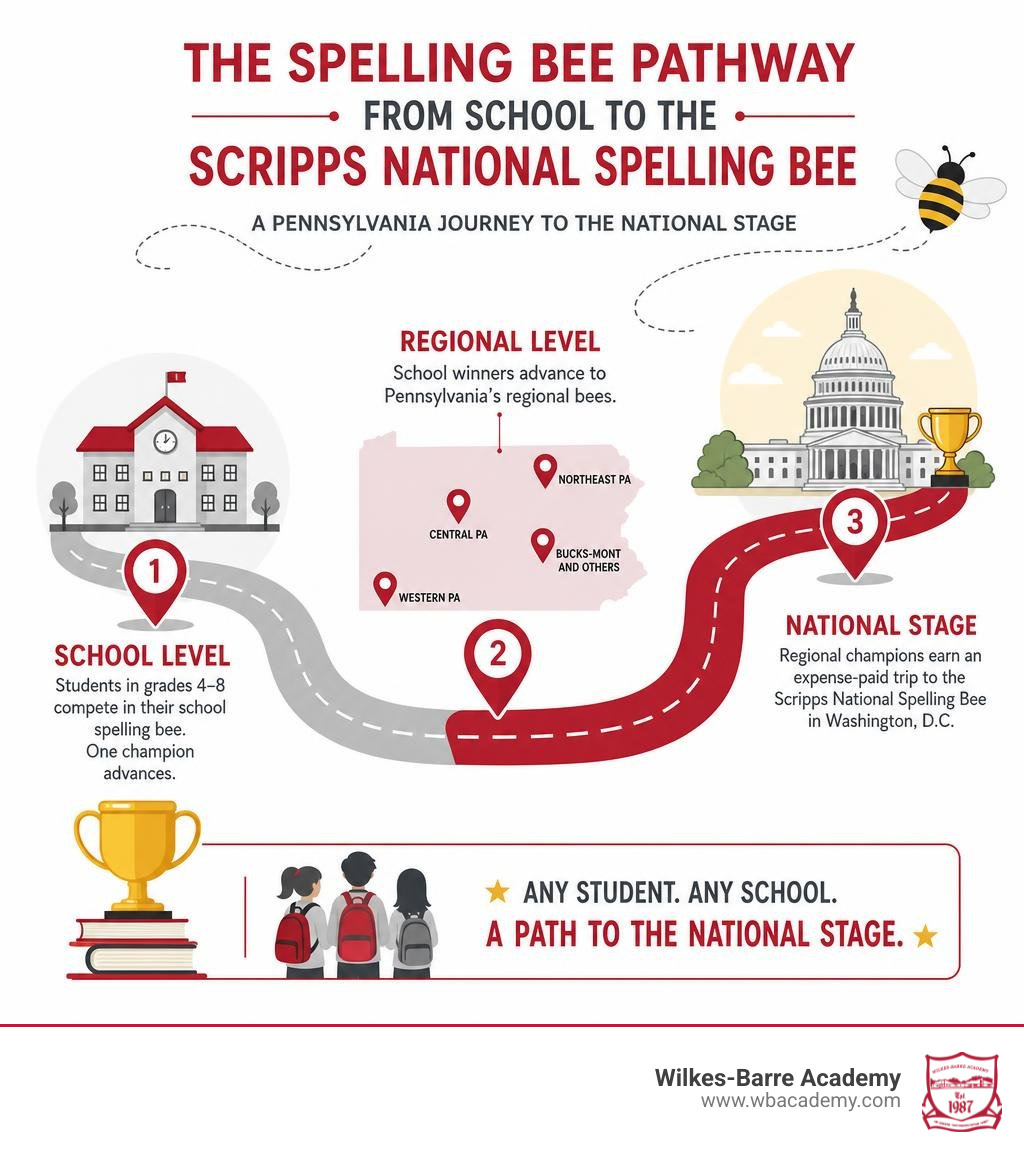
Spelling bee school Pennsylvania programs give K-8 students a clear, structured path from their own classroom all the way to the national stage. Here’s how it works at a glance:
How to participate in Pennsylvania spelling bees:
- School level — Your child competes in their school’s spelling bee (grades 4-8). One champion advances per school.
- Regional level — School winners compete in one of Pennsylvania’s regional bees (Central PA, Western PA, Northeast PA, Bucks-Mont, and others).
- Nationals — Regional champions earn an expense-paid trip to the Scripps National Spelling Bee in Washington, D.C.
Pennsylvania has a rich network of regional spelling bees. WITF has run the Central PA Spelling Bee for nearly seven decades, drawing students from 65-70 schools across 11 counties. In Northeast PA, the Manufacturers & Employers Council hosts a regional event that draws over 100 community members. In Western PA, 81 students competed in a recent regional qualifier, with the final held at Point Park University.
In 2026, 247 spellers from across the country competed at the Scripps National Spelling Bee — and Pennsylvania students were part of that journey.
The message is simple: any student, from any Pennsylvania school, can reach the national stage.
Must-know spelling bee school pennsylvania terms:
Navigating the Spelling Bee School Pennsylvania Landscape
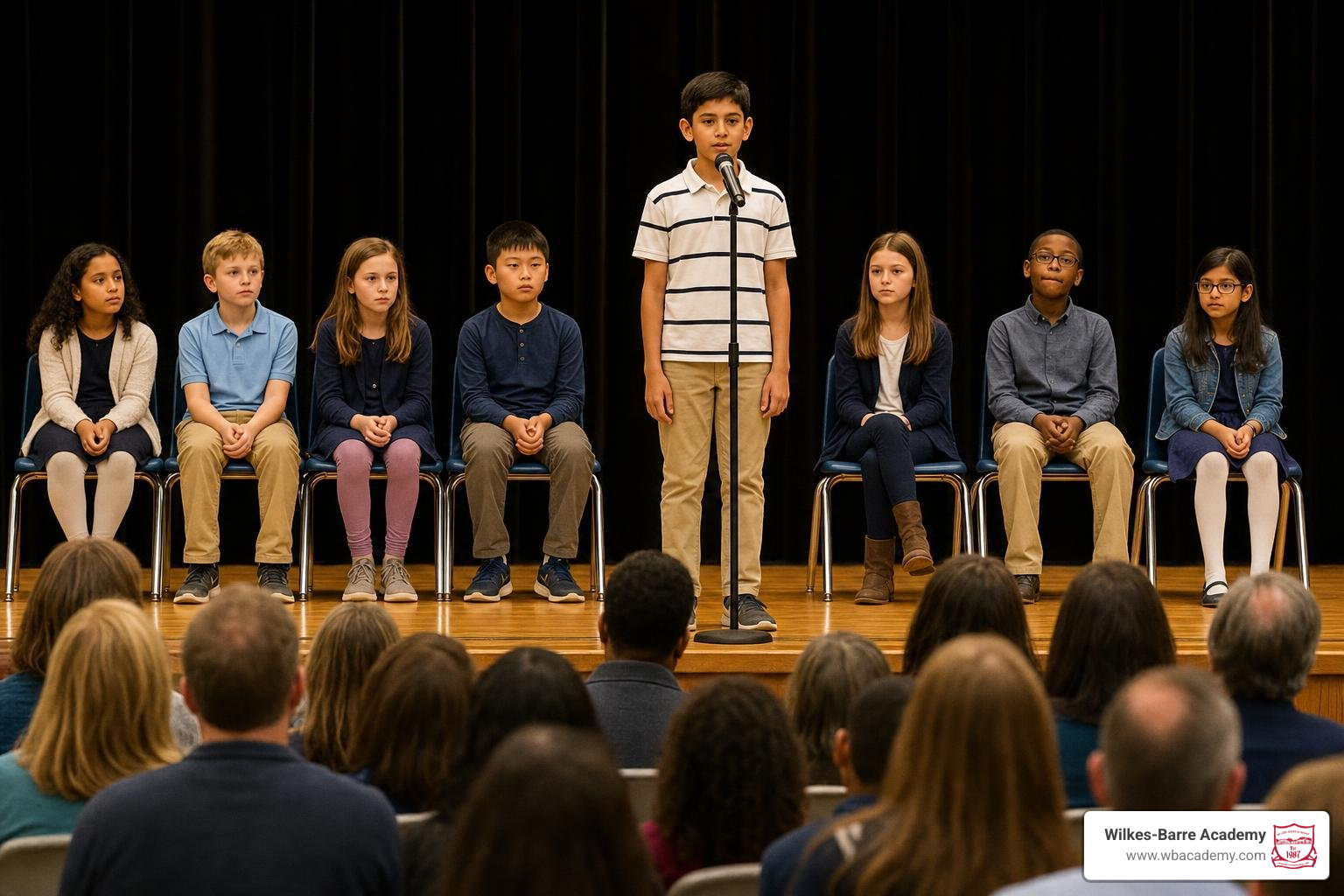
Participating in a school spelling bee is about much more than memorizing letters in a specific order. For students across the Commonwealth, from our close-knit classrooms in Luzerne County to schools in the western valleys, the journey is an incredible vehicle for cognitive and personal growth. When a child steps up to the microphone, they are not just showcasing their spelling skills; they are demonstrating poise under pressure, public speaking confidence, and the rewards of dedicated effort.
At Wilkes-Barre Academy, we believe that academic competitions are a cornerstone of a well-rounded education. When students engage with challenging material outside the standard curriculum, they develop an appreciation for lifelong learning and a deeper curiosity about the world.
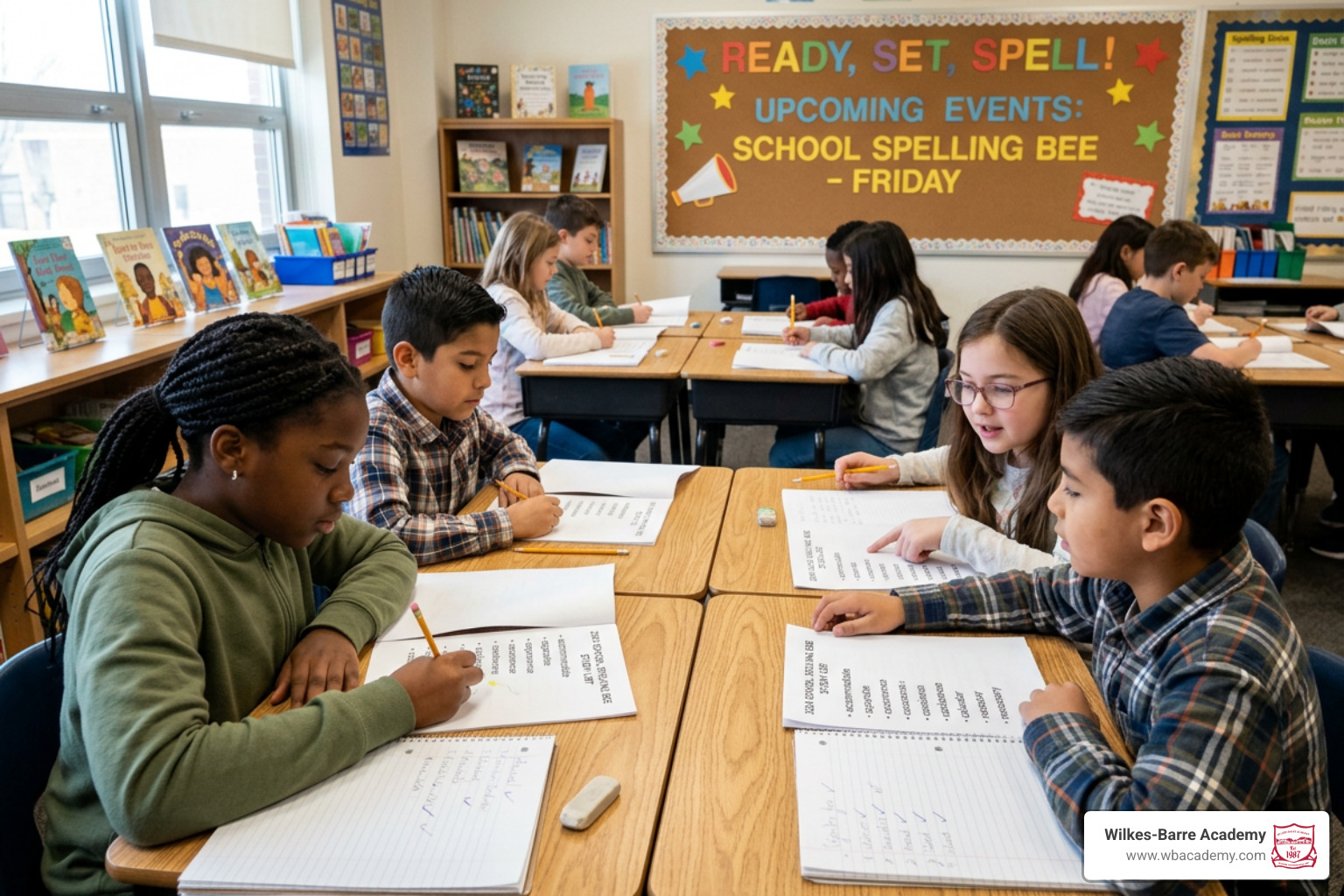
The journey begins right in the classroom. School-level bees are designed to be accessible and encouraging, serving as the first step toward the prestigious Scripps National Spelling Bee: Bee Week Homepage. For elementary and middle school students, this progression provides a clear roadmap of achievement.
By integrating these literacy challenges into our Academics, we help students build vocabulary, improve English grammar, and strengthen reading comprehension. The structured nature of the competition teaches children how to set long-term goals and break down large tasks—like studying a list of thousands of words—into manageable daily habits.
How to Register Your Spelling Bee School Pennsylvania Program
For a school’s champion to have the opportunity to advance to the regional and national stages, the school must first be officially registered with the national organization. The enrollment process is straightforward but requires attention to key deadlines:
- Early Registration (Summer to Fall): The registration window typically opens in the late summer. Local coordinators reach out to school administrators and principals to gauge interest and prepare materials.
- Official Scripps Enrollment: Schools must register their program through the Scripps National Spelling Bee Enrollment Portal. This portal provides access to the official classroom and school-level study lists, rules, and promotional materials.
- Registration Deadlines: While the final school registration deadline is generally around January 30, individual regional sponsors often require earlier commitments to schedule local semi-finals. For instance, in the Central Pennsylvania region, schools must register their participating spellers for the regional semi-finals by mid-January to secure their slots.
- School Bee Execution: Once registered, schools receive the classroom pronouncer guides and can host their own internal competitions to crown a school-wide champion.
Top Study Resources for Spelling Bee School Pennsylvania Competitors
Preparing for a spelling bee can feel like a monumental task, but having the right resources makes all the difference. Students do not have to tackle the dictionary blindly. Scripps and local educational partners provide highly structured tools to guide their preparation:
- Words of the Champions: This is the official 4,000-word study list compiled by the Scripps National Spelling Bee. It is divided into three difficulty levels (One Bee, Two Bee, and Three Bee) to help students progress systematically from basic vocabulary to highly complex, obscure terms.
- The Word Club App: This digital study tool is a favorite among modern competitors. It gamifies spelling and vocabulary preparation, offering flashcards, spelling tests, and pronunciation guides that students can access on tablets or smartphones.
- Merriam-Webster Unabridged Dictionary: As the official dictionary of the Scripps National Spelling Bee, this is the ultimate authority for word origins, definitions, pronunciations, and etymologies.
- Classroom Word Lists: For younger students or those just starting out, grade-specific lists help build a solid foundation before they transition to advanced regional materials.
At our school, we encourage students to participate in these enriching Spelling Bee activities during designated periods, making preparation a fun, collaborative, and stress-free experience.
Regional Competitions and Qualifying Rounds Across PA
Once a student wins their school-level bee, they advance to the regional level. Pennsylvania’s regional spelling bees are major community events, supported by local media organizations, universities, businesses, and non-profit groups. These sponsors cover the costs of the events and, crucially, provide the funding to send regional champions and their guardians to the national finals in Washington, D.C.

These regional showdowns bring together the brightest young minds from public, private, charter, and home schools, creating a wonderful celebration of academic achievement. The atmosphere is filled with excitement and mutual respect, as seen when competitors shake hands and wish each other luck before the final rounds begin.
To give you an idea of how these regional events are structured across the state, here is a comparison of some of the major spelling bees in Pennsylvania:
| Regional Bee | Major Sponsors & Partners | Key Locations / Venues | Counties / Areas Covered |
|---|---|---|---|
| Central PA Spelling Bee | WITF, Pennon Education | WITF Public Media Center | 11 Central PA Counties |
| Western PA Spelling Bee | Point Park University | Pittsburgh, PA | 27 Western PA Counties |
| Northeast PA Regional Bee | Manufacturers & Employers Council | D.H.H. Lengel Middle School | Schuylkill County & surrounding areas |
| Bucks-Mont Regional Bee | CAPS, MER/PSEA, Merriam-Webster | Local intermediate units | Bucks and Montgomery Counties |
| Diamond City Regional Bee | Local athletic & community sponsors | Wilkes-Barre / Luzerne County | Luzerne County and surrounding NEPA areas |
Central Pennsylvania and the WITF Tradition
The Central Pennsylvania Spelling Bee is one of the oldest and most respected academic traditions in the region. Boasting a 69-year history, the event was originally sponsored by PennLive and the Patriot-News before WITF took over its organization about 15 to 17 years ago.
Today, sponsored by WITF and Pennon Education, this massive program coordinates with 65 to 70 participating elementary and middle schools across 11 counties. The competition is highly structured:
- Schools can send up to 8 top spellers to participate in the WITF Regional Online Written Semi-Finals.
- The preliminary written tests, which shifted to an efficient online format during the pandemic, narrow the field down to the top 35 spellers.
- These 35 finalists compete in the live, televised championship round.
In the 2026 Central Pennsylvania spelling bee, 34 spellers competed in a thrilling 16-round live final. The champion, Vedika Burman, a 6th grader from Central Dauphin Middle School, secured her victory by masterfully navigating the official Scripps word list, earning her spot at the national finals.
Western Pennsylvania and Northeast PA Showdowns
On the other side of the state, the Western Pennsylvania Spelling Bee covers an expansive 27-county region. In 2026, 81 local students participated in the regional qualifier, which ultimately advanced the top 15 spellers to the final in-person event held at Point Park University in Pittsburgh. This historic regional bee has seen incredible displays of talent over the years, including multi-time champions like Jane Ross, an eighth grader from Hampton Middle School, who won the 75th annual regional bee by correctly spelling the word “cacaxte.”
In Northeast Pennsylvania, the Northeast PA Manufacturers & Employers Council Regional Spelling Bee showcases the incredible spelling talents of local students. Held at the D.H.H. Lengel Middle School Auditorium in Pottsville, the 2026 competition featured 42 Schuylkill County students representing 12 school districts.
The event drew a crowd of over 100 relatives, friends, and community members. In a final, 5th grader Nora Lloyd from Blue Mountain Elementary-East clinched the championship in the fourth round by spelling the word “ripples.” Highlighting the community’s deep support for academics, the championship trophy was custom-crafted by a local vocational school student, representing a true community collaboration.
Bucks-Mont and Susquehanna County Events
The Bucks-Mont Regional Spelling Bee, sponsored by the Council of Advancement of Public Schools (CAPS), the Mideast Region of the Pennsylvania State Education Association (MER/PSEA), and Merriam-Webster, provides a fantastic competitive platform for students in Bucks and Montgomery counties. Schools register their champions via the Scripps platform, and top performers like 2026 winners Siddhesh Ganesh (1st place) and Maia Mathai (2nd place) showcase the high academic standards of the region.
For younger learners, county-specific events offer unique, low-pressure formats. The United Way of Susquehanna County hosts a county-wide spelling bee with distinct formats designed to build confidence:
- 4th Grade: An in-school, game-show style competition that makes spelling collaborative, interactive, and highly inclusive.
- 5th Grade: A traditional spelling bee format that prepares students for the rigors of standard Scripps competitions.
These events feature generous rewards, including school-level prizes and a county championship cash prize of $1,000, ensuring that students feel celebrated for their academic dedication.
Evolution of the Modern Spelling Bee Format
Spelling bees have evolved significantly from the days of simple oral elimination rounds. To keep pace with modern educational standards and ensure fair, rigorous testing, spelling bees across Pennsylvania have adopted innovative formats.
One of the most notable changes is the integration of digital technology. The preliminary rounds of many regional bees, such as the WITF Central PA Bee, are now conducted as online written tests. This shift, which accelerated during the pandemic, allows hundreds of students to participate safely and efficiently from their home schools, reducing travel times and allowing for rapid, objective grading.
Additionally, the Scripps National Spelling Bee and its regional affiliates have introduced the following structural updates:
- Vocabulary Rounds: Introduced to emphasize that spelling is not just about memorization, but about deep word comprehension. In these rounds, spellers must correctly identify the definition of a word from multiple-choice options.
- The Spell-Off: To prevent marathon competitions that exhaust young participants, a “Spell-off” format may be triggered. In this round, spellers are given 90 seconds to spell as many words correctly as possible. The competitor with the highest count is crowned the champion. This was dramatically highlighted at the 2026 Scripps National Spelling Bee, where national champion Shrey Parikh set a record by correctly spelling 32 words in the Spell-off.
These modern updates teach students how to think critically under tight time constraints, preparing them for future academic and professional challenges.
Frequently Asked Questions about Pennsylvania Spelling Bees
Navigating the rules and pathways of spelling competitions can raise many questions for parents and educators. Below are some of the most common questions regarding spelling bee school Pennsylvania programs.
Who is eligible to compete in Pennsylvania spelling bees?
Generally, students in grades 4 through 8 are eligible to participate in official Scripps-affiliated spelling bees. Some local programs, such as the Susquehanna County Bee, offer specialized formats for younger elementary students. To advance to the regional level, a student must be enrolled in a registered school and win their official school-wide competition.
How do students advance to the Scripps National Spelling Bee?
The path to the national stage requires winning a registered school bee and then winning the designated regional championship for your county. The champion of each regional bee receives an all-expenses-paid trip for themselves and one parent or guardian to travel to Washington, D.C., to compete in the Scripps National Spelling Bee during “Bee Week” in late May.
What prizes do Pennsylvania spelling bee winners receive?
Prizes vary by region but are highly rewarding. School-level winners often receive official certificates, medals, or small cash prizes. Regional champions win trophies, dictionaries, cash prizes (sometimes up to $1,000), and the coveted expense-paid trip to the national finals.
Conclusion
Participating in a spelling bee is a transformative journey that builds literacy, instills confidence, and fosters a lifelong love of learning. From the initial classroom rounds to the bright lights of regional stages and the national finals in Washington, D.C., these competitions celebrate the incredible potential of Pennsylvania’s young scholars.
At Wilkes-Barre Academy, our single-classroom-per-grade structure allows us to offer an academically advanced curriculum that nurtures these exact skills. Through close family-school connections and a supportive, diverse community, we empower our students to excel in Student Activities and reach their highest academic goals.
Are you ready to inspire a love of words and academic achievement in your child? We invite you to explore our advanced programs and vibrant school community. Visit the Wilkes-Barre Academy Homepage or learn more about how we support student success by checking out our dedicated Spelling Bee page today!