
The Fast Track to High School Success via Private Education
Why an Advanced Curriculum in Elementary School Sets the Stage for High School Success
Advanced curriculum in elementary school is a structured approach to learning that goes beyond standard grade-level content — pushing students to think deeper, move faster, and tackle more complex ideas earlier.
If you’re trying to decide whether your child needs a more rigorous academic environment, here’s what you need to know right away:
What advanced elementary curriculum typically includes:
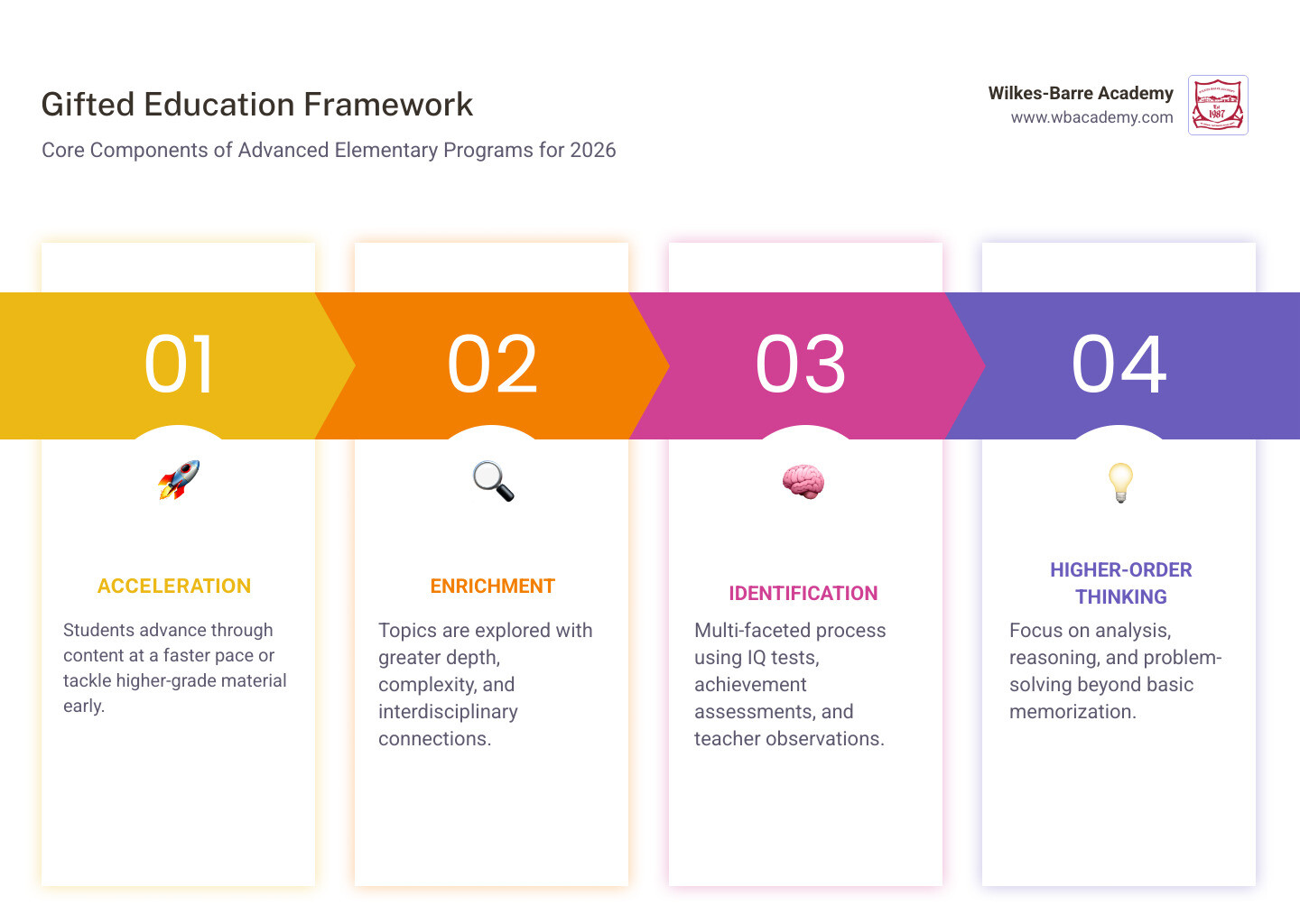
- Acceleration — moving through grade-level content faster, or working on content from higher grades
- Enrichment — exploring topics with greater depth and complexity at the same grade level
- Extended standards — measuring students against benchmarks that go beyond the standard curriculum
- Higher-order thinking — emphasizing reasoning, analysis, and problem-solving over memorization
- Interdisciplinary learning — connecting ideas across subjects like math, science, and language arts
Who it’s designed for:
Most gifted programs target the top 2–10% of students based on academic ability. Identification usually involves IQ testing, achievement tests, teacher input, and portfolio reviews.
Many parents notice the signs early — a child who finishes work too quickly, asks unusually complex questions, or grows frustrated in a classroom that isn’t moving fast enough. That frustration is a signal worth taking seriously.
Research consistently shows that when advanced learners aren’t challenged early, they risk disengagement, underachievement, and even social difficulties down the road. The right program doesn’t just teach more — it teaches differently.
Defining the Advanced Curriculum Elementary School Model
When families search for an advanced curriculum elementary school, they are usually looking for more than extra worksheets or harder homework. They want a learning model that changes the level, pace, and depth of instruction.
In practice, advanced curriculum differs from standard curriculum in a few big ways:
- It goes deeper into concepts, not just broader into more topics
- It increases complexity by asking students to analyze, compare, defend, and create
- It often uses extended standards rather than only grade-level benchmarks
- It connects subjects through larger themes and real-world applications
- It makes room for faster pacing when a child has already mastered the basics
For example, some advanced academic frameworks build on standard state expectations but raise the challenge through greater depth, complexity, and speed. A useful public example is the Grade 5 Full-Time Advanced Academic Program Progress Report Alignments | Fairfax County Public Schools, which shows how advanced learners are evaluated against more demanding outcomes across language arts, math, science, and social studies.
That matters because advanced learners do not simply need “more school.” They need school to work differently.
At Wilkes-Barre Academy, our approach centers on individualized learning, strong teacher knowledge of each student, and a classroom culture where curiosity is expected. Because we are a single-classroom-per-grade school, we can know students well and respond to their readiness with greater flexibility than a larger system often can. You can explore more info about our academics.
A strong advanced model in elementary school usually includes:
- Open-ended discussion rather than one-answer-only tasks
- Cross-subject themes that help students connect ideas
- Independent or small-group projects
- Performance tasks that require evidence and explanation
- Opportunities for students to work above grade level in one or more subjects
In other words, advanced curriculum is less about racing and more about fitting instruction to demonstrated ability. Sometimes that means acceleration. Sometimes it means enrichment. Often it means both.
Identifying Giftedness and Readiness for Rigorous Learning
Not every advanced learner looks the same. Some are obvious from day one. Others quietly master material, hide their abilities to fit in, or show high potential in one area only.

A child may be ready for more rigorous learning if they:
- Learn new material unusually quickly
- Need fewer repetitions than classmates
- Ask complex, abstract, or unexpected questions
- Show intense interest in a topic
- Prefer older peers or adults for conversation
- Become bored, distracted, or frustrated with repeated practice
- Produce work that shows advanced reasoning, vocabulary, or creativity
Formal identification often uses multiple data points rather than a single score. That is important because one test can miss a child who is highly capable but anxious, twice-exceptional, or simply having an off day.
Common tools include:
- IQ or cognitive assessments, such as the WISC-V
- Achievement testing in areas like math or reading
- Teacher observations
- Parent nominations
- Portfolio reviews and work samples
- Prior report cards and classroom performance
Research and best practice support this multi-measure approach. Gifted students are often described as those performing in the top 2 percentiles on intellectual testing, but actual school selection rates vary, and many programs serve 10% or fewer of students. That means identification should be careful, flexible, and ongoing.
Early intervention matters. When advanced learners are recognized early, schools and families can prevent the boredom-underachievement cycle before it starts. A child who is challenged appropriately in second or third grade is more likely to build healthy academic habits, confidence, and persistence before middle school and high school expectations increase.
For local families comparing schools, broader context can also help. Resources like Best elementary schools in Luzerne County can be one starting point, but the key question is not just “Is the school strong?” It is “Will the school truly respond to my child’s pace and level?”
Core Strategies for Implementing Advanced Instruction
An advanced program works best when it is built into everyday teaching, not treated as an occasional bonus prize.
Schools commonly use several proven strategies:
- Curriculum compacting
- Cluster grouping
- Flexible placement
- Responsive instruction
- Subject acceleration
- Independent study options
Curriculum compacting means pre-assessing students and skipping material they have already mastered. Instead of doing 20 nearly identical problems, a student who demonstrates understanding moves on to deeper tasks. This is efficient, respectful, and usually much better for morale. Nobody likes proving 20 times that 2 + 2 still equals 4.
Cluster grouping places several advanced learners in the same classroom so they can work with intellectual peers. This helps instruction because the teacher can more readily plan for a group needing greater complexity, and it helps socially because students see that strong curiosity is normal.
Flexible placement lets a student move by readiness rather than being locked into one path all year. A child may need advanced math, grade-level writing support, and enrichment in science all at once. Good schools make room for that kind of real-life academic profile.
Responsive instruction means teachers adjust based on current evidence, not assumptions. If a student is ready, the work changes.
At Wilkes-Barre Academy, classroom tools also support this kind of differentiated learning. Our use of instructional technology can help students practice, research, create, and extend learning at the right level. Families can read more info about classroom technology.
Math and Problem-Solving in an Advanced Curriculum Elementary School
Advanced elementary math should not look like a race to memorize procedures earlier. The strongest math programs build reasoning.
That includes:
- Logic puzzles
- Multi-step problem solving
- Visual models
- Pattern recognition
- Number sense
- Algebraic thinking
- Proportional reasoning
Some advanced math resources for elementary students have become popular because they make challenge engaging, especially through puzzles, story-driven lessons, and higher-order thinking. Research on advanced math pathways consistently points to a useful principle: mastery matters more than memorization.
For young advanced learners, that means asking questions like:
- Why does this strategy work?
- Can you solve it another way?
- What pattern do you notice?
- Can you prove your answer?
Visual models are especially powerful. They help students understand fractions, ratios, equations, and geometry at a conceptual level instead of treating math as a magic trick performed by adults with answer keys.
Strong problem-solving practice also builds resilience. A challenging puzzle teaches students to persist, revise, and try again. That is excellent preparation not just for algebra later, but for science labs, coding, and frankly, life.
For families who want rigorous opportunities beyond daily classwork, more info about Continental Math shows one way students can extend their thinking through competition and challenge.
Language Arts and Humanities in an Advanced Curriculum Elementary School
Advanced instruction in language arts is not just “read harder books.” It asks students to think, discuss, and write with greater sophistication.
Key elements often include:
- Content-based literacy
- Close reading
- Rich discussion
- Evidence-based writing
- Vocabulary study through Greek stems and Latin roots
- Socratic seminars
- Research and synthesis
Content-based literacy matters because advanced readers often thrive when reading is tied to science, history, culture, and big ideas. Instead of isolated comprehension drills, they investigate topics, compare sources, and build arguments.
Greek and Latin roots can be especially helpful for advanced vocabulary growth. Students begin to decode complex academic words across subjects, which supports both reading comprehension and writing.
Socratic-style discussion also belongs in advanced humanities instruction. When students learn to ask questions, challenge ideas respectfully, and support claims with evidence, they are practicing the exact habits that later make high school seminars and essay writing stronger.
World language study can deepen this growth too. Exposure to another language supports pattern recognition, cultural awareness, and flexible thinking. Families can explore more info about Spanish classes.
Beyond the Classroom: Enrichment and Extracurriculars
An advanced curriculum should not end when the dismissal bell rings. Many students need places to apply their strengths in authentic, visible ways.
The best enrichment opportunities do at least one of three things:
- Extend academic challenge
- Build peer connection
- Develop confidence through performance and presentation
Examples include:
- STEM clubs
- Science competitions
- Math contests
- Debate and public speaking
- Writing contests
- Geography and spelling events
- Summer enrichment
- Problem-solving teams
These experiences matter because advanced learners often need challenge plus community. A child who feels “different” in a regular classroom may suddenly find their people in robotics, science, math, or word study.
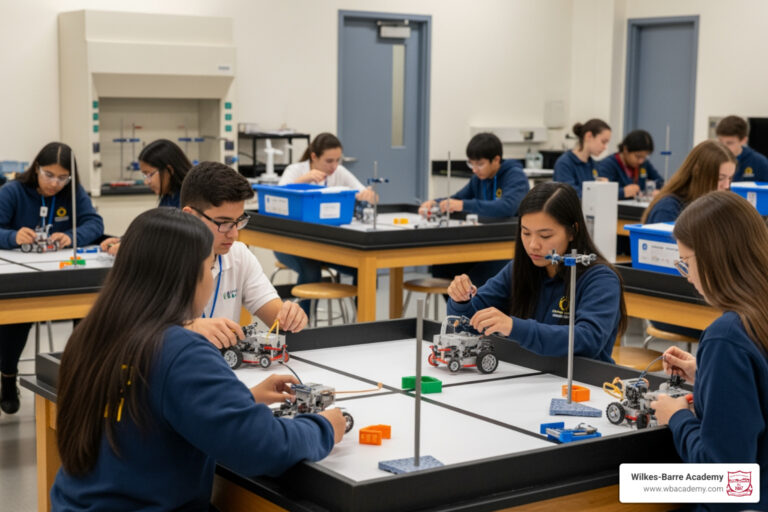
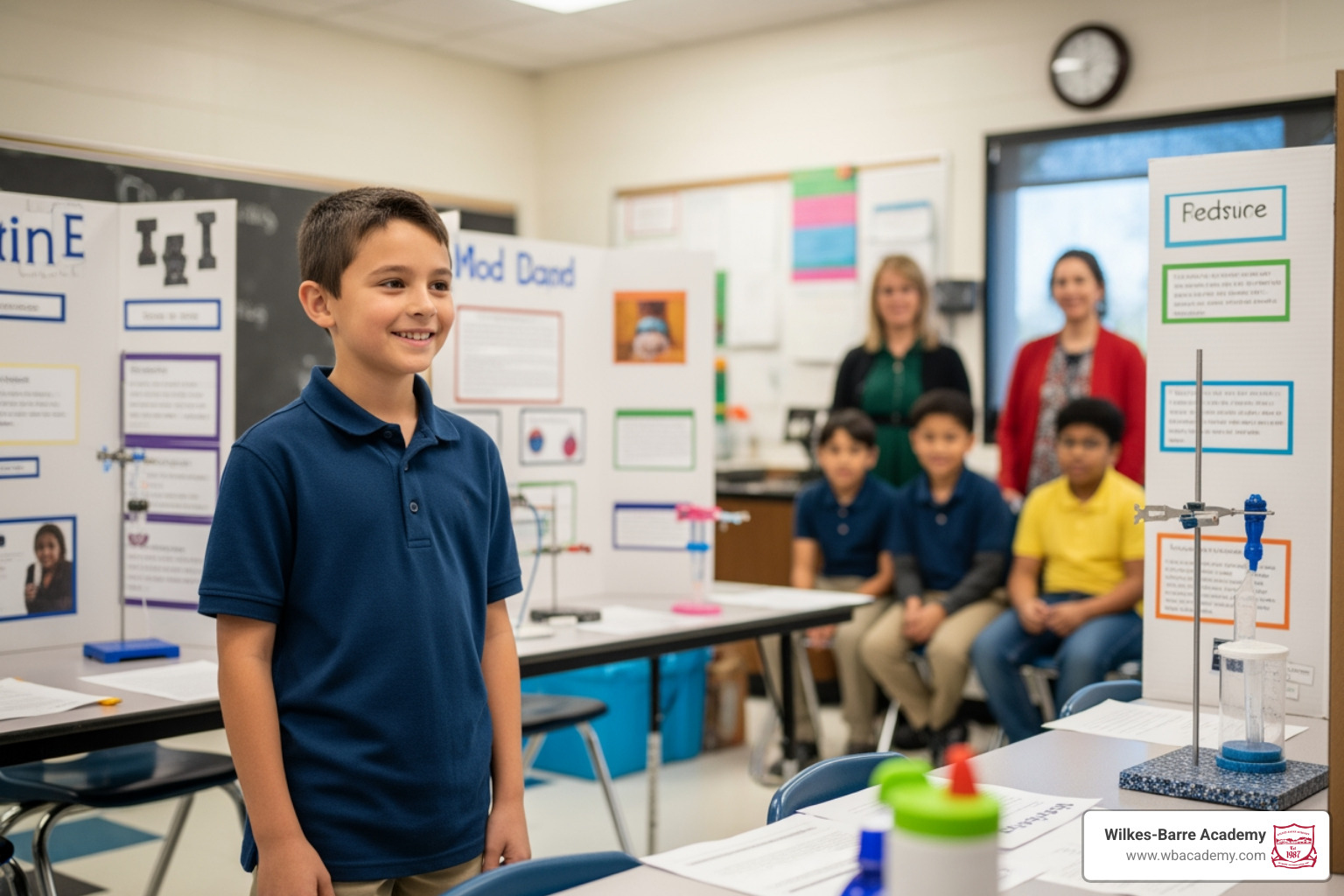
At Wilkes-Barre Academy, students have opportunities to stretch themselves through activities such as Science Fair, Science Olympiad, Spelling Bee, and Geography Bee.
These kinds of programs support advanced learning because they reward inquiry, preparation, and independent thinking. They also teach students how to handle challenge publicly, which is an underrated skill. It is one thing to know an answer. It is another to explain it clearly while standing in front of a room.
Benefits and Challenges of Accelerated Learning
Advanced elementary education can be transformative, but it works best when families and schools understand both the benefits and the tradeoffs.
Benefits
Research and practice point to several major advantages:
- Stronger engagement and less boredom
- Better academic growth
- Increased confidence from meaningful challenge
- Development of creativity, resilience, and perseverance
- Earlier exposure to advanced skills needed for later coursework
- Opportunities to learn with similar peers
Students who are challenged appropriately often become more willing to struggle productively. That is a healthy trait. When school is too easy for too long, students may never develop the muscle of persistence. Then the first real challenge can feel like a crisis instead of a normal part of learning.
Advanced instruction can also improve social development when it places students with peers who share similar interests and pace. For many children, finally finding intellectual peers is a huge relief.
Challenges
At the same time, advanced programs are not magic.
Potential drawbacks can include:
- Social isolation if a child feels out of sync with peers
- Pressure to perform all the time
- Gaps if acceleration moves too quickly without support
- Uneven development, where advanced academics do not match emotional maturity
- Mistaking perfectionism for healthy achievement
This is why good programs look at the whole child. We want students to grow intellectually without tying their entire identity to being “the smart one.” Challenge should build confidence, not chronic stress.
Physical movement and team experiences can help maintain that balance. Sports, games, and wellness routines support self-regulation, teamwork, and healthy risk-taking. Families can explore more info about physical fitness.
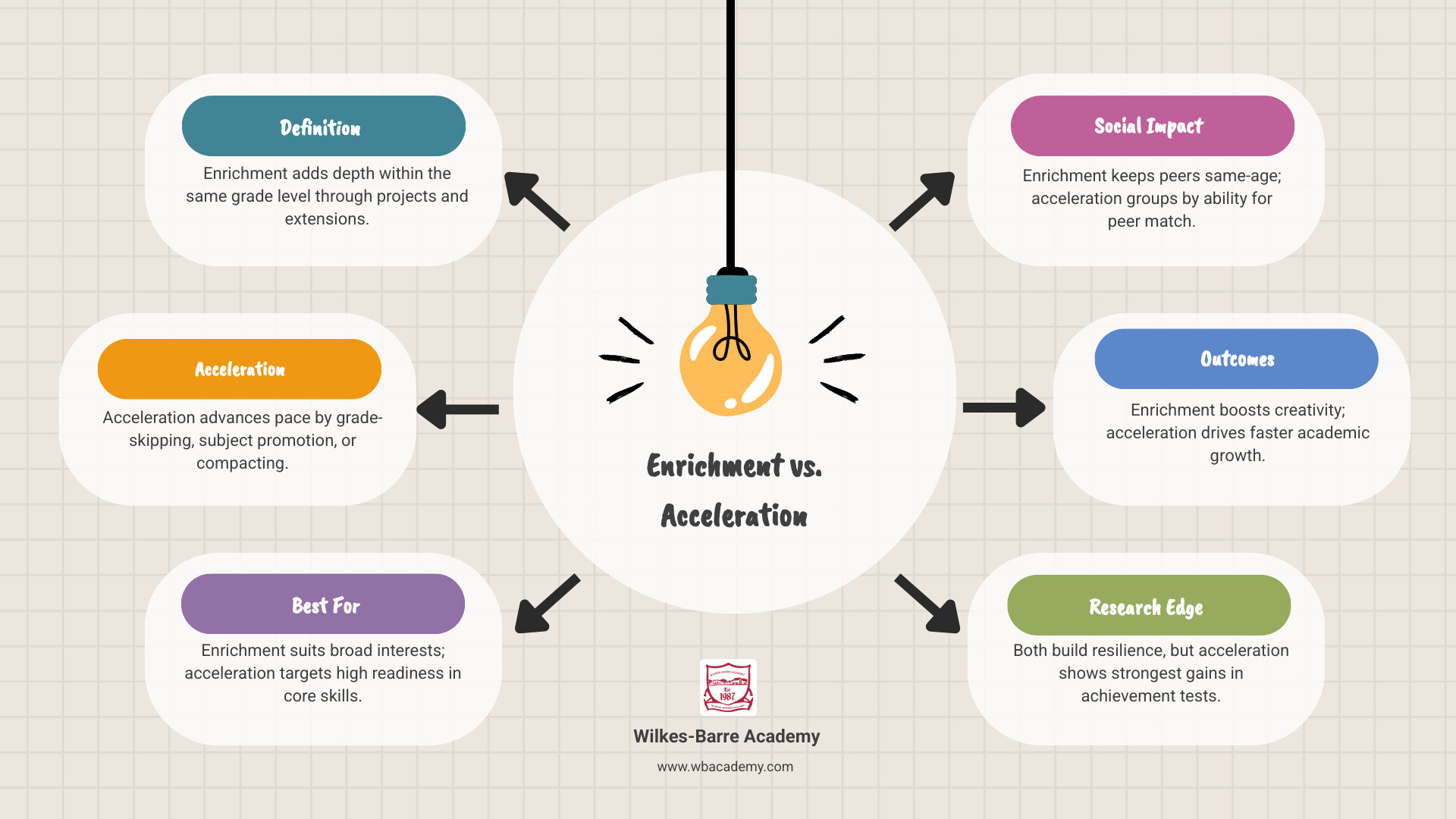
Here is a simple comparison:
| Approach | What it means | Best for | Watch-outs |
|---|---|---|---|
| Enrichment | Deeper, broader work at the same grade level | Students who need complexity without changing placement | Can become “more work” instead of better work if not designed well |
| Acceleration | Faster pace or access to higher-grade content | Students who already show mastery and need forward movement | Requires monitoring for academic gaps and social fit |
In many cases, the strongest plan blends both.
Frequently Asked Questions about Advanced Elementary Education
How do schools identify gifted students for advanced programs?
The best identification process uses multiple measures. Schools may review IQ scores, aptitude tests, achievement tests, classroom performance, teacher observations, parent input, and work samples.
A tool like the WISC-V can provide useful insight into cognitive strengths, while achievement tests show what a student already knows in reading, math, or other subjects. Portfolio assessment adds another layer by showing how a child actually thinks and produces work over time.
Identification should not be one-and-done. Children develop unevenly, and readiness can become clearer as they grow. A student not formally identified in early elementary years may still need advanced instruction later.
What is the difference between enrichment and acceleration?
Enrichment increases depth and complexity without necessarily changing grade level. Students may study a topic in more sophisticated ways, complete independent projects, or engage in advanced discussion and analysis.
Acceleration moves students through material faster or places them into higher-level content earlier. This could mean subject acceleration in math, full-grade acceleration, or telescoping, where a student completes a multi-year curriculum in less time.
Both approaches can be effective. Enrichment is excellent for deep thinking. Acceleration is important when a child has already mastered the current level and genuinely needs new material.
Are online advanced programs effective for elementary students?
They can be, especially for students who benefit from self-paced instruction, flexible scheduling, or access to advanced content not available locally. Online options may include virtual classrooms, self-paced modules, live small-group classes, and ability-based grouping.
That said, elementary students usually do best online when parental involvement is strong and the program includes meaningful teacher interaction. For some children, online learning solves pacing problems. For others, in-person community and close teacher relationships remain the better fit.
The right answer depends on the child. In many cases, families want the rigor of advanced learning without losing the warmth, accountability, and social connection that come from a close-knit school setting.
Conclusion: Preparing for High School Success
An advanced curriculum elementary school experience should do more than help students get ahead on paper. It should help them become thoughtful readers, flexible problem-solvers, confident communicators, and resilient learners.
That is exactly why early challenge matters so much. When advanced learners are seen early and taught well, they enter middle school and high school ready not just for harder classes, but for the habits those classes require: independence, persistence, curiosity, and self-advocacy.
At Wilkes-Barre Academy, we believe rigorous academics work best when paired with individualized attention, strong family-school relationships, and a diverse, close-knit community. Our K-8 setting in Wilkes-Barre gives us the chance to know students well and help them grow with intention.
If you would like to see how academic challenge and enrichment can work together, explore more info about the Word Study Bee and learn more about our advanced academic programs.