A – Z Guide to Pennsylvania Private School Bus Rules
How Private School Busing Works in Pennsylvania
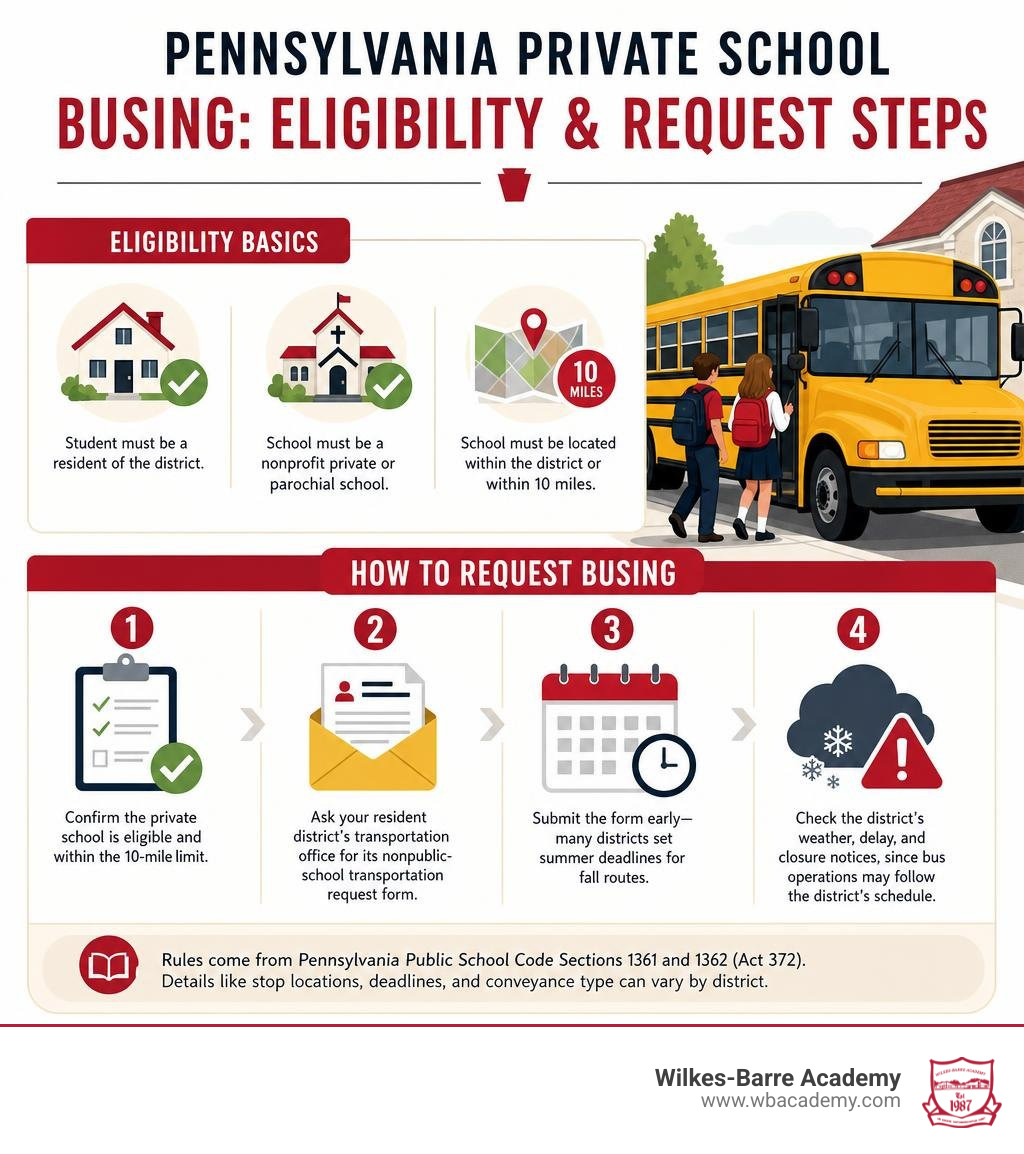
For most families, private school busing in Pennsylvania is arranged through the public school district where the student lives. If that district provides transportation for its own students, it generally must provide comparable free transportation for resident students attending an eligible nonprofit private school located inside the district or within 10 miles of its boundary.
To get started:
- Confirm that the private school is eligible and within the 10-mile limit.
- Ask your resident district’s transportation office for its nonpublic-school transportation request form.
- Submit the form early – many districts set summer deadlines for fall routes.
- Check the district’s weather, delay, and closure notices, since bus operations may follow the district’s transportation schedule.
The rules come mainly from Pennsylvania Public School Code Sections 1361 and 1362, often discussed alongside Act 372. Details can vary by district, including stop locations, request deadlines, and whether a yellow bus, transit pass, or another approved method is used.
This guide explains the rules that matter most to Luzerne County families, from the 10-mile radius to weather-day plans and special rules for Approved Private Schools.
Legal Foundations: Act 372, the 10-Mile Radius, and Permissible Conveyances
The backbone of nonpublic student transportation in Pennsylvania is codified under 24 P.S. § 13-1361 of the Pennsylvania Public School Code of 1949, widely known as Act 372. The law establishes an “identical provision” mandate: if a public school board chooses to provide free transportation for its resident public school pupils, it must provide identical transportation services to resident students who attend non-profit, nonpublic private and parochial schools.
Under Section 1361, eligibility extends beyond local municipal borders. Public school districts are legally obligated to transport eligible resident students to non-profit private schools located:
- Within the physical boundaries of the resident public school district; or
- Outside the resident school district’s borders, at a distance not exceeding 10 miles by the nearest public highway.
This 10-mile distance is measured along public thoroughfares starting from the point where the student’s driveway connects with the public road directly to the nearest entrance point of the private school grounds. Private driveway lengths do not factor into the calculation.
State law also sets clear walking distance thresholds that apply equally to public and nonpublic students. Districts are not required to provide transportation if an elementary student lives within 1.5 miles, or a secondary student lives within 2.0 miles, of their school along non-hazardous public walking routes. However, if a walking route poses safety hazards—such as an absence of sidewalks along high-speed roadways—parents or school officials can request a hazardous walking route certification from the Pennsylvania Department of Transportation (PennDOT). Once PennDOT certifies the route as hazardous, the walking distance exemption is waived, requiring the resident district to provide busing regardless of mileage.
For a broader overview of state guidelines, explore our guide to private school busing in Pennsylvania.
Permissible Modes of Transportation Under Section 1362
Under 24 P.S. § 13-1362, Pennsylvania school districts are permitted to fulfill their transportation obligations through several authorized conveyances:
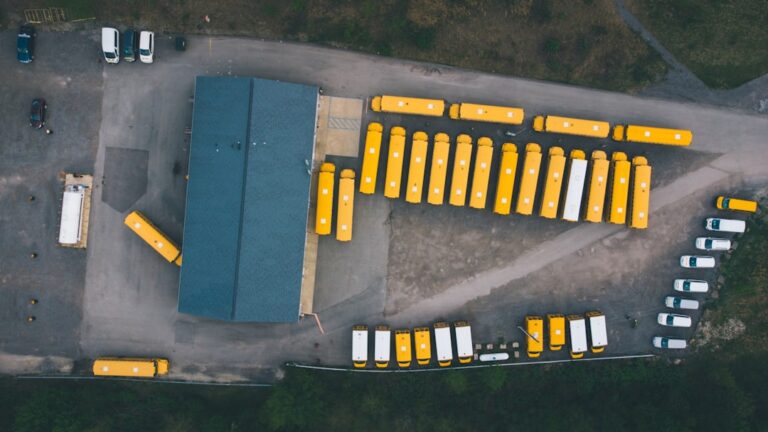
- School conveyances owned and operated directly by the district (traditional yellow buses and vans)
- Vehicles operated by contracted private school bus fleet operators
- Common carriers, including municipal public transit authorities and electric railways
- Board-approved private conveyances
Over 80% of Pennsylvania school districts contract their transportation operations through private bus contractors. To support these services, the Commonwealth provides direct funding reimbursements to school districts under Section 2509.3. These include an annual flat allocation of $385 per nonpublic student transported, alongside vehicle depreciation allowances that offset fleet contracting costs.
How Does Private School Busing Work in Pennsylvania Across Schedules, Weather, and School Types?
Families exploring educational options often ask: how does private school busing work in Pennsylvania? Understanding the system requires looking closely at how daily logistics, regional calendars, and district boundaries interact. The resident school district bears full logistical and financial responsibility for designing routes, establishing pickup points, and assigning vehicles for resident private school students.

Under 24 P.S. § 13-1361, public districts must provide transportation on the specific dates and times that the nonpublic school is in regular session, in accordance with the official school calendar adopted by the private school’s governing board.
| Feature | Nonpublic / Private Schools (Act 372 / § 1361) | Public Charter Schools (§ 1726-A) |
|---|---|---|
| Governing Law | 24 P.S. § 13-1361 | 24 P.S. § 17-1726-A(a) |
| 10-Mile Boundary Rule | Applies (must transport up to 10 miles outside district) | Applies (must transport up to 10 miles outside district) |
| Mode of Transit Mandate | Strict Identical Mode: Must provide yellow bus if offered to public peers | Flexible Transit: Districts may issue public transit passes instead of yellow buses |
| Calendar Alignment | Follows nonpublic school’s adopted annual calendar | Follows charter school’s adopted annual calendar |
| State Subsidy to District | $385/student + standard PDE formula reimbursement | Standard PDE pupil transportation formula |
How Does Private School Busing Work in Pennsylvania Compared to Charter Schools?
The legal framework for private school transportation differs significantly from charter school rules, especially following landmark judicial decisions. In Bell v. Wilkinsburg School District, the Pennsylvania Supreme Court reviewed Section 1726-A(a) of the Charter School Law, which requires districts to transport charter students “under the same conditions” as district students.
The Court held that providing transportation “under the same conditions” does not mandate identical modes of transit for charter pupils. Consequently, school districts facing driver shortages and budget constraints may provide public transit passes or common carrier vouchers to charter students even while running traditional yellow buses for their own public school students.
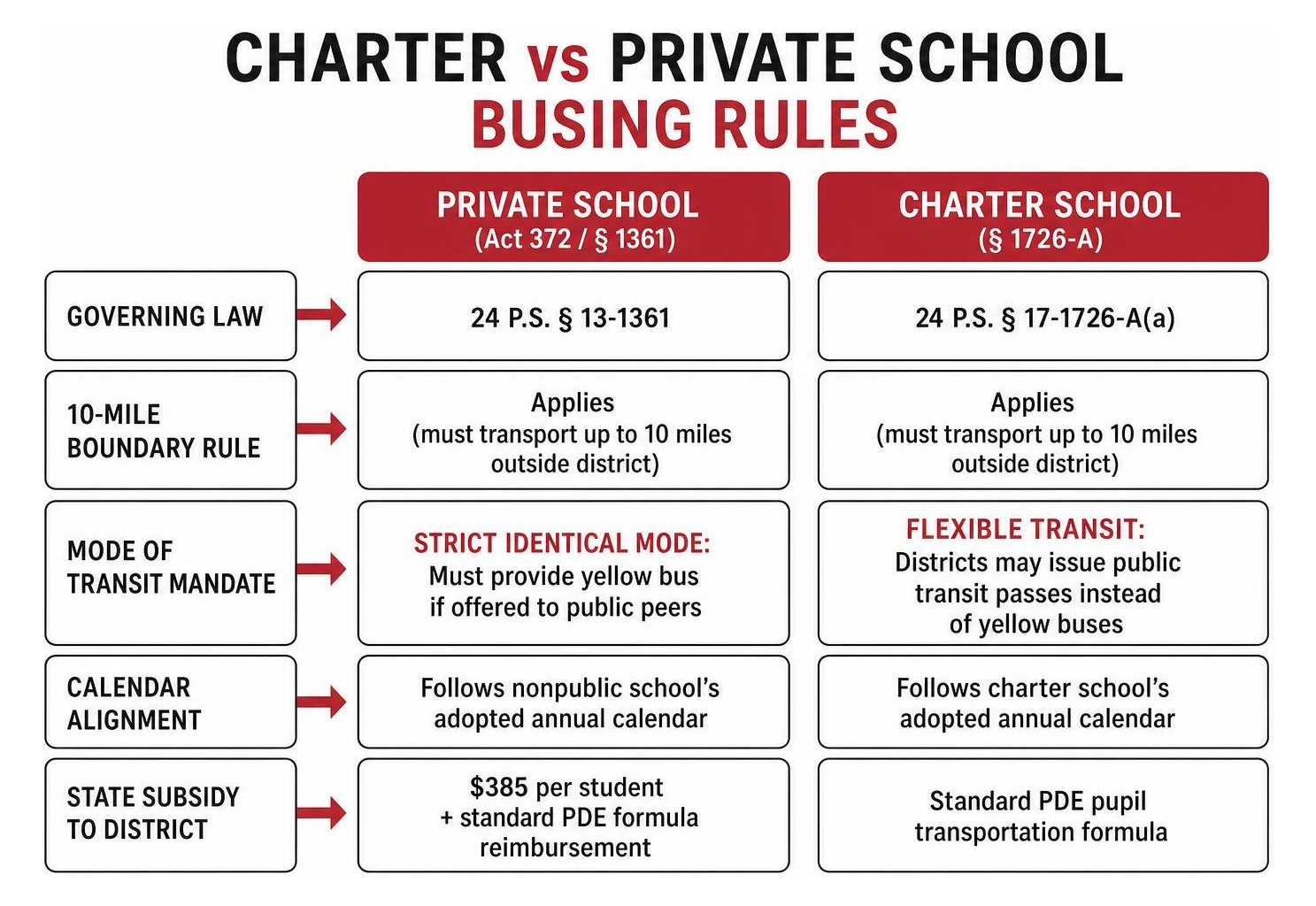
This ruling does not apply to private and parochial schools. Private and religious nonpublic schools remain protected by the strict “identical provision” language of 24 P.S. § 13-1361. If a public school district provides yellow bus transportation to its enrolled students, it cannot unilaterally downgrade resident private school students to public transit passes without violating state law. For detailed legal analysis, review the PA Supreme Court ruling in Bell v. Wilkinsburg.
How Does Private School Busing Work in Pennsylvania for Weather Delays and Calendars?
Weather emergencies introduce unique operational challenges because student busing follows the operating schedule of the resident public school district providing the ride, rather than the private school itself:
- District Weather Delays: If your resident public school district issues a 2-hour delay due to snow or icy conditions, its school buses run on that 2-hour delayed schedule, even if your child’s private school plans to open on time.
- District Weather Closures: If the resident public school district cancels classes due to inclement weather, it will not operate bus routes to private schools, even if the private school remains open.
- Private School Early Dismissals: If a private school decides to dismiss early due to approaching weather, but the surrounding public school district does not, the public district cannot alter its midday routes. Transportation is provided only at the regularly scheduled dismissal time.
Because morning bus routes may deliver students according to public district timetables, private schools maintain morning drop-off supervision to keep students safe if they arrive before delayed classes begin. Families commuting to our single campus can learn more about local traffic patterns and drop-off logistics by checking how commuting made easy in Wilkes-Barre simplifies the daily school run.
Approved Private Schools (APS), Residential Programs, and Funding Obligations
For exceptional students with severe disabilities or specialized educational needs placed in state-approved private facilities, transportation is governed by 24 P.S. § 13-1374 rather than standard Act 372 rules.
Under Section 1374 and Pennsylvania Department of Education Basic Education Circulars (BECs), the nature of state-mandated transportation depends directly on the student’s program enrollment:
- Day Programs: Eligible exceptional students enrolled in day programs receive daily round-trip transportation Monday through Friday throughout the school term, including during partial-week holiday schedules and semester breaks.
- 5-Day Residential Programs: When an approved private school operates a 5-day residential program without weekend care, the sending public district must provide transportation to the facility on Monday morning and return transportation home on Friday afternoon.
- 7-Day Residential Programs: Students enrolled in full-time residential placements receive round-trip transportation at the beginning and close of the school year, as well as during scheduled school breaks.
Under Section 1374, school districts hold the legal option to provide room and board (maintenance) in lieu of transportation. However, if an Approved Private School closes its residential facilities during weekends, holidays, or semester breaks, the district cannot rely on room and board provisions and must provide physical transportation instead.
Under 24 P.S. § 25-2509.1, all approved transportation costs for exceptional students are charged directly to the student’s school district of residence, regardless of whether routes are operated by the district or coordinated through a regional Intermediate Unit (IU). Under 24 P.S. § 13-1305, when a nonresident child is placed into a private home or foster setting, transportation costs are assigned to the school district where the private residence is located. For complete statutory details, consult the Pennsylvania Department of Education guidance on Approved Private Schools.
Step-by-Step Guide for Parents: Requesting Busing and Alternative Programs
Securing district-funded transportation for your child requires proactive coordination with your resident school district’s transportation office.

Follow these steps to complete the process:
- Obtain the Act 372 Request Form: Contact your resident public school district’s transportation department or download their official Nonpublic Student Transportation Request Form.
- Submit Before District Deadlines: Submit completed forms by the district’s annual deadline (typically July 1 preceding the upcoming school year). Late submissions can result in route assignment delays.
- School Administrative Processing: For complex route adjustments or address changes during the year, private school administrators submit official Transportation Action Requests (TAR) through centralized regional routing systems like COMPASS.
- Confirm Stop Details: During late August, districts issue bus passes or route letters detailing assigned neighborhood pickup corners, vehicle numbers, and estimated departure times. Under Pennsylvania law (18 Pa. C.S. § 5571), parents are strictly prohibited from entering a school bus.
Alternative Transportation Programs and Urban Options
In dense metropolitan areas like Philadelphia, school districts provide structured alternatives to yellow buses:
- Parent Flat Rate Program: Eligible parents who opt out of district-provided yellow bus or van service can receive a monthly stipend of $300 per month ($3,000 per school year) for full round-trip transportation, or $150 per month ($1,500 per school year) for morning-only transit. To maintain monthly eligibility, students must reside 1.5+ miles from school and maintain at least a 70% in-person monthly attendance record.
- SEPTA Student Fare Cards: Secondary nonpublic students (grades 7–12) residing beyond the 1.5-mile walking boundary receive prepaid transit cards for regional rail, subways, and city buses.
For general enrollment guidelines, review our essential school paperwork and information.
Frequently Asked Questions About PA Private School Transportation
Is my local school district required to bus my child to a private school?
Yes, provided three statutory requirements under 24 P.S. § 13-1361 are met:
- Your resident public school district provides transportation to its own enrolled public students.
- Your child attends an eligible, non-profit private or parochial school.
- The school is located within the district’s borders or within 10 miles of the district boundary by the nearest public highway.
If you have additional questions regarding eligibility or documentation, check our frequently asked questions about nonpublic transit.
What happens if our private school is open but the public school district is closed?
If your child’s private school is open for regular instruction according to its officially adopted calendar, but the resident public school district is closed for an in-service day or administrative break, state law requires the public district to provide transportation.
The only exception occurs during severe weather: if the public district closes due to hazardous road conditions, student busing is suspended regardless of whether the private school attempts to hold in-person classes.
Can a school district give my child a public bus pass instead of a yellow bus?
For private and parochial school students, no—unless public school peers in the same grade level are also assigned public transit passes. Under 24 P.S. § 13-1361, private school students are entitled to identical transportation arrangements.
While the Pennsylvania Supreme Court ruled in Bell v. Wilkinsburg that charter schools may be transitioned to public transit passes under Section 1726-A, nonpublic non-profit schools remain legally protected by Section 1361’s identical service requirement.
Conclusion
Pennsylvania’s Act 372 ensures that families exercising school choice maintain equitable access to safe, reliable, and publicly funded transportation. By understanding the 10-mile radius calculation, staying mindful of summer application deadlines, and monitoring resident district weather alerts, parents can easily establish a smooth, stress-free morning commute.
At Wilkes-Barre Academy, our dedicated educators foster academic excellence, character development, and individualized learning within our single-location campus in Luzerne County. If you are planning your child’s educational journey and want to verify your neighborhood’s busing routes, explore Wilkes-Barre Academy transportation options to learn how easily your family can connect with our school community.