Private School Student Safety Pennsylvania: A Parent’s Guide to the Law
What Every PA Parent Should Know About Private School Safety Policies
Private school safety policies in PA are governed by a real set of laws — not just each school’s own rulebook. If you’re a parent choosing a private school in Pennsylvania, understanding those rules can give you confidence that your child is protected by more than good intentions.
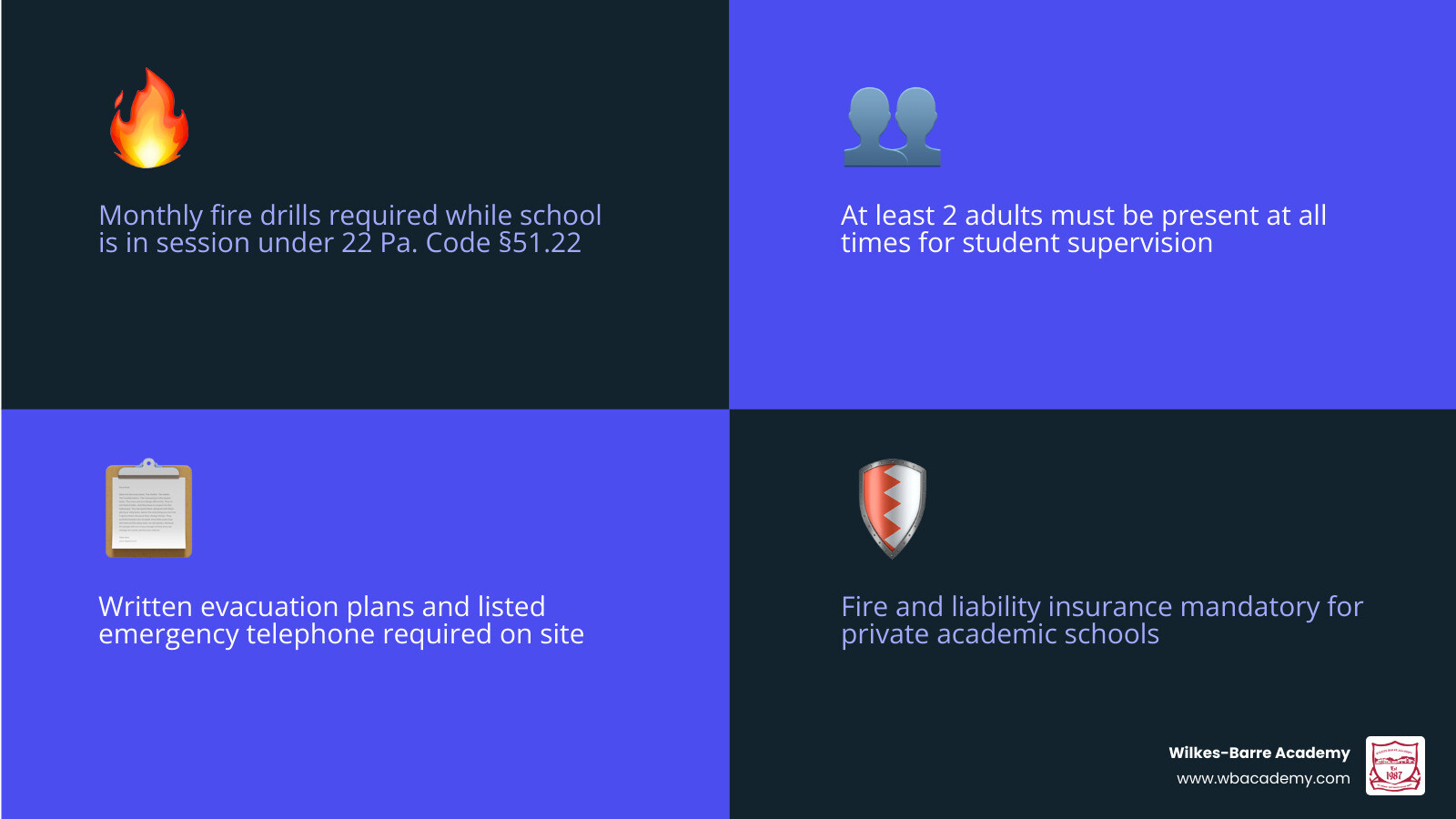
Here’s a quick snapshot of what Pennsylvania law requires from private schools:
| Safety Requirement | What the Law Says |
|---|---|
| Fire drills | Monthly, while school is in session |
| Adult supervision | At least 2 adults present at all times |
| Insurance | Fire and liability insurance required |
| Evacuation plan | Written plan required |
| Playground barriers | Fencing near highways, water, or hazards |
| Emergency contact | Listed telephone number on site |
These rules come primarily from 22 Pa. Code §51.22 and the Private Academic Schools Act (24 P.S. §§6701-6721). Additional layers of safety — like threat assessment teams, staff training, and security drills — flow from newer legislation like Act 44 of 2018.
Research consistently shows that safety ranks as the second most important factor for parents when choosing a school, just behind academic reputation. That makes sense. A child can’t learn well in a place where they don’t feel secure.
This guide breaks down exactly what the law requires, where private schools differ from public ones, and what questions you should be asking when evaluating any Pennsylvania private school.
Understanding Private School Safety Policies PA: The Legal Framework
When parents search for private school safety policies pa, they are usually trying to answer one big question: “What is legally required, and what is simply a school’s choice?”
In Pennsylvania, private academic schools are not unregulated. Their baseline legal framework comes from 22 Pa. Code §51.22 and the Private Academic Schools Act, 24 P.S. §§6701-6721. Those laws set minimum safety expectations for private academic schools, including supervision, insurance, emergency planning, and physical safeguards.
At the same time, some newer Pennsylvania school safety laws were written mainly with public school systems in mind. That is where things can get confusing. In plain English:
- Private schools do have core legal safety duties.
- Some statewide school safety mandates apply broadly to “school entities,” which may include nonpublic schools in certain contexts.
- Public schools generally have more detailed reporting, staffing, and governance mandates than private schools.
For a helpful overview of statewide school safety developments, parents can review Pennsylvania School Safety Legislation – Center for Safe Schools and our own Student Safety & Security Awareness page.
Core Requirements Under 22 Pa. Code §51.22
This regulation is the clearest starting point for private school safety in Pennsylvania. It requires private academic schools to maintain several basic protections:
- A listed telephone number on site
- Provisions to protect student health
- Provisions to protect students’ physical welfare
- A written evacuation plan
- Monthly fire drills while school is in session
- Evidence of fire insurance
- Evidence of liability insurance covering the premises and occupants
- Fencing or natural barriers for playgrounds near highways, waterways, ditches, or other unsafe areas
That list may look simple, but it covers a lot of ground. It means a private school cannot treat safety as informal or optional. It must be planned, documented, and supported by real operational measures.
A few practical takeaways for parents:
- Ask whether the school has a written evacuation plan and how often it is reviewed.
- Ask how student health needs are handled during the school day.
- Ask what insurance coverage the school maintains.
- If younger children use outdoor play areas, ask how those spaces are separated from nearby traffic or hazards.
This legal framework does not spell out every modern safety measure by name. You will not see phrases like “secure vestibule” or “visitor management app” in §51.22. But the regulation creates the minimum floor. Many strong private schools build well above that floor.
Staffing Mandates for Private Academic Schools
One specific Pennsylvania rule is easy to overlook but very important: at least two adults must be present at the school while students are in attendance.
That “two-adult rule” matters for supervision, emergencies, accountability, and common sense. If one adult has to respond to a medical issue, call 911, escort a student, or manage a parent arrival, another adult still remains with students. No school wants safety to depend on one heroic person doing twelve jobs at once.
For parents, this requirement also connects to a broader question: not just “Is the school legal?” but “Is the school well-staffed for daily life?” Small schools can absolutely be safe and effective, but they need clear supervision systems, backup coverage, and strong routines. Our Handbook – Wellness reflects how health and student wellbeing fit into that larger safety picture.
Mandatory Drills and Emergency Preparedness
Pennsylvania expects schools to practice for emergencies, not just talk about them. Drills help students and staff respond calmly when something stressful happens. Nobody loves drills, of course, but confusion is a terrible emergency plan.
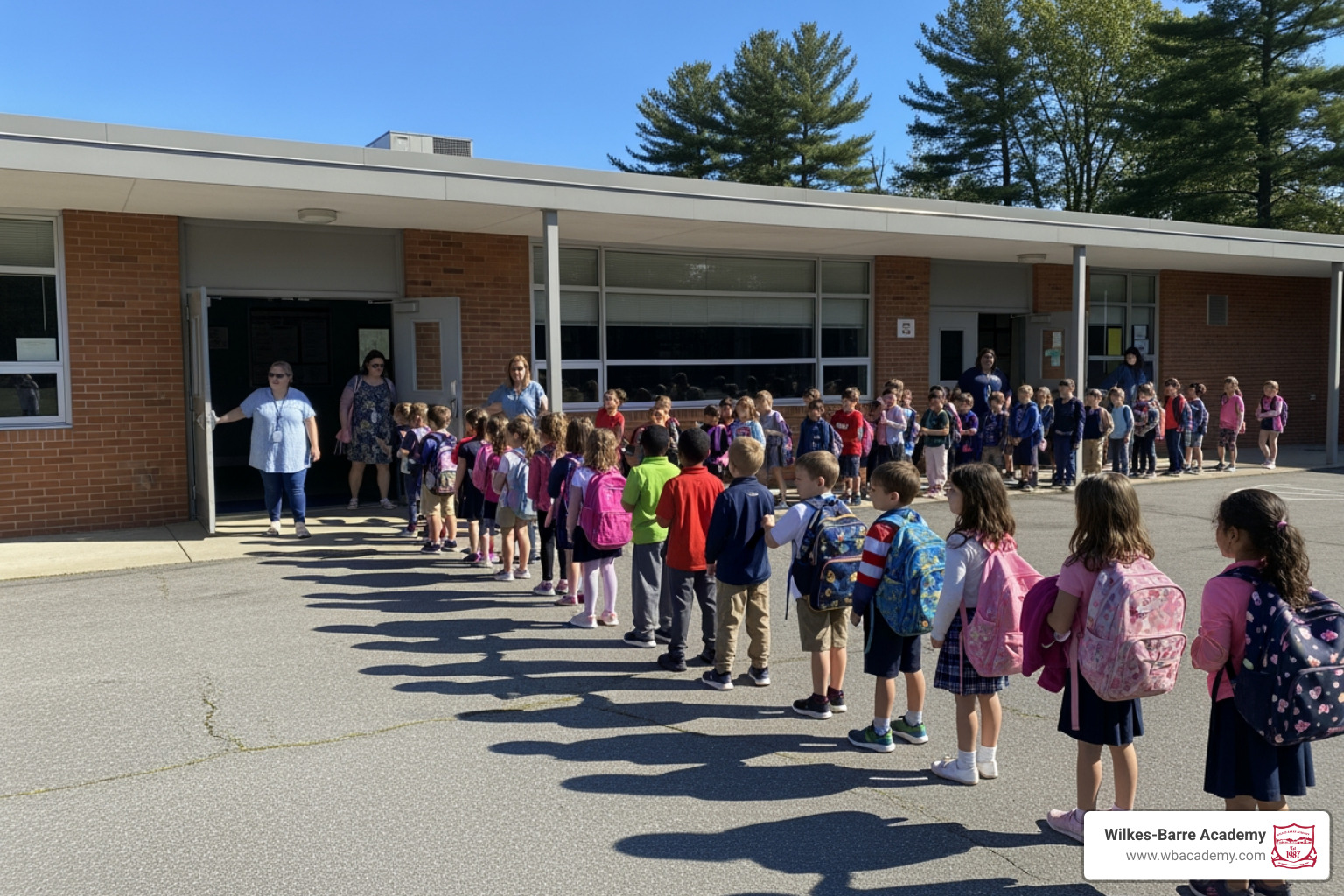
For private schools, monthly fire drills are clearly required under 22 Pa. Code §51.22. Pennsylvania’s broader school safety framework also includes school security drills and bus evacuation drills, though the exact application may differ depending on the school’s status, transportation program, and how state rules classify the school entity.
Here is the practical comparison parents should know:
| Drill Type | Typical Pennsylvania Standard |
|---|---|
| Fire drills | Monthly while school is in session for 7 or more days |
| School security drills | 2 per year, first within 90 days of school start |
| Bus evacuation drills | 2 per year, first week of school and first week of March |

Private schools should, at minimum, be able to explain:
- Which drills they conduct
- How often they conduct them
- How students are prepared in age-appropriate ways
- How parents are informed when appropriate
- How local first responders are involved
You can also review Pennsylvania’s broader school safety guidance here: School Safety | Department of Education.
Requirements for School Security Drills
Under Pennsylvania’s modern school safety structure, schools generally conduct two security drills per year, with the first drill within the first 90 days of the school year. These may include:
- Lockdown
- Lockout
- Shelter-in-place
- Evacuation
- Reunification
- Active threat response
In many cases, schools are encouraged to notify parents ahead of time and coordinate with police, fire, or emergency management before conducting security drills. That helps avoid confusion and supports better practice.
For private schools, the key point is alignment with best practice even where the legal details may not mirror public districts word for word. Parents should ask:
- Does the school practice more than fire evacuation?
- Are drills developmentally appropriate for young children?
- Are local responders familiar with the building?
- Is there a parent communication plan if a real emergency occurs?
Good schools do not run drills to frighten children. They run them to reduce panic, improve muscle memory, and help adults lead with confidence.
Bus Safety and Evacuation Protocols
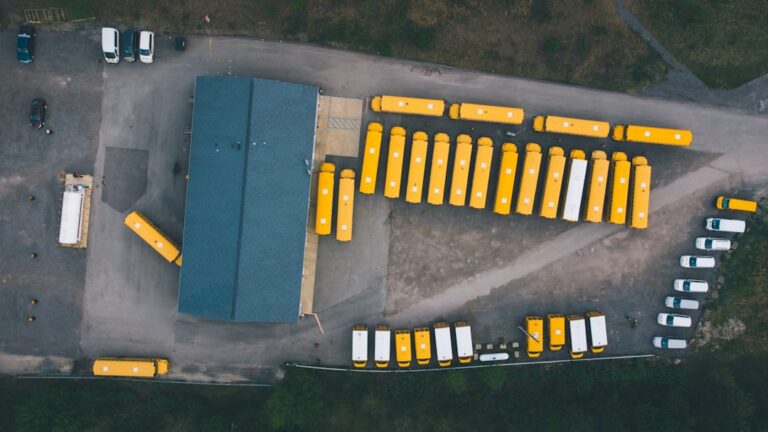
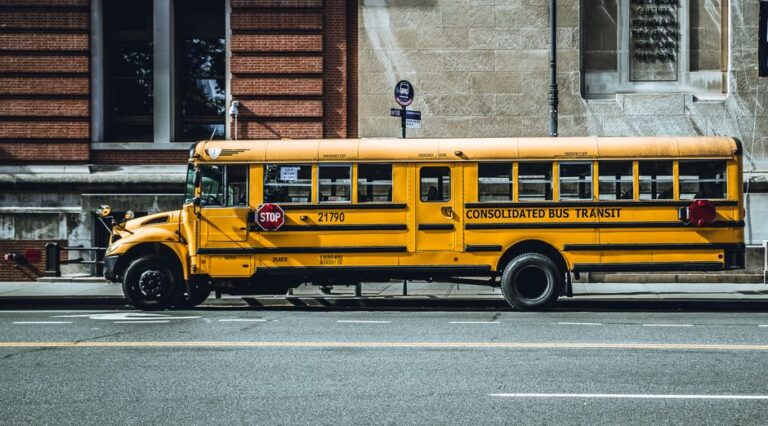
Bus safety is another area where statewide standards matter. Pennsylvania requires two bus evacuation drills per year for students who ride school buses, typically during the first week of school and again in the first week of March. A school bus is generally defined as a vehicle designed to carry 11 or more passengers, including the driver.
If a private school provides transportation or contracts for bus transportation, parents should ask:
- Are bus evacuation drills conducted twice yearly?
- Who supervises loading and unloading?
- How are younger students taught safe bus behavior?
- What happens if weather, traffic, or a roadside emergency affects the route?
Transportation safety also overlaps with overall student wellness and readiness. Families can see how we think about student wellbeing more broadly on our Physical Fitness page.
The Role of the School Safety and Security Coordinator
One of the biggest questions parents ask is whether private schools must appoint a School Safety and Security Coordinator, often called an SSSC.
The short answer: Pennsylvania’s SSSC framework came from Act 44 of 2018 and is a central requirement in the public school safety system. Many responsibilities attached to that role include drill compliance, staff training coordination, annual reporting, and liaison work with responders. Coordinators are expected to complete seven hours of mandated training within one year of appointment.
For private schools, this is where the law becomes more nuanced. Not every private academic school is regulated in exactly the same way as a public district, and some mandates were clearly designed for public school governance structures. Still, nonpublic schools can be affected by parts of the broader safety framework, especially when participating in grant programs or operating within categories recognized by the state’s school safety system.
What matters most for parents is function, not just title. Even if a school is not identically situated to a public district, someone should be clearly responsible for:
- Emergency planning
- Drill coordination
- Staff training
- Incident response procedures
- Communication with first responders
- Safety documentation and review
For statewide assessment standards and related criteria, see School Safety and Security Assessment Criteria.
Staff Training Obligations for Private School Safety Policies PA
Pennsylvania’s broader school safety model expects annual staff training in areas such as:
- Emergency procedures
- Situational awareness
- Behaviors of concern
- Suicide awareness
- Bullying prevention
- Trauma-informed practices
- Behavioral health awareness
A commonly cited benchmark is three hours of school safety and security training for school staff each year, with at least part of that training focused on emergency procedures and behaviors of concern. In the public school framework, that training is often coordinated by the SSSC.
For private schools, even where every public mandate may not apply in exactly the same form, these topics are increasingly part of the expected standard of care. Parents should ask whether staff are trained to recognize:
- Escalating student distress
- Concerning behavior patterns
- Medical emergencies
- Abuse reporting obligations
- Crisis response procedures
That training should work alongside everyday health processes, including student medical information and response planning. Our Health Assessment page is one part of that larger picture.
Behavioral Health and Threat Assessment Teams
School safety is no longer just about locks, alarms, and clipboards. It also includes early identification of students or situations that may need support before they become crises.
Pennsylvania’s school safety laws have increasingly emphasized:
- Multidisciplinary threat assessment teams
- Anonymous reporting tools such as Safe2Say Something
- Trauma-informed planning
- Behavioral health awareness
Act 18 of 2019 established threat assessment team requirements within Pennsylvania’s broader school safety system. Public schools are more directly and uniformly governed by these requirements. For private schools, implementation may vary, but the concepts are highly relevant and increasingly expected as a best practice.
Safe2Say Something, Pennsylvania’s anonymous reporting system, is especially important because it gives students, families, and community members a way to report concerns before harm occurs. Parents should ask whether a private school teaches students how to report safety concerns and whether there is an internal response team ready to review those reports.
For more on Pennsylvania’s nonpublic safety funding and standards environment, see Pennsylvania School Safety Standards | CENTEGIX.
Physical Security and Facility Standards
A safe school building should not feel like a fortress, but it should not feel wide open either. Good physical security is layered, thoughtful, and calm.
Pennsylvania’s private school regulation specifically mentions fencing or natural barriers around playgrounds that sit near hazards like roads, waterways, or ditches. That is a concrete legal requirement, not a suggestion.
Beyond that, many schools adopt additional physical protections such as:
- Secure entrances or vestibules
- Controlled visitor access
- Sign-in procedures
- ID checks or visitor badges
- Exterior cameras
- Locked classroom and exterior doors
- Clear pickup and dismissal routines
These measures are not all spelled out in 22 Pa. Code §51.22, but they align with the duty to safeguard students physically. They also reflect recommendations often promoted by safety organizations and Pennsylvania education stakeholders.
Even everyday school policies can contribute to safety by making identification and supervision easier. Clear routines and expectations matter, which is one reason family-facing policies like our Dress Code play a role in orderly school operations.
Funding and Grants for Private School Safety Policies PA
One area that has improved in recent years is grant funding for nonpublic schools. Pennsylvania has offered Targeted School Safety for Nonpublic Schools grants, with some programs allowing awards up to $75,000.
These funds may support safety improvements such as:
- Physical security upgrades
- Entry control systems
- Communication tools
- Training
- Mental health or trauma-informed supports
- Security assessments
A major point parents and school leaders should understand is that funding is often tied to baseline criteria. Under Act 55 of 2022, schools may need to meet Level 1 or Tier 1 baseline standards before spending grant funds on some broader projects.
Because grant opportunities and deadlines can change, schools in Luzerne County should watch state announcements and regional support resources, including School Safety and Security – Luzerne Intermediate Unit 18.
PSEA has also advocated for stronger school safety funding statewide, especially for practical improvements like secure entry systems, visitor management, facility audits, and staffing support. That advocacy is public-school focused in many places, but the underlying recommendations often adapt well to private school settings too.
Compliance Checklists and Reporting
Private schools should think in terms of a living checklist, not a one-time binder that gathers dust on a shelf. A useful compliance review includes:
- Confirm current fire and liability insurance
- Verify at least two adults are present whenever students are in attendance
- Maintain a written evacuation plan
- Document monthly fire drills
- Review playground barriers and campus hazards
- Keep a listed telephone number on site
- Update emergency contacts and health information
- Review visitor management procedures
- Confirm transportation drill compliance if buses are used
- Review staff training records
- Coordinate with local police, fire, EMS, and county emergency management as appropriate
In Pennsylvania’s broader safety system, schools are often encouraged to update their Emergency Operations Plan and share updates with county emergency management agencies by September 30 each year. That deadline is especially associated with public-school compliance guidance, but it is still a smart benchmark for private schools.
Regular facility audits are also wise. Some safety advocates recommend folding those audits into strategic planning cycles every few years. That is a sensible approach for schools in Luzerne County that want to move beyond bare legal compliance and toward a stronger culture of prevention.
Frequently Asked Questions about PA Private School Safety
Are private schools required to follow the same drill schedule as public schools?
Not always in exactly the same way. Private schools are clearly required to conduct monthly fire drills under 22 Pa. Code §51.22. Public schools are also subject to more detailed statewide rules on security drills, bus evacuation drills, coordinator oversight, and reporting. Many private schools align with those broader standards anyway because they reflect good safety practice.
Do PA private schools need a designated Safety Coordinator?
Public schools are directly subject to the School Safety and Security Coordinator framework created by Act 44 of 2018. For private schools, the answer can depend on how the school fits into Pennsylvania’s broader school safety laws and programs. Even when the exact public-school mandate does not apply in identical form, private schools should still designate a clear person or team to manage safety planning, training, drills, and emergency coordination.
What financial assistance is available for private school security upgrades?
Pennsylvania has offered Targeted School Safety for Nonpublic Schools grants, including opportunities up to $75,000 for eligible safety improvements. These grants may support physical security, training, communications, or related safety initiatives. Because deadlines and requirements change, schools should monitor current state guidance and regional resources.
Conclusion
Parents in Luzerne County do not need to guess about school safety. Pennsylvania law gives private schools a real legal framework, starting with core protections like insurance, fire drills, evacuation planning, physical safeguards, and adult supervision. Newer school safety laws add another layer through training, threat response, reporting systems, and grant-supported improvements.
The biggest takeaway is this: private school safety is both legal and practical. A school should be able to explain not only what the law requires, but also how those requirements are carried out in daily life.
At Wilkes-Barre Academy, we believe a safe learning environment and a strong academic environment belong together. As a private, non-profit K-8 school in Luzerne County, we value close relationships, individualized learning, and a community where families feel informed and supported. To learn more about how we approach prevention, awareness, and student protection, visit our Student Safety & Security Awareness page.