Everything You Need to Know About PE Programs in PA Schools
What PA Parents Need to Know About K-8 Physical Education
A PE program in K-8 school PA is more than just gym class — it’s a structured, standards-based part of your child’s education that supports their physical health, social skills, and even academic performance.
Here’s a quick overview of what PA’s K-8 PE programs look like:
| Topic | Key Facts |
|---|---|
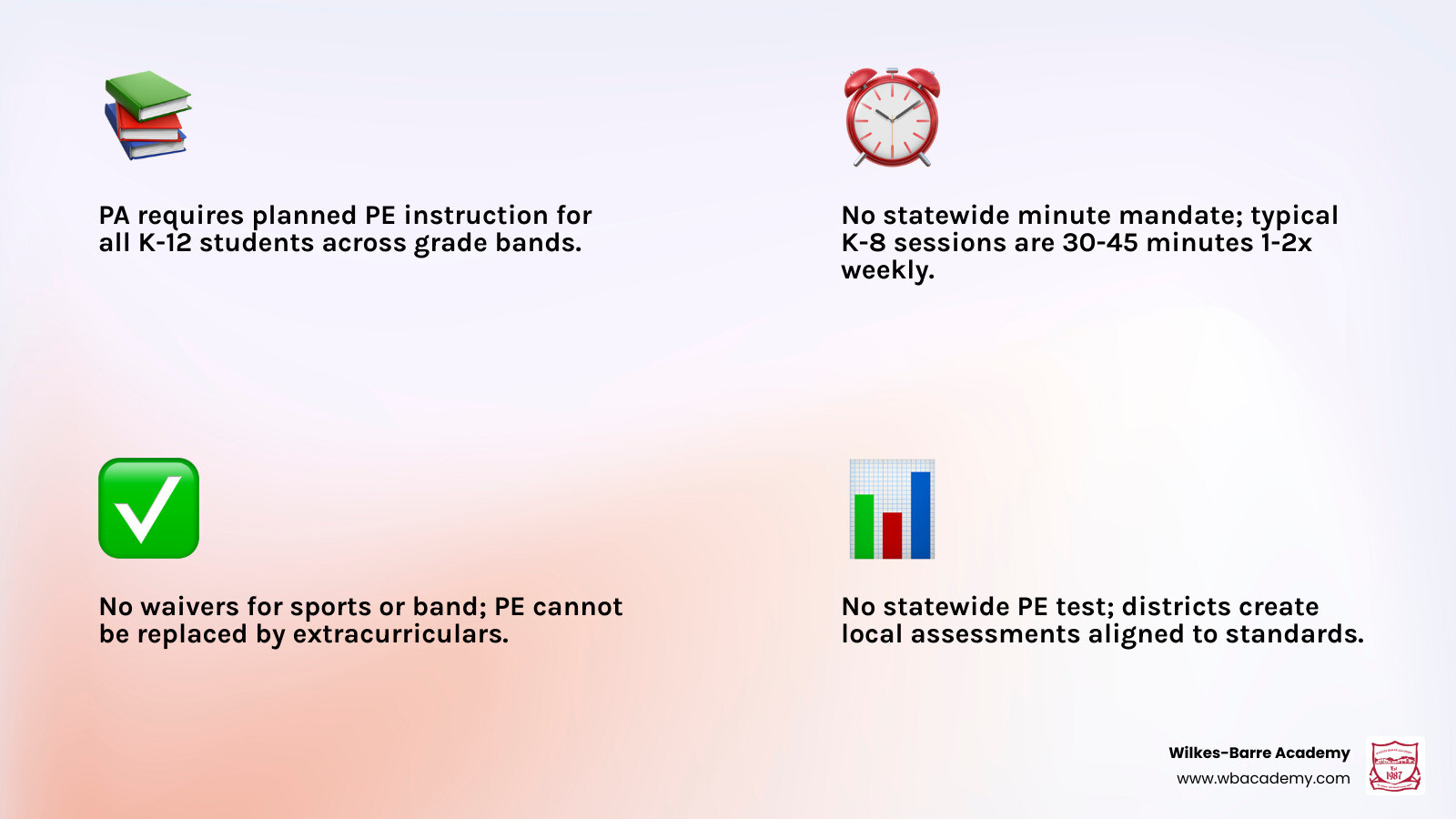
| State Requirement | Planned PE instruction is required for all students in grades K-12 |
| Scheduling | No statewide minute mandate; districts set their own schedules |
| Typical Time | 30-45 minutes, once or twice per week for K-8 |
| Waivers | Sports, band, or ROTC cannot replace PE — no exceptions |
| Assessment | No statewide PE test; each district creates its own |
| Standards | Aligned to PA Academic Standards and SHAPE America’s 2024 National PE Standards |
Pennsylvania law requires planned physical education instruction for every student — but how that looks in practice varies quite a bit from district to district.
What doesn’t vary is the goal: helping kids build the knowledge, skills, and habits to stay active and healthy for life.
Research backs this up. Studies show that children who spend more time in quality PE — where at least 50% of class time involves moderate-to-vigorous movement — have better fitness, stronger academic performance, and lower obesity risk. Yet many students currently spend less than half of their PE class time actually being active.
That gap matters. And understanding what a strong K-8 PE program should look like is the first step toward making sure your child is getting one.
PA State Standards, Certification, and Assessment
In Pennsylvania, physical education is part of the academic program, not an optional extra squeezed in between lunch and dismissal. The Pennsylvania Department of Education requires planned instruction in health and physical education across grade bands, including primary, intermediate, and middle grades. You can review the state’s official guidance on the Health and Physical Education – Commonwealth of Pennsylvania page.
For K-8 schools, the common grade spans used in Pennsylvania are:
- K-3: primary
- 4-6: intermediate
- 7-9: middle
That grade-band structure matters because student development in kindergarten looks very different from student development in eighth grade. A strong program builds skills progressively instead of expecting every child to learn the same way at the same pace.
Pennsylvania districts typically align their PE curriculum with two main frameworks:
- Pennsylvania Academic Standards for Health, Safety, and Physical Education
- SHAPE America’s National Physical Education Standards
As of May 2026, the 2024 revision of SHAPE America’s National PE Standards is especially important. The updated standards use clearer grade spans and learning indicators, which helps schools build more coherent K-8 programs. In simple terms, the newer standards make it easier for teachers to answer two big questions:
- What should students know?
- What should students be able to do at each stage?
That focus supports physical literacy, which is the ability, confidence, and desire to be active for life. We like that idea because it shifts PE away from “who is best at dodgeball?” and toward “how do we help every child move well, feel capable, and enjoy being active?”
Pennsylvania also uses the Standards Aligned System, or SAS, as a curriculum framework. SAS connects standards, instruction, curriculum, materials, and assessment so schools can build a complete program rather than a random collection of activities.
Teacher certification in Pennsylvania
Who can teach PE in a K-8 Pennsylvania school? In general, schools need properly certified educators. Pennsylvania’s certification guidance identifies Health and Physical Education teaching credentials, including Certification Code 4805 for relevant areas such as kinesiology, motor skill development, and adaptive physical education.
For families exploring educator pathways in Luzerne County, one example of local preparation is the Health, Physical Education Teacher Education (K-12) EHP Program.
How student progress is assessed
Pennsylvania does not have a statewide standardized PE test. That sometimes surprises parents, but it does not mean PE goes unmeasured. Instead, local schools develop their own assessment systems to determine whether students are meeting standards.
A local PE assessment system may include:
- Teacher observation during activities
- Skills checklists
- Rubrics for movement patterns and game play
- Fitness goal setting and reflection
- Written or verbal responses about health concepts
- Participation, effort, and safe behavior
Good PE assessment looks at more than athletic talent. It measures growth, understanding, effort, skill development, and responsible participation.
Core Components of a PE Program K-8 School PA
A quality PE program in K-8 school PA should be broad, developmentally appropriate, and intentionally sequenced. That means younger students focus heavily on foundational movement, while older students build toward more complex games, fitness concepts, teamwork, and personal responsibility.
Common K-8 PE components in Pennsylvania include:
- Locomotor skills such as running, hopping, skipping, jumping, and galloping
- Non-locomotor skills such as balancing, bending, twisting, and stretching
- Manipulative skills such as throwing, catching, kicking, striking, and dribbling
- Coordination and body awareness
- Rhythm and movement activities
- Cooperative games and team-building
- Small-sided games and introductory sports
- Health-related fitness concepts such as endurance, strength, flexibility, and heart health
- Safety, rules, and respectful participation
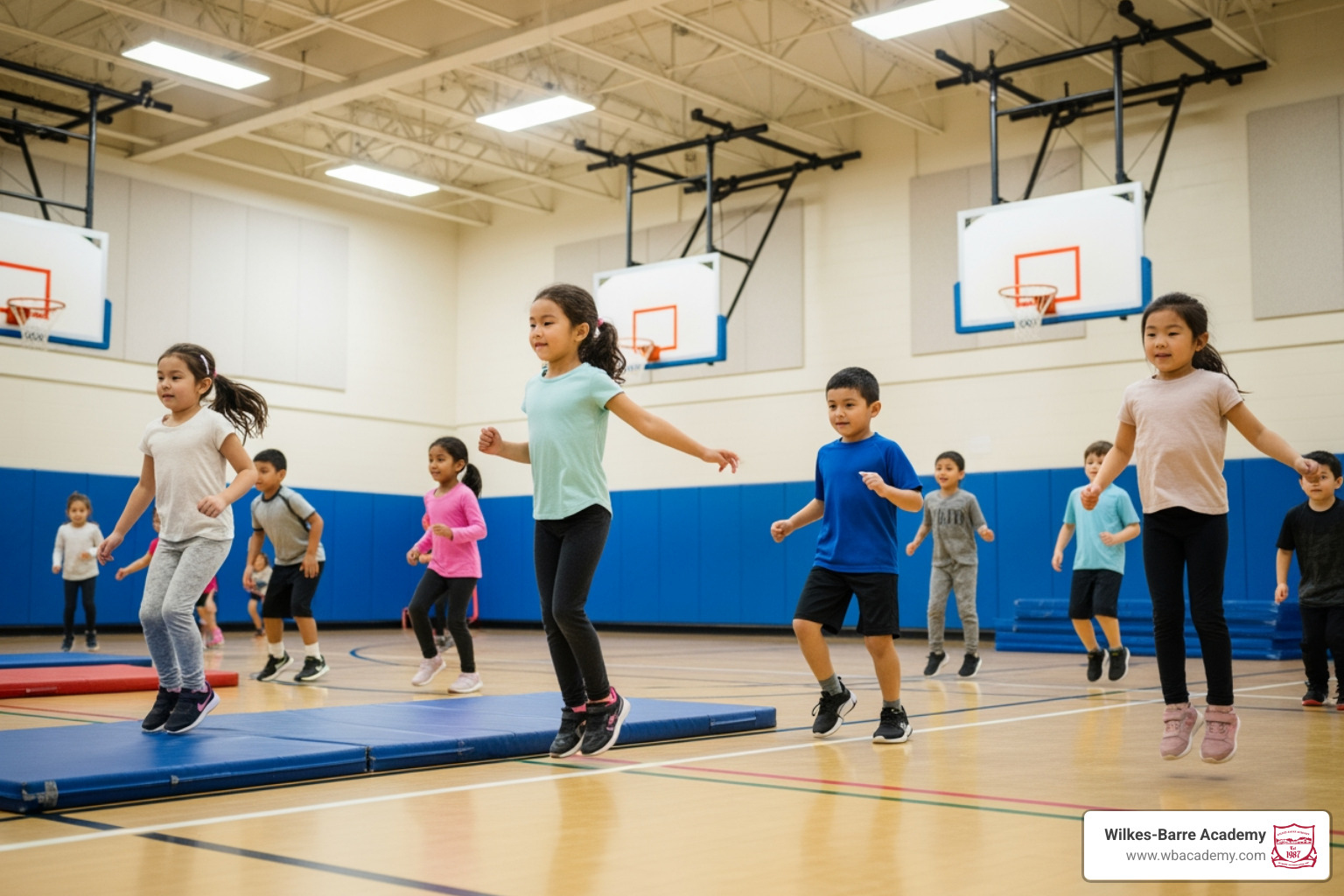
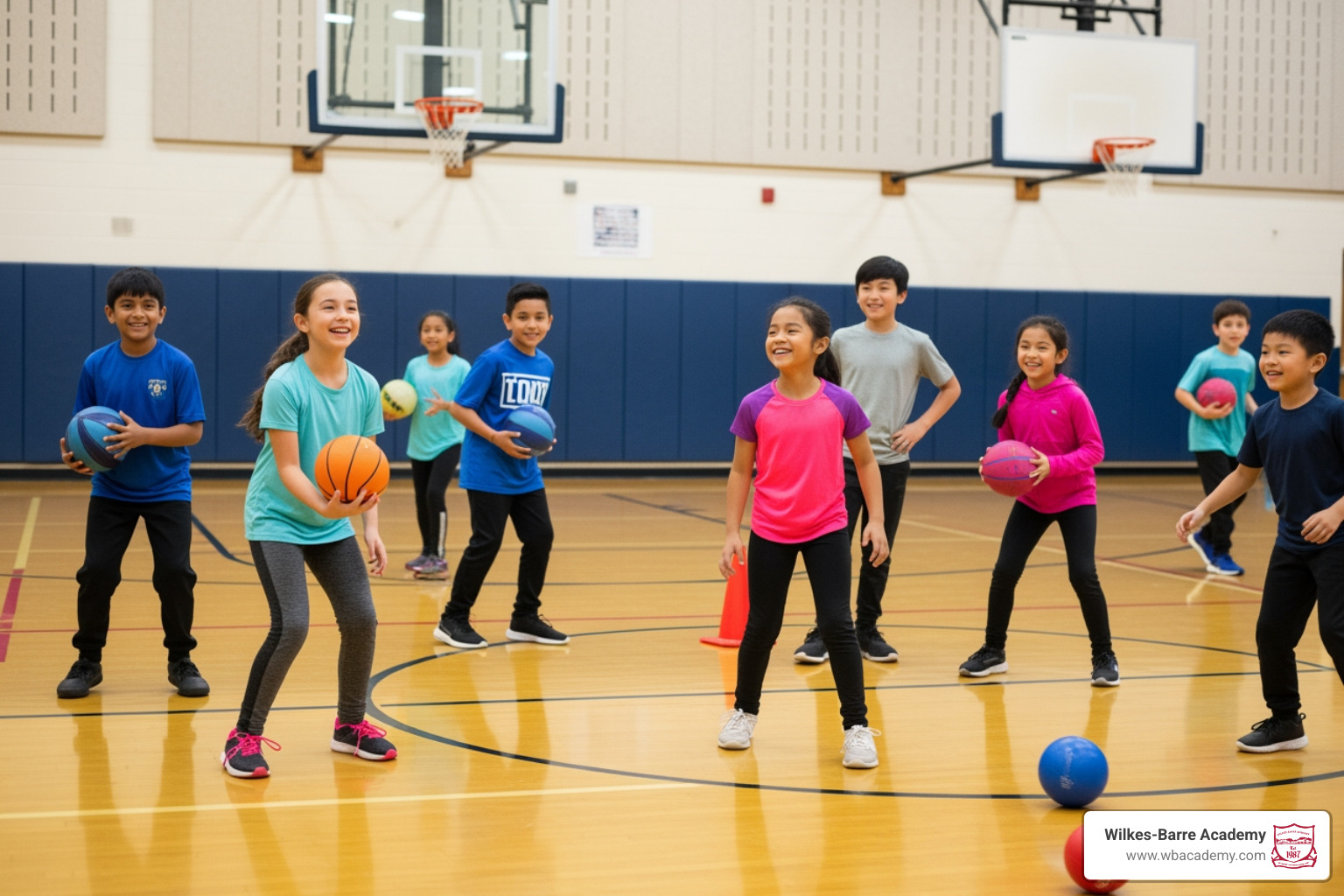
In elementary grades, lessons often center on movement patterns and confidence. Students might play tag games, scooter activities, parachute games, jump rope, dance, balance challenges, or introductory striking and throwing games. These are not just “fun extras.” They build the movement vocabulary children need before they can succeed in more advanced activities.
By middle grades, PE often expands to include:
- More formal team sports and lead-up games
- Personal fitness planning
- Strategy and decision-making
- Social and emotional skills in competition
- Lifetime activities students can continue outside school
That progression is one reason PE should not be replaced by recess, sports participation, or free play. Recess is valuable, but it is not standards-based instruction. A school sport can be excellent, but it usually serves a subset of students and focuses on performance. PE is for every child, every year.
At our school, we see physical education as part of the bigger picture of student growth. It connects naturally with our focus on whole-child development and supports the same long-term goals we value in Physical Fitness: confidence, healthy habits, resilience, and lifelong wellness.
Instructional Time and Scheduling for a PE Program K-8 School PA
Here is one of the most important things for Pennsylvania families to know: the state requires PE, but it does not set one statewide number of minutes per week. Scheduling authority belongs to local schools and districts.
That is why PE schedules can vary. Across Pennsylvania, many K-8 schools use 30- to 45-minute PE periods once or twice per week. Some schools also schedule separate health instruction.
Examples from Pennsylvania schools show the range:
- Some kindergarten programs meet for one 30-minute PE class each week
- Some elementary programs schedule two 30-minute periods weekly
- Some districts schedule 45 minutes once per week in grades 1-8
- Some schools pair PE with separate weekly health classes
Here is a simple comparison:
| Pennsylvania example | Kindergarten PE | Elementary PE | Middle grades PE |
|---|---|---|---|
| Common local schedule | 30 min 1x/week | 30-45 min 1-2x/week | 30-45 min 1x/week |
| Published district example | 30 min 1x/week | 45 min 1x/week | 45 min 1x/week |
| Published school example | 30 min 1x/week | 30 min 2x/week | Varies by school |
The key takeaway is not that one exact schedule is required statewide. It is that planned instruction must happen, and schools should schedule enough time to teach standards well.
If we are evaluating quality, minutes alone are not enough. A 45-minute class where students spend most of the time waiting in line is less effective than a well-designed lesson that keeps students moving, thinking, and practicing. In PE, quality matters as much as quantity.
Addressing Health and Obesity in a PE Program K-8 School PA
PE plays a real public health role in Pennsylvania schools. Childhood obesity, low activity levels, and poor fitness habits do not solve themselves just because a child owns sneakers.
Research highlighted in Pennsylvania-based public health analysis shows why stronger PE matters. In one Allegheny County modeling effort, an active PE initiative was projected to reach 62,100 children. The cost was estimated at about $37 per child over 10 years, with gains including 7 additional active minutes per school week, about a 3% increase in moderate-to-vigorous physical activity, and 13 fewer cases of childhood obesity in the final year.
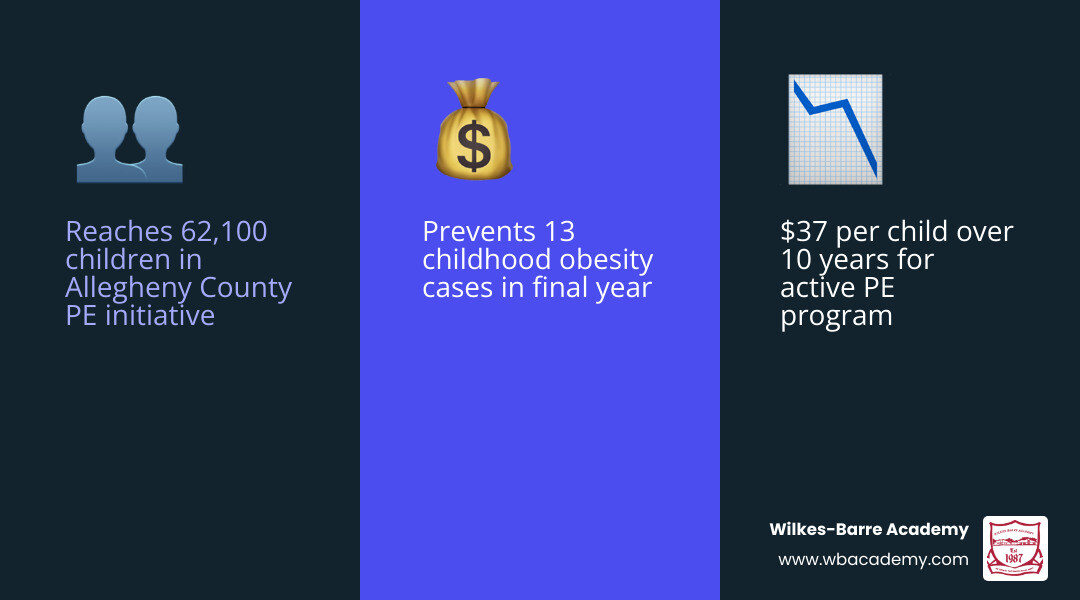
Those numbers may sound modest, but across a large student population they are meaningful. Public health improvement often works exactly like that: steady, practical changes repeated consistently.
A major benchmark in evidence-based PE is having students spend at least 50% of class time in moderate-to-vigorous physical activity, often called MVPA. That matters because many children currently spend less than half of PE class actually moving at that level.
Evidence-based PE practices
Research-backed PE curricula and teacher training models have shown that well-structured lessons can increase active time, improve fitness, strengthen sports skills, and support academic outcomes.
The bigger lesson is not that one branded program is the only answer. It is that PE works best when schools use structured, evidence-based practices, train teachers well, and design lessons for active engagement.
In practical terms, that means:
- Little standing in lines
- Clear routines and equipment setup
- Small-sided activities instead of elimination games
- Modifications so all students can participate
- Fitness concepts taught alongside movement
- Intentional lesson design with lots of active repetitions

Strong PE also reinforces lifelong health habits. Students learn how exercise supports heart health, mood, focus, strength, flexibility, and stress management. For K-8 students, that foundation is powerful because habits formed early tend to stick.
Inclusive Practices and Adapted Physical Education
An effective PE program should work for all students, not only the fast, coordinated, or sports-loving ones. In Pennsylvania, inclusion is a core expectation, and adapted physical education is part of that conversation.
Adapted PE refers to specially designed instruction, supports, or modifications that help students with disabilities or diverse learning and physical needs participate meaningfully and safely. Depending on the student, that may include:
- Modified equipment such as larger, softer, or lighter balls
- Visual schedules or simplified directions
- Adjusted rules or reduced game space
- Partner or peer supports
- Different movement goals for the same lesson
- Extra practice time or alternate stations
The goal is not to water down PE. The goal is access. Students should still work toward growth, independence, skill development, and social participation.
Inclusive PE benefits students in several ways:
- Physical development through appropriate movement practice
- Social development through teamwork and shared activities
- Confidence through achievable success
- Independence through gradually increasing self-management
- Belonging within the school community
This fits naturally with the Whole School, Whole Community, Whole Child model, which connects physical health, social-emotional growth, academic learning, and school climate. When PE is inclusive, it supports that whole-child mission instead of operating in its own little gym-shaped bubble.
For families interested in the broader role of movement and wellness in student development, our page on Physical Fitness offers more context on how healthy habits support lifelong success.
Frequently Asked Questions about PA Physical Education
Can students waive PE for varsity sports in PA?
No. Pennsylvania does not allow students to skip required PE because they participate in interscholastic sports, band, or ROTC. The reason is simple: physical activity is only one part of physical education. PE also includes instruction in motor skills, personal fitness, rules, safety, teamwork, health knowledge, and lifelong activity habits.
Is there a statewide standardized test for PE?
No. Pennsylvania does not administer a statewide standardized PE assessment. Local schools are responsible for developing assessment systems that measure whether students are meeting standards. That can include skills rubrics, teacher observations, fitness reflections, participation measures, and standards-based grading.
What is the difference between physical activity and physical education?
Physical activity is any bodily movement that raises energy use. Recess, sports practice, free play, and walking the dog all count.
Physical education is an academic subject. It includes planned instruction, grade-level standards, teaching strategies, assessment, and skill progression. In other words:
- Physical activity is movement
- Physical education is learning through movement
Both matter, but they are not interchangeable.
Conclusion
A strong K-8 PE program in Pennsylvania should be standards-based, inclusive, developmentally appropriate, and designed to help children build lifelong healthy habits. Families in Luzerne County should expect more than occasional gym games. They should expect thoughtful instruction, qualified teachers, meaningful assessment, and a program that supports every child.
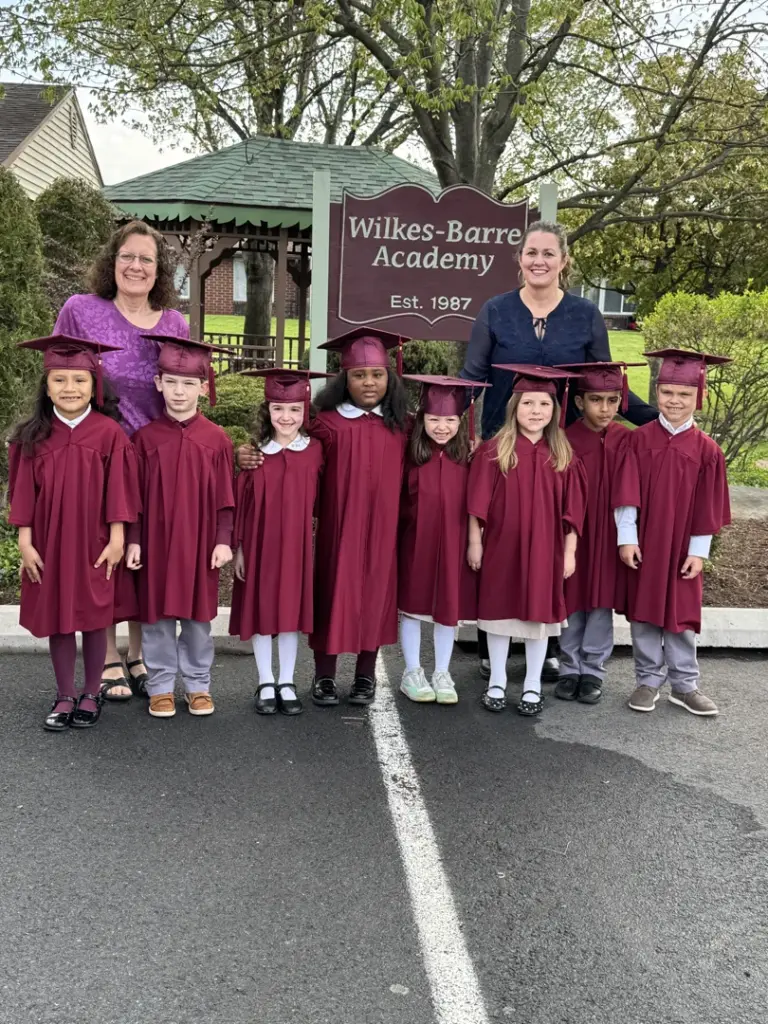
At Wilkes-Barre Academy, we value that whole-child approach. As a private, non-profit K-8 school in Luzerne County, we believe individualized learning, strong family-school connections, and a close-knit community create the right environment for students to grow academically, socially, and physically.
If you want to learn more about how movement, wellness, and healthy habits support student success, visit our Physical Fitness page.
For families exploring education and community resources in our area, you can also learn more through Schools and Homes in Education (SHINE) – Wilkes University and Luzerne County Head Start: Home.